With a start and finish in Krakow’s Main Market Square, a route that mixes historic landmarks with everyday city life, and one of the best destination experiences around it, the Cracovia Marathon is an easy race to recommend.
I first spent an extended period in Krakow in 2018.
For around a month, I stayed in Kazimierz, bought groceries, took boxing classes, worked from cafes, and got to know the city beyond its main tourist sights. Krakow became one of those places I remembered not through a single landmark, but through the routines I had built there.
Eight years later, I returned to run the Cracovia Marathon.
It was my third marathon overall and the second in a project to run 100 marathons and ultras across 100 countries. It was also only two weeks after the Antalya Marathon, making it my first real attempt at stacking races close together.
I chose Krakow because I already knew the city was worth returning to. This time, I wanted to find out what it would feel like to run through it.
Returning to a familiar city from a different side
This time, I stayed north of the Old Town instead of in Kazimierz.
That small change made Krakow feel surprisingly different. During my earlier stay, most of my daily life had been south of the Old Town, around Kazimierz, the river, and the streets leading toward Wawel Castle. From the north, I found more residential areas, a large park I had never visited, and parts of the city I had little reason to explore before.
The Krakow I remembered was still there, but it had also changed.
I remembered Kazimierz for its smaller, rustic cafes, often filled with old furniture, antiques, and decor that made the neighborhood feel tied to the past. Some were still around. Others had closed, while newer and more modern cafes had appeared across the city.
Krakow still had the charm that made me like it in 2018, but it no longer felt frozen in that memory.
That mix of old and new would also become one of the strengths of the marathon.
Starting in the heart of Krakow
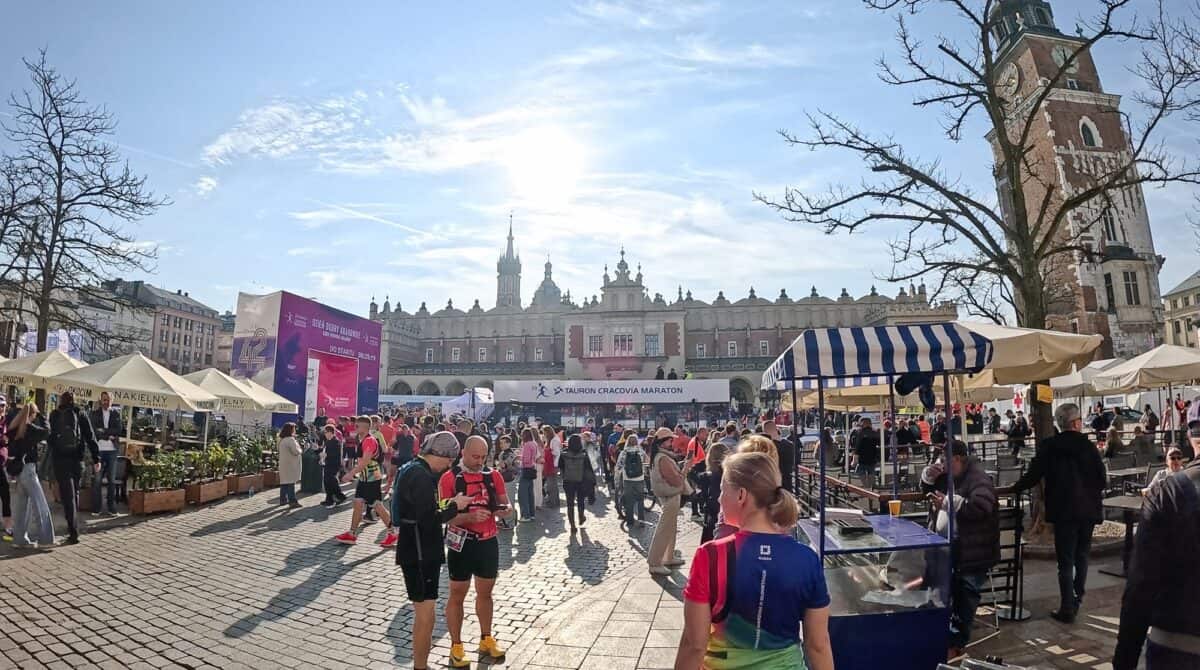
The Cracovia Marathon felt much bigger than my previous race from the moment I arrived at the start.
The marathon begins and ends in Krakow’s Main Market Square, in the center of its Old Town. The course then passes through several districts, including sections along the Vistula Boulevards, before returning to the square.
The starting waves stretched from the main square toward the edge of the Old Town. I had placed myself in the final group because I wanted to run conservatively, only to realize that I had walked too far into the center and needed to make my way back toward my starting position.
The event was large enough to create real energy without feeling impossible to navigate.
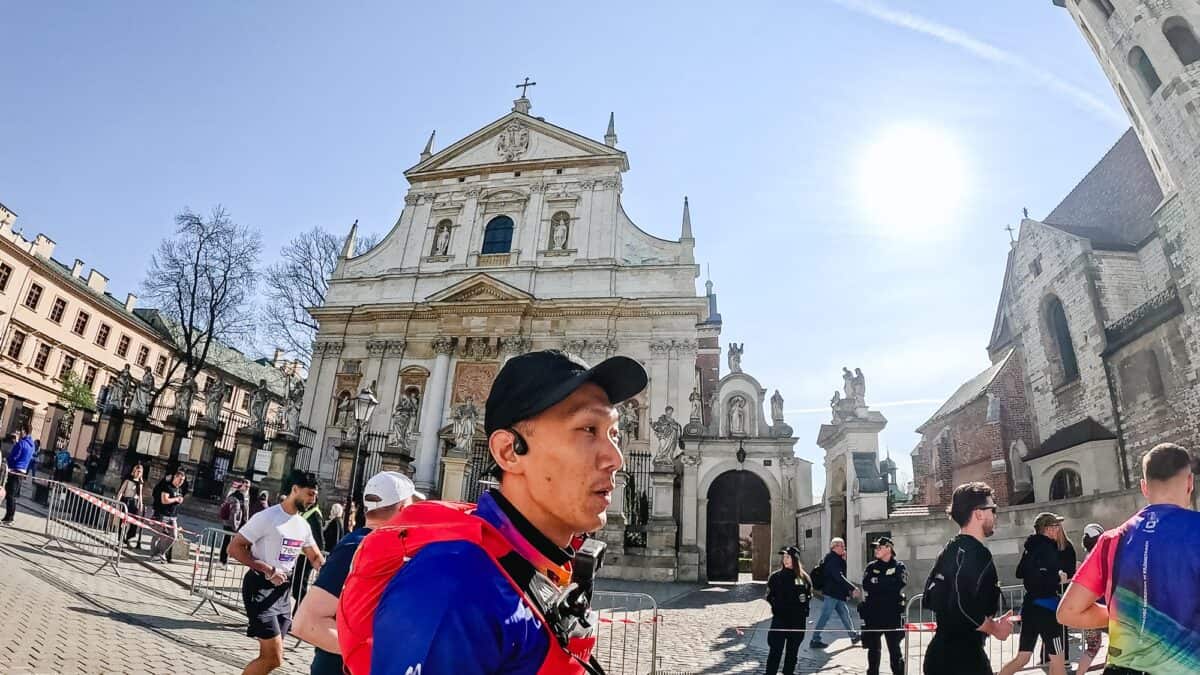
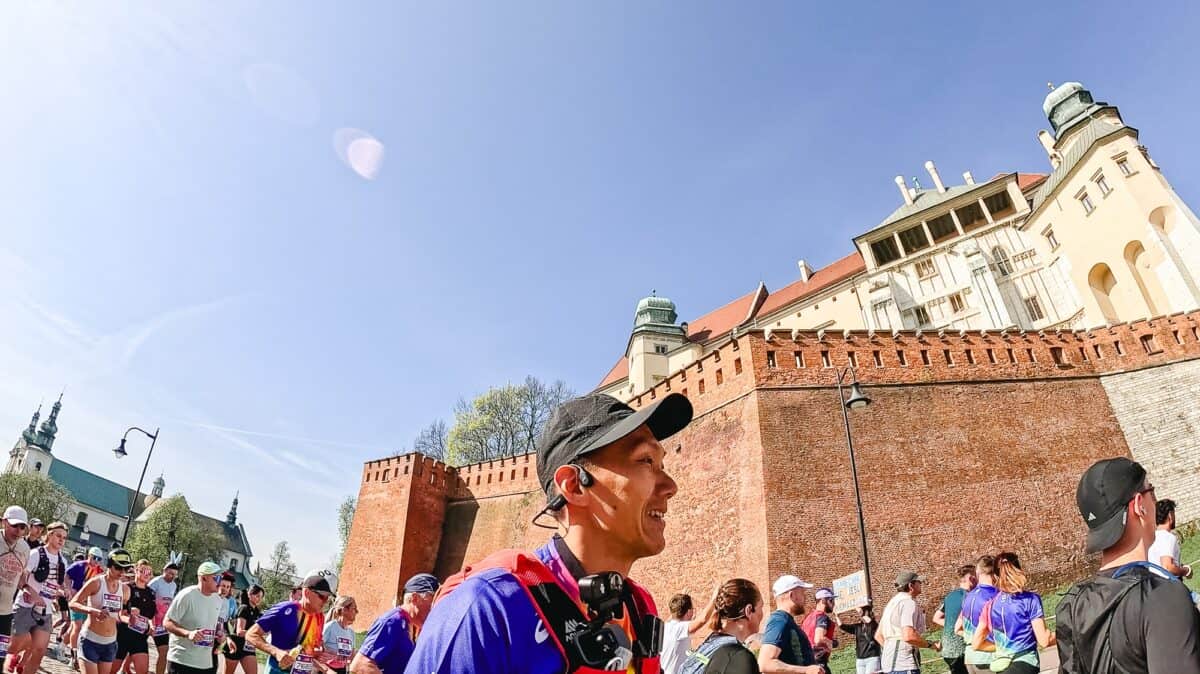
The opening section was crowded and exciting. We ran through the Old Town and around the Wawel area, surrounded by the parts of Krakow most visitors would recognize.
The weather was cooler than I was used to, so I started with a base layer beneath the event shirt. As the day warmed up, I eventually stopped to remove it.
If you are traveling from somewhere warmer, a light layer that you can easily remove or carry may be useful. Spring conditions can change quite a bit over the course of the race.
A route through more than the tourist center
The most memorable parts of the course were around the Old Town, Wawel Castle, and the river.
These areas had the strongest support, but they were also naturally busy. Locals were enjoying the weekend, tourists had gathered around the historic center, and people were sitting in parks or along the river.
Running beside the Vistula felt especially connected to everyday life in the city. People were sitting on the grass, visiting cafes, walking, and spending time by the water.
The route also went much farther into Krakow than the places I had known from my earlier stay.
There were residential sections, deeper park areas, and parts of the modern city where the crowds became thinner. They were not as scenic as the center, but they showed me areas I would never have visited on my own.
That is one of the things I enjoy about city marathons. A normal trip tends to keep you around the same central districts. A marathon shows you how those places connect to the wider city.
Krakow gave me the famous version of the city, but it also expanded the map I already had in my head.
When feeling recovered was not enough
I arrived in Krakow believing I had recovered from Antalya.
My knees were still slightly sore, but nothing felt serious enough to suggest that I should not run. I had avoided hard training between the races and felt normal in daily life.
I also thought I understood what had gone wrong in Antalya.
This time, I started at the slower pace I had originally planned. I carried water, prepared electrolytes, and began eating much earlier. During the opening kilometers, I was taking gummies and treating the race almost like a moving picnic.
Then, around 12 to 15 kilometers, the pace began to feel harder than it should have.
That distance was usually routine for me. During training, I regularly ran more than 20 kilometers, so struggling this early was the first warning that this was not simply another pacing problem.
I slowed down and began stretching at aid stations. Later in the race, I felt a sharp pain in my problematic left knee, which is always an “uh-oh” signal for me.
From there, the marathon became a careful cycle of walking, testing a short run, and stopping again whenever the pain returned.
My breathing was still fine. The problem was entirely in my legs.
Krakow was where I learned that feeling recovered in daily life and being ready to run another marathon are not always the same thing.
What runners farther back should know
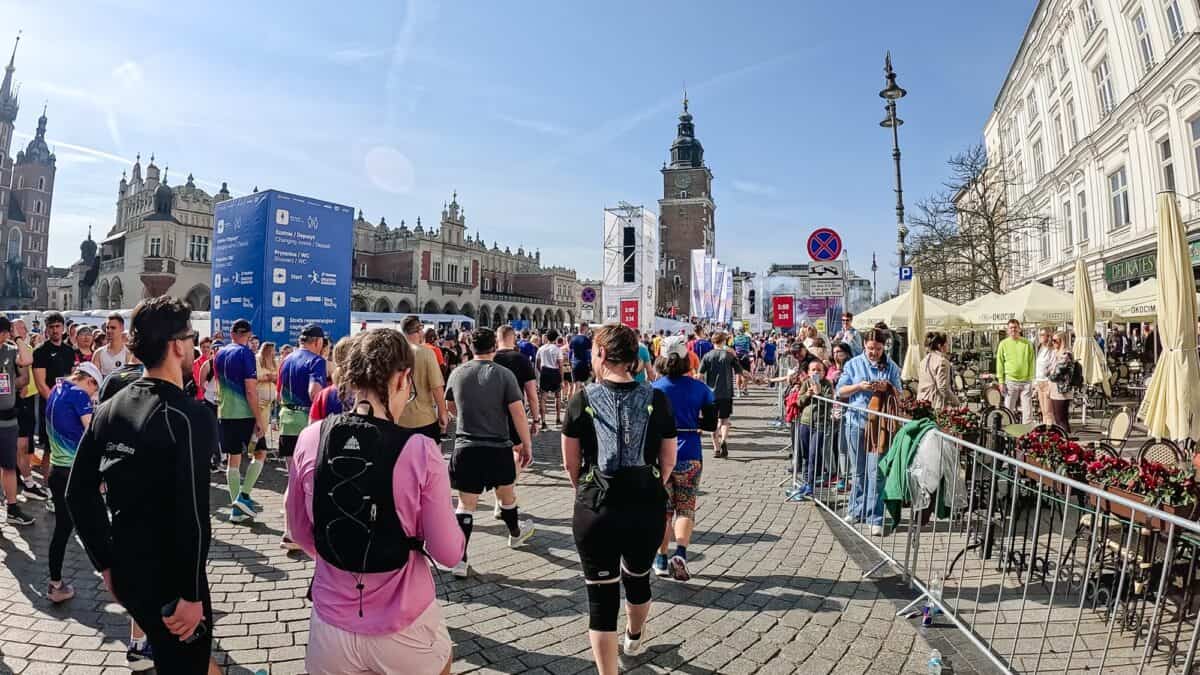
The Cracovia Marathon felt well supported overall.
Aid stations offered water, isotonic drinks, fruit, sugar, and candies. I also remember energy gels and fruit bars being available at limited points.
However, if you expect to finish farther back, I would not rely on gels still being available when you arrive. Carry your own fuel if it is important to your race plan.
The six-hour time limit gave me enough room to manage the knee pain and continue through a mix of running and walking.
Even so, this was the first marathon where I genuinely questioned whether I would finish.
As the remaining distance became shorter, I kept recalculating the pace I needed to stay inside the cutoff. Eventually, I knew I could make it, even if I had to walk much of the way.
Knowing which finish line matters
The final section brought us back toward the Old Town, where the crowd became louder again. Other runners were pushing through the last few hundred meters, while spectators encouraged anyone still walking to run.
At that point, I was considering a third marathon the following weekend.
It was never confirmed then, but the possibility was real enough that I did not want to turn the knee pain into something worse just to produce a stronger-looking finish.
One runner who had already completed the marathon stood near the course with his medal around his neck, urging everyone forward.
When we made eye contact, he shouted at me to run.
I smiled and nodded, but kept walking.
He looked disappointed.
His intention was positive. From his point of view, I was close to the finish and should use whatever energy I had left. What he could not know was that my goal was not only to finish Krakow. I was also trying to protect what might come next.
Other people can encourage you, advise you, or question what you are doing. But they rarely know the full goal you are working toward.
For most runners around me, the Main Market Square was the final finish line. For me, it was one checkpoint in a much longer project.
One of the best finishes for a city marathon
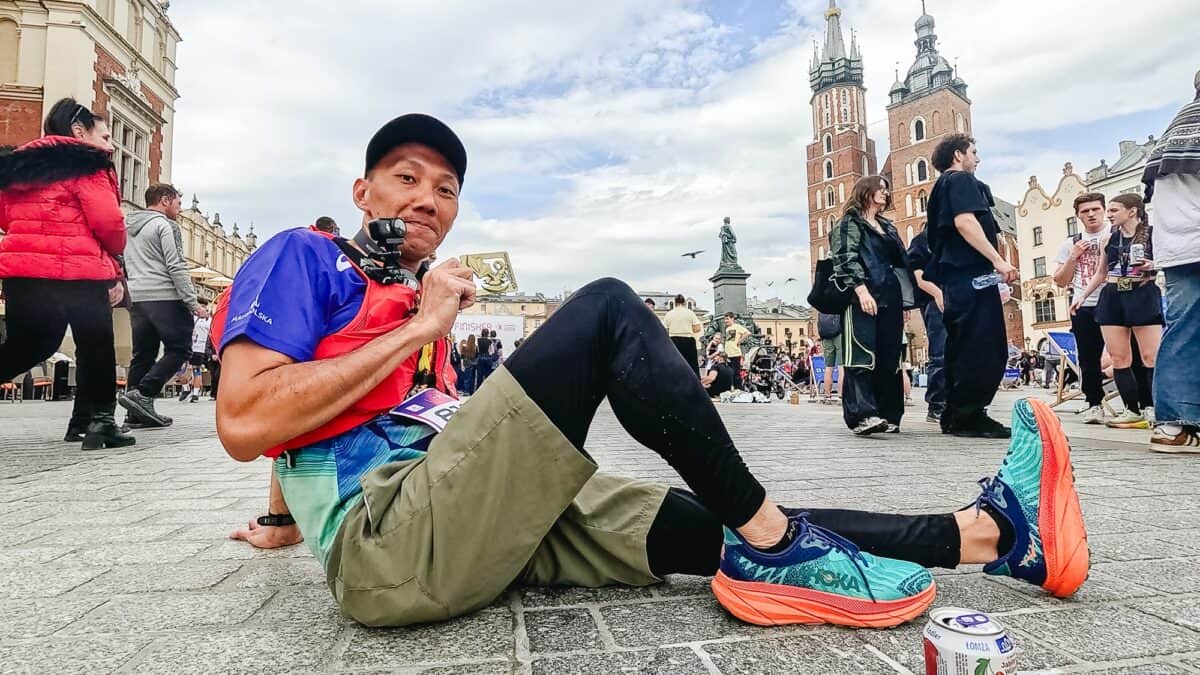
The course returned to the Main Market Square, giving the event a finish that felt every bit as atmospheric as the start.
I was especially happy to receive the medal.
The design featured the Wawel Dragon, one of Krakow’s best-known legends. It remains my favorite medal from the races I have completed so far. What made it special was not simply the gold design, but that it clearly belonged to Krakow.
After finishing, I collected a warm meal and drinks, then found a place to sit on the ground in the Old Town. Proper warm food after several hours on the course is always a big plus, especially when recovery is already on your mind.
I could see the church, runners were still finishing nearby, and the square remained filled with the atmosphere of the event.
Krakow is worth more than a race weekend
Krakow is one of the easiest cities in Europe to recommend as a travel destination.
If you stay near the Old Town, you will be close to the start, finish, historic streets, restaurants, and much of the city’s atmosphere. Kazimierz remains my favorite area because of its cafes, older buildings, and character, although staying north of the center was convenient for the expo and showed me a different side of the city.
The expo was outside the Old Town, so how convenient it feels will depend on where you stay. For me, it was around a 10-minute walk. From Kazimierz, it would have required a longer trip, but it was still easy enough to reach.
Race morning was straightforward, although I would arrive early if you need to use the toilets, check a bag, or find a specific starting wave. With several thousand runners gathering around the historic center, queues and walking distances can be longer than expected.
Krakow also deserves far more than two days.
The Old Town, Kazimierz, Wawel Castle, river areas, cafes, and museums could easily fill several days. Auschwitz-Birkenau and the Wieliczka Salt Mine are also common day trips from the city.
I would allow around five days if you want to run the marathon without squeezing the destination into a rushed weekend.
The race that changed the rest of my season
The third April marathon never happened because the remaining race options did not come together in time.
But Krakow still changed how I approached everything that followed.
My next confirmed block involved three marathons in three weeks. After what happened in Poland, I began looking more seriously at planned run-walk strategies. My idea of a conservative pace became slower, and recovery between races became more important than the finishing time of any single marathon.
I also began eating more after races because I would rather slightly overdo recovery than arrive at the next start underfueled.
Despite having to enter a bit of survival mode, Krakow did not leave me thinking mainly about pain.
What I remember is returning to a city I already loved, receiving one of my favorite medals, and understanding that a series of marathons has to be approached differently from one isolated race.
The Cracovia Marathon deserves more international attention for simpler reasons too. It starts and finishes in one of Europe’s most beautiful historic squares, follows a varied route through the city, and offers the atmosphere of a large race without the scale of a major.
If you have never visited Krakow, combining the city with the marathon feels like an easy decision.
And if you already know it, running through Krakow may show you that there is still more of the city left to discover.


