Scotland is best known for its Highland landscapes, historic castles, Scotch whisky, bagpipes, tartan, golf, and the cities of Edinburgh and Glasgow. It is also associated with mist-covered lochs, rugged islands, clan history, traditional music, and foods such as haggis and shortbread.
Those familiar images are part of Scotland, but they can make the country appear more old-fashioned and uniform than it really is. Edinburgh’s stone architecture feels very different from Glasgow’s music and arts scene. The Highlands are not interchangeable with the islands, and the northeast has its own castles, fishing towns, farmland, and whisky traditions.
1. The Scottish Highlands
The Highlands are the Scotland many visitors imagine before arriving: mountains, glens, moorland, lochs, deer, and long stretches of road with few settlements.
The region covers a large part of northern and western Scotland, but it does not have one consistent landscape. Glencoe is known for steep mountain walls and a dramatic road through the glen. The northwest has exposed coastline, pale beaches, and isolated peaks, while the eastern Highlands gradually meet the forests and broad valleys of the Cairngorms.
Inverness is commonly used as a base for the northern Highlands, although the city itself feels more like a compact regional center than a remote Highland settlement.
Distances can be deceptive. Narrow roads, ferries, photography stops, and changing weather make journeys considerably slower than they appear on a map. A car offers the most freedom, but rail routes and small-group tours work well for selected areas.
The scenery may be the immediate attraction, yet the Highlands are not empty wilderness. Their landscapes also reflect farming, sporting estates, depopulation, tourism, conservation, and the Highland Clearances.

2. Edinburgh
Edinburgh is Scotland’s capital and the country’s most visited city.
Its center is divided between the medieval Old Town and the planned Georgian New Town, which together form a UNESCO World Heritage Site. The Old Town climbs along the Royal Mile between Edinburgh Castle and the Palace of Holyroodhouse, while the New Town is arranged around broad streets, crescents, gardens, and neoclassical buildings.
Edinburgh can look severe in grey weather, but that is part of its character. Dark stone closes in around narrow lanes before the city suddenly opens toward Arthur’s Seat, Calton Hill, or views across the Firth of Forth.
The city is also known for literature, universities, museums, pubs, and a festival calendar that completely changes its atmosphere in August.
Many of the most recognizable landmarks in Edinburgh are close enough to combine on foot, though the steep streets make the center more tiring than its size suggests.

3. Edinburgh Castle and the Royal Mile
Edinburgh Castle sits on Castle Rock, a volcanic formation overlooking the city.
The site has been fortified for centuries and has served as a royal residence, military stronghold, prison, and national symbol. Inside are the Honours of Scotland, the Stone of Destiny, St Margaret’s Chapel, military collections, and views across Edinburgh.
The Royal Mile runs downhill from the castle through the Old Town to Holyrood. Despite the name, it is a sequence of connected streets rather than a single road.
Its central stretch can feel crowded and heavily geared toward visitors, particularly during summer. The more interesting details are often found inside the closes and narrow passageways that branch away from the main route.
Edinburgh Castle requires more time than its compact exterior suggests, and advance booking is sensible during peak periods. It is one of several major castles and palaces in Edinburgh, but it should not be used as the template for every Scottish castle. Many are smaller, more isolated, ruined, or still occupied.

4. Glasgow
Glasgow is Scotland’s largest city and the clearest counterpoint to Edinburgh.
Where Edinburgh is associated with historic streets and monumental architecture, Glasgow is known for music, art, industrial heritage, nightlife, and a more direct urban energy.
The city expanded rapidly through shipbuilding, engineering, manufacturing, commerce, and trade. Its wealth produced grand Victorian buildings, while the decline of heavy industry left behind difficult economic and social changes.
Today, Glasgow has major museums, independent restaurants, music venues, football clubs, university districts, and work by architect and designer Charles Rennie Mackintosh.
The center is laid out on a grid and is relatively easy to navigate. The West End feels leafier and more residential, while the East End contains landmarks such as Glasgow Cathedral, the Necropolis, and the Barras.
The wider guide to what Glasgow is known for explores how the city’s industrial past and modern cultural identity fit together.

5. Scottish Castles
Scotland is famous for castles, but the word covers very different kinds of places.
Edinburgh and Stirling are large royal fortresses built on prominent volcanic rock. Eilean Donan occupies a small tidal island and is known largely for its setting. Dunnottar stands on a cliff-edged headland, while ruined strongholds such as Urquhart Castle have become closely associated with the surrounding landscape.
Other castles developed into comfortable residences rather than remaining defensive structures. Balmoral, Glamis, Inveraray, and Blair Castle belong to a different tradition from exposed medieval ruins.
The most rewarding choice depends on what interests you. Stirling offers strong royal history, Dunnottar has one of the most dramatic approaches, and smaller ruins may provide a quieter experience than Scotland’s headline attractions.
Opening periods vary, particularly for privately owned properties and remote sites. Several castles also close sections for conservation work, private events, or winter.
This collection of castles in Scotland compares more of the country’s royal residences, fortresses, estates, and ruins.

6. Scotch Whisky
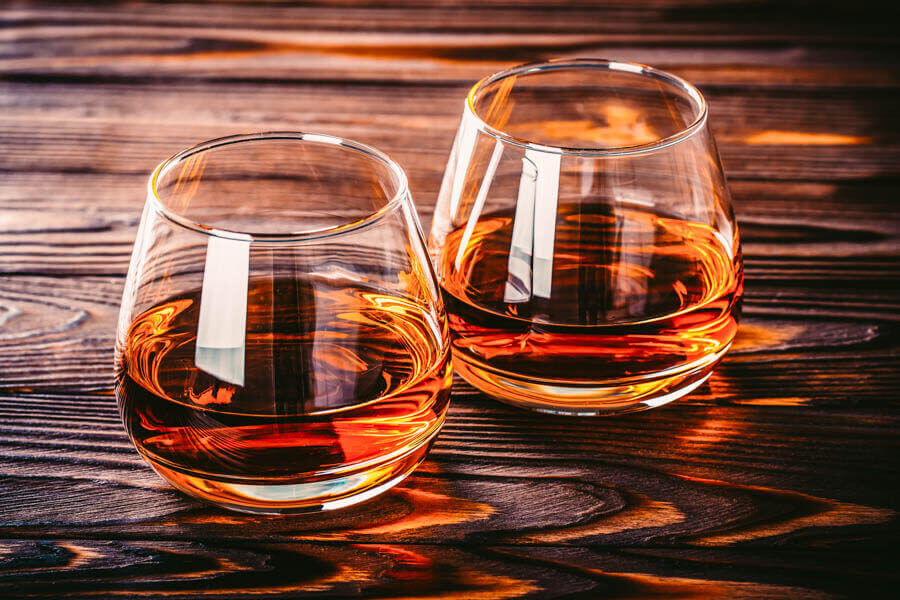
Whisky is one of Scotland’s most recognizable exports and a major reason people travel through its rural regions.
To be sold as Scotch whisky, the spirit must be produced and matured in Scotland under legally defined conditions. It must spend at least three years ageing in oak casks, although many bottlings mature considerably longer.
Single malt is made from malted barley at one distillery. Blended Scotch usually combines malt and grain whiskies from multiple distilleries.
Scotland’s five traditional whisky regions are the Highlands, Lowlands, Speyside, Islay, and Campbeltown. These labels are useful for planning, but they do not guarantee a particular flavor. Production methods, peat, casks, ageing, and individual distillery choices matter more than regional stereotypes alone.
Speyside has the densest concentration of distilleries, while Islay is particularly associated with heavily peated whisky. Distillery tours usually explain fermentation, distillation, maturation, and blending before ending with a tasting.
Reservations are advisable, especially at smaller distilleries and during summer. If you are driving, tasting samples can often be packaged to take away rather than consumed immediately.
7. Lochs and Loch Ness
Scotland’s lakes are known as lochs, a word also used for some sea inlets.
Loch Lomond is the largest Scottish loch by surface area and lies within easy reach of Glasgow. Loch Awe is associated with castles and wooded shores, while Loch Maree sits within one of the northwest Highlands’ most memorable landscapes.
Loch Ness is the most famous, largely because of stories surrounding the Loch Ness Monster.
The loch is long, deep, and difficult to appreciate from a single roadside viewpoint. Boat trips provide a better sense of its scale, while the ruins of Urquhart Castle add a strong historical stop along the western shore.
The monster story is part of the attraction, but it does not need to dominate the visit. Loch Ness also works as part of a wider route through Inverness, the Great Glen, Fort Augustus, and the western Highlands.
If time is limited, it is worth asking whether you are genuinely interested in the legend. Other lochs may provide more impressive scenery with fewer tour buses.

8. The Isle of Skye
The Isle of Skye is famous for sharp mountain ridges, sea cliffs, rock formations, waterfalls, and exposed coastal landscapes.
Its best-known locations include the Old Man of Storr, the Quiraing, the Fairy Pools, Neist Point, and the Cuillin mountains. Portree is the island’s largest settlement and most practical base for visitors using public transport.
Skye’s popularity has consequences. Roads are narrow, parking at major viewpoints fills quickly, and famous stops can feel crowded during summer. Trying to cover the entire island in one day usually results in more driving than experiencing.
Weather also shapes the trip. Rain, fog, and wind may hide a view completely, then clear with little warning. Building flexibility into the itinerary is more useful than planning every hour around photographs.
Skye can be reached by bridge from the mainland or by ferry on selected routes. A car is useful, but it should not be treated as permission to stop wherever the road narrows or blocks local access.

9. Scotland’s Islands
Scotland has hundreds of offshore islands, with several dozen supporting permanent communities.
They are spread across distinct groups rather than forming one consistent island experience.
The Inner Hebrides include Skye, Mull, Islay, Jura, and smaller islands along the west coast. The Outer Hebrides stretch through Lewis, Harris, North Uist, South Uist, and Barra. Orkney lies off Scotland’s northern coast, while Shetland sits much farther into the North Atlantic.
Each group has its own geography, transport challenges, history, economy, and cultural influences. Harris is known for beaches and mountains, Islay for whisky, Mull for wildlife and colorful Tobermory, Orkney for prehistoric sites, and Shetland for maritime and Norse connections.
Ferry schedules determine many island itineraries. Weather can cause disruption, and taking a car may require booking well ahead. Trying to squeeze multiple island groups into a short trip rarely works because the transfers consume more time than the distances suggest.

10. Glencoe
Glencoe is one of Scotland’s most recognizable glens.
The main road passes between steep mountains and dark ridges, making it accessible even without a long hike. Short walks, viewpoints, and nearby waterfalls allow visitors to experience more than the scenery through a car window.
The glen is also associated with the Glencoe Massacre of 1692, when members of the MacDonald clan were killed by government troops who had been staying in their community. The event is frequently reduced to a simple story of clan betrayal, but it was connected to the wider political conflict following the removal of James VII and II.
Glencoe later experienced the effects of the Highland Clearances and changing land ownership. The sparse landscape visible today should therefore not be mistaken for land that was always uninhabited.
Fort William and Ballachulish make practical nearby bases. Glencoe is often included in rushed day tours from Edinburgh, but the long journey leaves limited time in the area.
11. Mountains, Munros, and Ben Nevis
Scotland contains the highest mountains in the United Kingdom.
Ben Nevis, near Fort William, reaches 1,345 meters and is the country’s highest summit. Its standard Mountain Track is accessible to fit walkers, but it is still a serious mountain route rather than a casual sightseeing path.
Weather can change rapidly, visibility may disappear, and conditions near the summit can be much colder than those in Fort William.
Scotland is also known for Munro bagging. A Munro is a Scottish mountain at least 3,000 feet high, and “bagging” one means reaching its summit. Completing the entire list is a long-term goal for many walkers.
Mountain height alone does not determine difficulty. Navigation, exposure, remoteness, river crossings, snow, and path conditions can make lower hills more hazardous than expected.
Visitors seeking an easier outdoor experience have many options beneath the summits, including glen walks, forest paths, coastal trails, and lower viewpoints.
12. The North Coast 500
The North Coast 500 is a touring route through the northern Highlands, beginning and ending in Inverness.
It connects places such as the Black Isle, Applecross, Wester Ross, Sutherland, Caithness, and the northeast coast. The route became popular for its mountain passes, beaches, sea cliffs, castles, and long coastal roads.
Calling it Scotland’s version of Route 66 oversimplifies the experience. Many roads are narrow and single-track, communities are small, fuel stations can be widely spaced, and accommodation is limited during busy periods.
Five hundred miles is only the official driving distance. Detours, walks, stops, and slower roads mean the route should not be treated as a two-day loop.
Campervans and motorhomes require particular care. Passing places are for allowing vehicles through, not for parking, and overnight stays should use appropriate campsites or designated locations.
The NC500 is rewarding when approached as a journey through inhabited landscapes rather than a race between photo stops.

13. Bagpipes and Traditional Music
Bagpipes are among the strongest international symbols of Scotland.
The Great Highland bagpipe is the best-known form, although Scotland also has other piping traditions. Pipes remain part of military ceremonies, parades, Highland games, weddings, funerals, competitions, and live performances.
Traditional Scottish music extends well beyond bagpipes. Fiddles, accordions, harps, whistles, guitars, singing, and modern folk arrangements all contribute to the country’s music culture.
Glasgow has a particularly strong live-music scene, while the Highlands and islands host festivals, local sessions, and community performances. Edinburgh offers traditional music in pubs, though venues closest to the Royal Mile can sometimes prioritize a visitor-friendly version of the experience.
A small pub session usually gives a better sense of how traditional music functions socially than a heavily staged dinner show.
Scottish music has also developed through exchange with Irish, Scandinavian, North American, and wider European traditions rather than existing in isolation.

14. Kilts and Tartan
Tartan consists of intersecting colored bands woven into patterned cloth. Kilts are pleated garments made from tartan or other materials and are now widely associated with Scottish identity.
The modern system linking particular tartans to specific clans is not an unchanged medieval tradition. Regional patterns and Highland dress existed earlier, but many formal clan associations were standardized or popularized during the 18th and 19th centuries.
That does not make tartan meaningless. It remains important in formal clothing, military uniforms, weddings, Highland dancing, pipe bands, fashion, and expressions of family or regional identity.
Most people in Scotland do not wear kilts as everyday clothing. They appear more often at ceremonies, celebrations, performances, and sporting events.
Visitors can buy inexpensive souvenir kilts throughout Edinburgh, but these should not be confused with a properly fitted wool kilt. Quality garments require substantial fabric, skilled construction, and a correspondingly higher price.
15. Clans, Jacobites, and the Highland Clearances
Clans are often presented as ancient extended families permanently tied to a castle and tartan.
In reality, clan society involved kinship, political allegiance, military obligations, land, protection, and relationships between chiefs and communities. Not everyone sharing a clan name was closely related by blood.
The Jacobite risings of the 17th and 18th centuries sought to restore the exiled Stuart monarchy. The final rising ended at the Battle of Culloden in 1746, near Inverness.
After Culloden, the British government imposed measures intended to weaken Highland military and social structures. Over the following decades, major economic changes and the Highland Clearances displaced many rural tenants as landowners reorganized estates around sheep farming, sporting interests, and other forms of profit.
Migration took Highlanders to Scottish cities and overseas, including North America, Australia, and New Zealand.
Understanding this history changes how the Highlands look. Empty glens and ruined settlements are not always signs of untouched nature. In many places, they are evidence of communities that were removed or gradually disappeared.
16. Gaelic and Scots
English is spoken throughout Scotland, but it is not the country’s only language.
Scottish Gaelic is a Celtic language historically associated particularly with the Highlands and islands. It remains strongest in parts of the Outer Hebrides, although speakers live across Scotland.
Road signs in some regions appear in both Gaelic and English. Visitors may encounter Gaelic through place names, music, broadcasting, schools, museums, and cultural events.
Scots developed from northern forms of Middle English and has numerous regional varieties. Words such as wee, bairn, kirk, bonnie, and dreich are widely recognized, though Scots is much more extensive than a collection of informal expressions.
Gaelic, Scots, and Scottish English should not be treated as interchangeable accents. They have different histories and linguistic positions.
Learning the pronunciation of every place name is unrealistic, but listening rather than confidently imposing an English pronunciation usually goes a long way.
17. Ceilidhs and Highland Games
A ceilidh is a social gathering involving traditional music and group dancing.
Modern public ceilidhs generally include a band and a caller who explains the dances, making them accessible to beginners. The atmosphere is usually more energetic and informal than the word “traditional” may suggest.
Highland games combine athletic events, dancing, piping, competitions, and community gatherings. Heavy events may include tossing the caber, putting the stone, throwing weights, and the hammer throw.
Games take place in different towns throughout the warmer months, so there is no single permanent Highland games attraction to visit year-round.
Both ceilidhs and games are participatory parts of Scottish culture, but they can also be staged specifically for tour groups. Local event calendars, community halls, and established gatherings generally provide a more natural experience.
The most enjoyable approach to a ceilidh is to accept that mistakes are expected and join in rather than watching every dance from the side.

18. Golf and St Andrews
Scotland is widely regarded as the home of golf.
The modern game developed over centuries, and the Old Course at St Andrews became one of its most influential locations. The Royal and Ancient Golf Club was founded there in the 18th century, while the course continues to host major championships.
St Andrews attracts golfers from around the world, but the town is not only a golf resort. It also has a historic university, cathedral ruins, a castle, beaches, and a compact center.
Playing the Old Course requires planning and is not guaranteed simply because you arrive in town. Other courses around St Andrews and across Scotland provide more accessible alternatives.
Links courses are especially associated with coastal land, firm turf, wind, dunes, and natural-looking terrain. Scotland also has inland parkland courses and small community clubs where the atmosphere can be less formal than expected.
Even non-golfers may find St Andrews worthwhile, though the town becomes considerably busier during major tournaments and university events.
19. Haggis, Neeps, and Tatties
Haggis is Scotland’s most famous dish and the one most likely to provoke questions before it reaches the table.
It is traditionally made with sheep offal, oatmeal, onion, fat, stock, and seasoning. The mixture was historically cooked inside an animal’s stomach, although modern commercial versions commonly use other casings.
Haggis is often served with neeps and tatties. In Scotland, neeps generally refers to swede rather than the small white turnips common in some other countries. Tatties are potatoes.
The dish is central to Burns Night suppers on January 25, when it may be carried into the room to bagpipe music and addressed using Robert Burns’s poem “Address to a Haggis.”
Outside that ceremony, haggis appears in breakfasts, pies, restaurant starters, fried snacks, and vegetarian versions. Its flavor is more peppery and oat-based than its reputation suggests.
The guide to traditional Scottish food covers haggis alongside soups, seafood, meat dishes, baking, and everyday meals.

20. Scottish Seafood
Scotland’s long coastline, islands, sea lochs, and fishing ports make seafood one of the country’s strongest food experiences.
Salmon, haddock, mackerel, mussels, oysters, scallops, crab, langoustines, and smoked fish all appear on menus. Quality and preparation vary, so a coastal location alone does not guarantee a good meal.
Cullen skink is a thick soup made with smoked haddock, potato, onion, and milk. It originated around Cullen on the Moray coast and is particularly suited to colder weather.
Arbroath smokies are haddock traditionally hot-smoked in and around the town of Arbroath. Smoked salmon is more widely available, but local smokehouses and smaller producers can offer a more distinctive experience than generic hotel breakfasts.
Seafood is often best in fishing towns, island restaurants, and simple harbor cafés rather than only in formal city dining rooms.

21. Shortbread, Tablet, and Scottish Baking
Scottish food is not limited to meat and whisky.
Shortbread is made from a simple combination of flour, butter, and sugar. Its texture depends heavily on ingredient quality and careful baking, which is why a good version tastes very different from a dry souvenir tin.
Tablet is a much sweeter confection made by cooking sugar, butter, and condensed or evaporated milk until it sets with a grainy, crumbly texture. It resembles fudge but is generally firmer and more sugary.
Cranachan combines cream, toasted oats, raspberries, honey, and sometimes whisky. Tipsy laird is a Scottish trifle, while clootie dumpling is a spiced fruit pudding traditionally cooked in cloth.
Bakeries also sell empire biscuits, fruit scones, morning rolls, pies, and regional specialties that may provide a more everyday picture of Scottish eating.
The wider collection of Scottish desserts and sweets explains what distinguishes these dishes and when they are commonly eaten.
22. The Full Scottish Breakfast
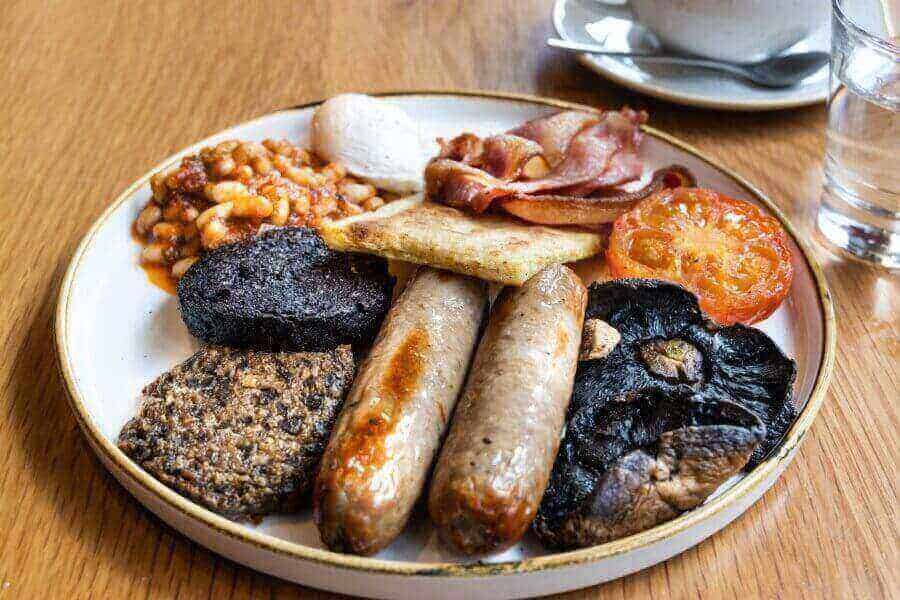
A full Scottish breakfast usually combines eggs, bacon, sausage, beans, mushrooms, tomatoes, and toast with specifically Scottish additions.
These may include black pudding, haggis, tattie scones, square sausage, or occasionally smoked fish. Exact combinations vary by hotel, café, household, and region.
Square sausage, also called Lorne sausage, is shaped into a block and served in slices. Tattie scones are thin potato-based griddle breads rather than sweet bakery scones.
The meal is substantial and often aimed at weekends, hotels, or a long day outdoors rather than being a universal daily breakfast.
Smaller cafés may allow individual items to be ordered in a filled morning roll, which is a more practical way to try one or two elements without committing to a large plate.
This guide to Scottish breakfast foods explains the meats, breads, fish, and accompaniments commonly found on the table.
23. Robert Burns and Scottish Literature
Robert Burns is Scotland’s national poet and one of the country’s most enduring cultural figures.
Born in Ayrshire in 1759, he wrote in Scots and English about love, politics, inequality, farming, humor, and ordinary life. His works include “Auld Lang Syne,” “Tam o’ Shanter,” and “A Red, Red Rose.”
Burns Night is celebrated on January 25 with poetry, speeches, haggis, whisky, and music. Formal suppers follow a recognizable structure, while informal versions may simply gather friends around Scottish food.
Scotland’s literary identity extends well beyond Burns. Walter Scott shaped popular images of the country through historical novels. Robert Louis Stevenson wrote works including Treasure Island and Strange Case of Dr Jekyll and Mr Hyde. More recent Scottish literature ranges from crime fiction to experimental writing and contemporary urban stories.
Edinburgh’s connection with writers, publishers, libraries, and book festivals contributed to its designation as the world’s first UNESCO City of Literature.
24. Film Locations and Scottish Mythmaking
Scotland’s landscapes and cities have become familiar through films and television, sometimes representing themselves and sometimes standing in for fictional worlds.
The Glenfinnan Viaduct is strongly associated with the Harry Potter films, while parts of Edinburgh are linked to the series through the author’s time in the city rather than serving as the primary filming location.
Doune Castle has appeared in Monty Python and the Holy Grail and Outlander. Glen Coe, Glen Etive, Skye, Glasgow, Edinburgh, and the Highlands have also appeared in major productions.
Screen tourism can lead visitors toward places they might otherwise overlook, but it also concentrates crowds at fragile or small locations. The Glenfinnan viewpoint and Skye’s roadside attractions can become particularly congested.
Scotland’s appeal on screen comes from the same contrasts visible during a trip: castles beside modern cities, exposed mountains near settled glens, rapidly changing weather, and landscapes that seem remote even when a busy road is just out of frame.
The fictional version of Scotland can be enjoyable, provided it does not replace the inhabited country around it.

What Best Defines Scotland?
Scotland is famous for whisky, castles, tartan, bagpipes, golf, and Highland scenery. All of those associations have a real place in the country, but none explains it alone.
The most useful way to understand Scotland is through its contrasts.
Edinburgh presents a monumental, historic capital, while Glasgow feels more industrial, musical, and contemporary. The Highlands contain celebrated scenery, but also the remains of displaced communities and changing rural economies. The islands share certain logistical challenges, yet differ considerably in language, landscape, architecture, and cultural influence.
For a first trip, Edinburgh and Glasgow provide the strongest urban introduction. Stirling, Loch Lomond, or the southern Highlands can then be added without spending an entire day in transit. A longer journey allows time for Glencoe, the Cairngorms, the northwest Highlands, or one carefully chosen island group.
A trip to Scotland can also be combined with England or extended across the Irish Sea to explore Ireland. The cultural connections are real, but treating the countries as interchangeable quickly obscures what makes each one distinct.
Scotland is ultimately defined less by one image than by the way its history, cities, landscapes, food, languages, and modern culture continue to occupy the same relatively small country.


Good to know that there’s so much to do in Scotland. I definitely want to visit soon. Thanks for sharing this!