Dubai is one of the luxurious and wealthiest of the seven emirates, filled with character, towering skyscrapers, beautiful beaches, and more. The sunny metropolis offers a healthy mix of modern-day culture and rich history paired with thrilling adventure, world-class shopping, and entertainment. However, you don’t have to burn your pocket when visiting this wealthy metropolis. There are many cheap and free things to do in Dubai as well.
The optimum time to visit Dubai is during Winter during the months of November to March when the weather is just right. During this time, the temperature can reach as low as 17°C, making it ideal for outdoor activities such as hitting the sand dunes or catching some sun at one of the many snowy-white beaches.
Places to visit in Dubai for Free
JBR Beach
The Jumeriah Beach is free to use and great place to get a tan
This is one of the cleanest and biggest beaches the sun-filled city has to offer, spanning at least 1 mile in length. JBR is short for Jumeirah Beach Residence, a residential complex home to dozens of residential skyscrapers and high-end hotels. The beach features soft powdery sand, a splash zone dedicated to young children, and an outdoor fitness center.
Next door to the beach is The Beach at JBR, a community of rural plazas with cafes, shops, and restaurants. There is also easy access from the beach to the vibrant outdoor shopping mall with stylish storefronts and restaurants. Often, there will be luxury sports cars cruising through the streets.
A sun-soaked trip to JBR Beach is a dreamy place to visit in Dubai for free. There are a range of food options but you can always pack your own snacks if you are on budget. The beach is available to visit from 7:30 am to 10 pm every day, with the exception of Wednesday and Thursday’s closing at 11 pm.
Dubai Marina
Dubai marina at night makes for a relaxing walk
The JBR beach is part of a larger area called the Dubai Marina. This is an affluent residential neighborhood popular among expats. Apart from the beach, the Dubai Marina Walk is another great place to visit if you like to sit by the water.
The waterfront pathway features a sight of countless luxury yachts, nice restaurants and the Dubai Marina mall. While it is nice to visit during the day to have a seat and read a book or soak in the sun, I love to go for a stroll here at night after dinner. The night lights and breeze are calming and you can sometimes see people performing along the pathway.
The Famous Souks
Look at the soccer boots made of gold – Souks in Dubai make for fascinating experiences
Dubai’s notorious souks are traditional Arab markets that offer some of the best shopping experiences in the city. Souks are one of the many free things to do in Dubai. There are plenty to see and check out even if you are just window shopping. If you plan to leave with some unique treasures in hand, be prepared to bargain as it is quite possible to negotiate the price on specific items. There are two types of these colorful markets; traditional souks and contemporary souks.
The traditional markets include the Gold Souk, Spice souk, Perfume Souk, and Textile Souk. Contemporary Souks consists of the Souk Madinat, Ripe Market, and Gold & Diamond Park. Both types offer exclusive fashion accessories, furniture, souvenirs, and delicious cafes and restaurants to grab a quick bite to eat and soak in the lively atmosphere.
At night, musicians come out to play some of their best tunes for the crowd to enjoy, making it an enriching experience for visitors. Dubai’s most legendary market would be the Gold Souk. Not only is it the most prominent market around, but also one that offers some of the world’s finest jewelry.
Dubai Mall
By far, the Dubai Mall is one of the most exciting and free places to visit in Dubai. With well over 12 million square footage, the massive mall hosts more than 1,300 retail shops, a SEGA game arcade, 22 movie theaters, an ice skating rink, and over 200 restaurants and cafes, not to mention the largest indoor aquarium in the entire world.
The Dubai Mall is the prime destination for luxury shopping, making it the fashion capital of the Middle East. You can spend even a full day just taking in every bit of this lavish masterpiece. The mall is open daily from 10 am to 12 am. The mall tends to get busier on the weekends, but it is also one of the best times to have an immersive experience as a place to visit for free in Dubai.
Burj Khalifa
Famous for being the tallest structure in the world, the Burj Khalifa stands tall at an overall height of 2,722 feet. The structure is a multi-complex with 160 stories, including nine extravagant hotels, residences, corporate suites, an outdoor observation deck, an artificial lake, and the world’s tallest performing water fountain, The Dubai Fountain.
However, you don’t even have to go up to marvel at this amazing architecture. Visiting the Burj Khalifa is also absolutely one of the best places to visit in Dubai at night.
Things to do in Dubai at Night
Burj Khalifa Fountain Show
The fountain show at Burj Khalifa is impressive and free to watch
The Burj Khalifa Fountain Show is one of the sun-kissed city’s most popular free things to do in Dubai at night. Located in the Burj Khalifa Lake, the stunning fountain show is performed daily at 1 pm and 1:30 pm and lasts up to 5 minutes. During the evening, the fountain show begins at 6 pm and occurs every half hour until closing at 11 pm. At the start of the event, hidden water jets shoot out water up into the air, up to 150 meters in a harmonic rhythm in sync with the music. The performance sparkles with the power of over 6,000 lights, lasers, and 50 projectors.
I recommend catching this spectacular view from the Waterfront Promenade located just outside the Dubai Mall. Although, due to its massive size, the performance can be seen from many locations around downtown. Every show is different so you can stick around and catch a few of them if you have time.
You can also take a traditional boat ride on the Burj Lake which brings you closer to the dancing water for a more magical experience.
Al Seef by Meraas
A historic and unique blend of old and new Dubai, Al Seef is a perfect place to visit in Dubai for free culture immersion. You get to admire the generational glow-up of Dubai. Al Seef hosts free festivals regularly, making it one of the trendiest spots in the city. The district offers unparalleled experiences consisting of waterfront shopping, art installations, firework shows, and dining.
You can spend 2 to 3 hours checking out the charming vibe, culture, and scenery. I find that the vibe of the place really comes out when the sun sets. During the night, the streets resonate a lively atmosphere with street performers and the sounds of the waves in the background sending a cool breeze through the air. Al Seef is at its prime in entertainment on Thursdays and Fridays.
Lots of cheap and free cultural things to do in Old Dubai
Global Village
One of the most worthwhile thing to do in Dubai at night
Global Village is a flourishing multi-cultural theme park with plenty of exciting attractions, unique international cuisines, cultural shows, and much more. Each gallery is themed under a certain country where you will find items like food, fashion, accessories from that specific country.
Dubai’s Global Village just recently celebrated its 25th season. The Global Village is only open from November to April each year. You should plan to spend at least 3 to 4 hours here, with the variety of activities and experiences available. I couldn’t finish visiting all the “countries” and was at some point just skimming through some of them.
A visit to the Global Village makes one of the best cheap things to do in Dubai. The entry fee can be as low as AED 15 (USD 4).
Arabian Night Tours
Dubai’s Arabian Night Tours features some of the city’s best outdoor activities, including dune bashing, camel rides, cruises, hot air balloon rides, a dance show, and so much more. There is something for everyone to enjoy, from desert delights to traditional Arabian BBQ. Most tours start in the morning and late afternoon and lasts till the night.
This is a paid activity but the Dubai desert experience is a worthwhile spending and caters to different budgets. There are many packages for your selection depending on the activities you want to participate in.
Umm Suqeim Beach
Although not as big or clean as the JBR beach, the popular Umm Suqeim Beach offers one-of-a-kind sunset views; hence the nickname Sunset Beach. Amongst the many beaches, Umm Suqeim Beach is one of the best places to visit in Dubai at night. Here is also where you can get a good view and photo with the famous Burj Al Arab Hotel.
It is a public beach which makes it entirely free to visit every day, 24 hours a day. Night swimming at beaches in Dubai is prohibited, with the exception of Umm Suqeim Beach, among just a few others. The beach is equipped with Smart Power light towers that help swimmers see better at night. The lights illuminate up to 125 meters of the beach and 30 meters of the sea. Visit this beach before sunset to beat the crowd, and find an excellent spot to catch the sunset for a gratifying and magical experience.
There are a few beaches in Dubai along the coast which are great for visits
Al Qudra & Love Lake
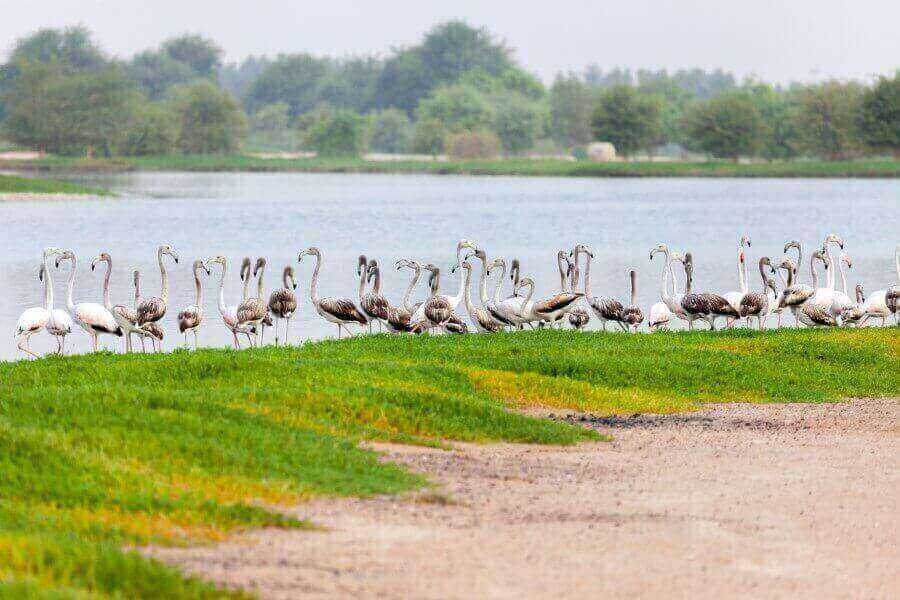
Escape the sparkling city and spend a night under the starry night at Al Qudra, in the center of the desert. Al Qudra is a remote location that provides visitors with a tranquil experience, disconnected from technology and connecting with mother nature. The area does not feature any restaurants or cafes but merely a place to camp out or have a picnic. During the night, the skies overhead are crystal clear, putting on a peaceful starlit show. This is also a great place to catch the sunset, with amazing colors reflecting on the lake if you are lucky.
Al Qudra is in tune with the wilderness, making it a perfect location for wildlife watchers. A few minutes away is Love Lake, an artificial lake shaped into two interlaced hearts. A visit here makes for a romantic getaway with someone special.
Dubai City Passes
If you are looking to go for different paid activities, don’t forget to check out the Dubai city passes available. These passes usually cover the key attractions and can be great money savers.
Life is journey of constant changes, growth and learning. In this episode, Thilini shares her story on how she recover from past mistakes to building a professional career, and ultimately exchanging a lucrative pay check for the freedom to travel around the world. We chat about the mindset of riding the wave of life, and also things to consider when leaving a well paid job for a nomadic travel life.
02:00: Taking actions without regrets
05:05: Maintaining a long distance relationship
07:50: Transiting from travel to digital nomad life
11:05: Managing others’ responses to your transition
14:00: Travel style and budget
17:10: Pursuing passions and ideas during pandemic
23:45: Learning from our past and how it shapes the future
28:05: The mindset to adapt and adjust
33:28: From finance to writing
38:40: How travel changes perspectives
42:50: What do you miss out when being away
44:30: A different phase of life with minimalism
50:10: Travel and experience to really discover
52:30: Tips for transiting from corporate to nomadic life
The following is an extremely summarized version extracted from the transcript of the full conversation. I strongly recommend listening to the podcast for all the valuable insights. You will also hear more detailed and contextualized stories from the guest(s), as well as pointers from me in a two-way conversation.
Hi Thilini! Please give an introduction of yourself.
I’m originally from Sri Lanka, where I grew up, study and started my financial career. I had a challenging childhood and youth, including losing both my parents. Eventually, my financial career became somewhat lucrative, but I had several problems in my personal life. So then, I emigrated to Australia through the skilled immigration program and continued my financial career in different roles. Finally, somewhere around 2018, I felt like I wanted to see and do more in life. So, when my partner was living in Texas, we decided to put our full-time jobs behind us and go traveling and use Mexico as a base. So that’s how it started.
What triggered your wanderlust, and gave you the courage to travel?
As I mentioned, I’ve faced challenges since early on in my life. So, I understood that life is fragile and finite; if you want something, you’ve got to go for it. I didn’t grow up traveling; I started as an adult. I made my first overseas trip when I was 21. I did travel a bit in Sri Lanka when my career became lucrative. But it was after I moved to Australia that I started traveling extensively. In Australia, we have a little more annual leave, but vacation days still limited us; sometimes, I had to take no pay. I talked to my partner; we have reached a stage where we were financially stable; we had no other obligations. We thought 50 years from now are we going to regret doing it or not doing it?
Did you plan to travel around the world, visit specific continents, or be free and easy?
What we thought was not to Nomad, fully, we wanted to use a base. We picked Mexico as a base because my partner was born there. It was also relatively easy for me to get a temporary residency. After we moved to Mexico, we started with South America and Central America and then we went to Europe. Before we gave up that base, we also explored locally and just traveled for a couple of months. Then we came back and completed a road trip across the country towards the Yucatan Peninsula, where we stayed. Then the pandemic hit.
How did you meet your partner and what’s your secret tip for maintaining a long-distance relationship?
We first met online, not through a dating site, but something else. Then we met in person and realized we were on the same page. We did have a long-distance relationship; it’s the longest possible distance you can imagine.
At the time, we both had full-time jobs, so we had a permanent base. The funny part was the time difference between Sydney and Texas; one person had to stay up late and sacrifice sleep, so you can’t talk all the time. You have a specific time in the evening or morning, plus some short calls in between. You need to have other interests because if your whole life revolves around the relationship, it can be challenging. You’ve got to have your hobbies, independence, and friends. I think it’s a balance between the two, and I think what’s most important is you need an end date. That means you can’t do long-distance forever.
How did you transit from a gap year for full-time travel to embracing a long-term nomadic lifestyle?
Firstly, we planned to take a year or two off, travel, and possibly go back to work. After about a year of traveling, we decided that we liked the flexibility and freedom, so we thought about what we could do using our skills. For the following few months, I had some anxiety, and I was struggling a little bit. So, I thought about my hobbies and focused on those things; that’s how we started. It’s great we get to do what we love and travel.
If your initial plan was to take a gap year and travel freely, why did you feel the need to have a base?
We had a moving base. The reason was that I didn’t want to get exhausted from traveling constantly and having to carry luggage or backpacks throughout. I was curious about Mexico; the lifestyle intrigued me; I wanted to explore the locality, learn Spanish, volunteer, and do community work. I thought it would be helpful to have a base, and Mexico worked perfectly because of its geographic location. The plan turned to be more location-independent work and less of a digital nomad. Location-independent means we don’t have to travel; we can travel if you want to.
How did your family and friends respond to your lifestyle change?
I had seen others do it before me. My colleagues and friends in Australia thought it was a great idea. My bosses wished they could do it too, but they couldn’t because of their work commitments. So, there were a couple of concerned people; sometimes, I think the concern is genuine. But generally speaking, I think the response was positive. There were some opinions, but I learned very young not to care too much about other people. Life’s too short. I had an older colleague who told me this before I left that opportunities come in small windows; you got to take them before they’re gone. Don’t miss it; one or two years is a short time considering the human lifespan, so just go.
Did you have a pre-plan budget in mind before leaving?
Roughly, but nothing specific. We thought we had enough money not to work for two years or even a little more. Mexico is a low-cost location, so the money goes further. We didn’t have a strict budget, but we were careful. We didn’t go to expensive restaurants and splash our cash. Instead, we stayed in mid-range hotels instead of backpacker hostels. A couple of times, we rented cars when we traveled, and in Mexico, we went on road trips. We prioritized how to spend money based on our likings and requirements.
What is your typical travel style?
When we were on the Pacific Coast, we made short trips of two to three weeks. Then we left that base and traveled for two months. Then we came back, and we went on a shorter trip to Cuba and Belize.
Have you found the pandemic a good opportunity to start writing?
So, I used just to write; I have some financial background and technical knowledge; maybe I could start writing. So, I offered my services directly to a few people and got started like that. Now, I am working on a couple of other ideas. So, it was a hobby that I was able to monetize.
Has the pandemic allowed you to pursue your passions?
Yes, exactly, that is precisely the point because we were caught up in our daily lives. Ideally, it would be best if you got started in your business before you quit your job. That is the ideal way, the less risky way, but for me, I was too entangled in daily life that I would never have got around to it.
I wanted to travel, and I wanted to become an entrepreneur. Then I lost the only family member I had early on, and things were not possible. So, I put my dreams on hold and continued working and sorting other personal issues. It went from one thing to another to another. The more you progress in your career, the harder it gets to leave, to quit. My dreams and all those fun things were falling behind.
Was the financial industry a busy and competitive lifestyle?
When I was younger, I used to have long hauls and very stressful jobs early on in my career. But later in my career, it was comfortable and not too stressful. Maybe I was getting a bit bored or not living the best life I could. I was thinking about working for 35 more years and then retiring. What if I had done something else?
Do you think your real passion was always in writing?
I do, definitely. I am entrepreneurial; I am working on many other things, and I’ve always had that mindset. I studied commerce in school and enjoyed it. I do like financial markets and trading and watching financial instruments fluctuate; that was fun. But, on the other hand, I think I was not too fond of the nine-to-five structure, lacking flexibility. There are still so many rules and regulations; you can’t just go off work; it doesn’t work. But, on the other hand, when you’re doing location-independent work, you can take your laptop and go and work anywhere.
Can you talk to us about some of your past experiences?
I was just young and dumb, and I should handle things better. Hindsight is a wonderful thing, I would tell my younger self I should have done X Y Z, but at the time, I didn’t have that capacity. It is a very stressful time because I was living in Sri Lanka, and my earnings were far less than in Sydney, and it was a much weaker currency. It taught me many things starting from handling stress, but it also highlighted more anxiety. Finally, I realized that I couldn’t continue the same way, I had to make some changes, and I had to get out of it. I wasn’t planning on spending the next 20 years getting out of debt; it had to happen quickly. So I restructured some debt, restructured the expensive ones. Before leaving, I was able to sell my car and pay off some of my debt. When I went to Sydney, I was employed relatively quickly. I did have to make sacrifices. Even though I was earning enough, I learned to live with flatmates. I learned how to allocate money to do what I like. I liked to travel, so travel was something I splashed on. At every stage of our life, we make our decisions based on our information and understanding. It’s sometimes not fair for us to look back later and judge ourselves, saying we should have done X, Y, Z. You’re not in the same situation anymore.
Do you think your growth mindset made it easy for you to transition out of your job to a nomadic lifestyle?
There’s always a way. As humans, we can underestimate our potential and abilities. Some people tell me they want to do this or wish they could do it. So, if you want to do it, and for whatever reasons it’s not possible, then take steps towards it. What do you wish to be doing ten years from now? There’s no point wishing; life just flows. The worst is worrying about finding another job or something else. But you can always find a way. It’s not as courageous or as risky as it sounds, especially today. As we live in an online world, there are so many opportunities. If you can get creative, you can always do something and make money. Still, time, opportunities, and experiences may not come again. The real risk is not taking those chances or those experiences. Also, the stresses of risk and change can come whether you like it or not. The pandemic caused many things to change. Many of those so-called steady jobs became unsteady, and many things happened, and people have to adjust to them as they had no choice. Sometimes, we rise to the occasion only when we are in difficult situations.
Has the pandemic caused many businesses to close, and then new ones take their place in Mexico?
Yes, and also back home in the village I grew up. People who lost their jobs in factories making clothes are now stitching masks and doing other things to put food on the table. I think people back home have started understanding that things aren’t as stable as they thought, and anything can happen. We could be here today, and something could happen tomorrow. So, we have to live to the fullest and be joyful now and not wait for something to happen in the future. As a result, people have stopped to think about what really matters. Is it chasing money or spending time with your loved ones and doing what you love?
Have you noticed much difference moving from the financial industry work to the writing world?
I was working not in consulting but in investment analytics and funds management. The comfortable six-figure amount in Australian dollars and the transition for me now are what I used to feel anxious about. When you’re doing something creative, like writing, you have to focus. You have to learn how to handle distractions and how to focus on work. I won’t let money stress me because I think I’ll always figure it out, and sometimes those thoughts do occur. But I decided to keep going, and now I have to keep going and make it work. I have no regrets. I’ve done everything I wanted to do in life. I’ve learned to chill out with my writing and use simple language, and drop the big words I’m used to using. It’s a process; we know as we go every month, we get a bit better or improve or get quicker.
Has travel changed your perspective on how you see other cultures?
Yes, I learned so many things from traveling. One is that as humans, we are not as different as society has made us think. In every country you go to, people have the same complaints, wants, exact needs, and problems. So, in a way, I found it very endearing that we are so similar; it’s nice that you can connect with people. Media portrays things very differently from what you see in Mexico; I found it very eye-opening. I learned that people back home move on with their lives, and sometimes friends move on; it’s just life. I learned to appreciate every moment, especially nature; it makes you realize that you’re just a speck in this vast universe. So, what are all these problems and anxieties? I don’t mean to diminish the problems of the world; there are huge problems. But sometimes, we also tend to worry about ridiculous things that we shouldn’t. I think the pandemic made many people realize that you shouldn’t waste time on unseen things.
Do you feel that you miss out on things with your friends back home due to your new lifestyle?
Yes. I keep in touch with my friends, but there are time differences, and people are busy. They have their lives, jobs, and families. Sometimes people move on, and they don’t have the time to coordinate things. I also learned young to accept that phases of life end, and then you go to the next stage of life; that’s just how it is. There are many friends I miss. Maybe we’ll have more great times in the future, after the pandemic. But we used to have the best possible times together, and that’s what matters the most. It’s like a happy nostalgic memory while I also missed them. I think the same about my father, it would have been great if I had him more into my adulthood, but we had the time we had; that’s just how it is.
Did you consciously think that you were starting your next phase of life when you decided to quit your job and go on this trip?
I didn’t spend much time contemplating it because I was so busy trying to organize everything, which was a nightmare while working. I worked up to one or two days before I left, so there was a lot to do. I viewed it as the next step following many different episodes in my life.
I sold my car and goods; I didn’t want to put things in storage. I didn’t take much with me; I felt so free. I used to have a shopping problem, and I thought it would make me happy. But they weighed me down; the things I’d worked hard to buy were baggage. I packed myself into a few bags, and I suddenly felt so free; it was terrific.
What are your plans and are you going to stay in Mexico?
Right now, I think that’s our only choice; I was lucky to have got a temporary residency. I had thought about going to Sydney. But I just went ahead and got it, and thankfully, for now, I can continue to stay. I also have worker rights here because temporary residency doesn’t come with work rights. So now I’m free to do whatever I want. The plans are to travel domestically; we have traveled quite a bit locally. When things open up, we will start going overseas again. I prefer having a base and location-independent work to nomadic because it’s less tiring and gives a little stability.
I love it here; there’s so much to do, and there’s pretty much everything. The healthcare system is sound. I was able to learn Spanish; I would say I’m semi-fluent. It has worked for me; I haven’t had any safety incidents. There are areas in the country and states that are considered unsafe, but we haven’t personally had any incidents. I’m not saying bad things don’t happen; they do, but sometimes things get exaggerated in the media.
If people are looking to go into the lifestyle, what are some things you would recommend before quitting your job?
I’d say have a financial buffer. If you are thinking of going for a while, then make sure you have a budget. That way, you won’t get stressed when you’re getting started in your business or freelancing. You don’t have to worry about every dollar you have. Second, while working, I would say get started with your freelancing or your side business. I know sometimes there are compliance rules, and it’s not allowed depending on what it is. But if it is unrelated, it shouldn’t be a problem. That way, you can get a head start. And the third one, I think, is that planning and all that is good, but think about how you would feel when you’re years old. If you look back, will you believe I wish I did that, or I’m glad I stayed, but don’t live in limbo?
How do you prepare for a cycling trip around the world? Freelance writer and cycling enthusiast Zoe Ashbridge shares how she transitioned from an office job to a freelance writer during a mega cycling trip around the world. We chat about how travel by bike is different from regular travel, what are challenges along the way and tips to take note when planning for such a trip. We also discuss how to kickstart your freelance journey on Upwork and the mentality to go after the life you want.
04:10: What led to the world cycle adventure
06:40: Adopting a “Just do it” mindset
08:00: Planning the cycling route and equipment
11:55: Travel plans can change
13:30: Some continents are easier for cyclists
16:15: Planning with the seasons
19:35: Getting fit with cycling
23:15: A different travel experience by bike
29:55: Interacting and communicating with locals
32:10: Tips for planning a cycle trip
35:32: A memorable story from travel
40:30: Budgeting and how to save up for a trip
45:20: Getting into freelance writing while traveling
47:10: Handing work during travels
51:47: The freelancing landscape
59:50: Tips to get started on freelancing platform
The following is an extremely summarized version extracted from the transcript of the full conversation. I strongly recommend listening to the podcast for all the valuable insights. You will also hear more detailed and contextualized stories from the guest(s), as well as pointers from me in a two-way conversation.
Please give an introduction of yourself.
My name is Zoe, and I am a freelance writer. Last year, or even the year before, I left my house in England, and I cycled to Vietnam with my boyfriend. We rode about 13,000 miles over a year, roughly 20,000 kilometers. We were planning to cycle around the world, but the pandemic stopped that from happening. I think we were nine days over a year on the road; we got the next plane home. I had started to explore remote working and dabbling in writing blog posts for people. I had never really felt like remoting working was accessible to me. Still, I have learned since that it was, and it’s accessible to a lot of other people as well.
What was the initial route planned?
The initial route was to leave England and then cycle a complete circumnavigation around the world, and then come back to England, all by bicycle. It was a mega trip, but I hardly did any planning because my work was fantastic, and they did the whole lot. I followed obediently. The plan was to go south to Singapore, Australia, South Australia, and New Zealand from Vietnam. Then the goal was to go across the USA, Portugal, Spain, France and then back home to England.
What got you into cycling, and why did you choose cycling as a way to travel the world?
I always cycled before I met my boyfriend, Stewart. I would go out on my own. I have a terrible sense of direction; the fact that I’ve cycled to Vietnam is quite laughable if you know me very well. I would never be able to do anything like that on my own. I was a reasonably keen road cyclist, wasn’t particularly fast, but enjoyed getting on my bike and outdoors. Maybe a few years after cycling on my own, I was just at work, and the people I worked for employed a new developer. I met him, and we ended up getting involved romantically, and he cycled too. A month into our relationship, he said he was planning on quitting his job, and he asked me to leave mine and cycle around the world. I said, let’s do it, and then six months later, we both quit our jobs. They were terrific about it, supportive, and we are still on excellent terms. I never went back to freelancing.
What is your mindset when taking the leap of faith to quit your job and go cycle around the world?
I think I’m just not scared about taking risks. I think about calculated risks. I’m willing to think about what is the worst that could happen? I knew I would probably come back alive. If we broke up, I could get a plane home. Quitting your job can feel quite scary, but there are other jobs out there, especially if you’re willing to do anything. When I came back from the trip, I didn’t have a job, but I was happy to work in a supermarket and earn minimum wage for a while. I enjoyed it. So although it feels risky, I think it will just alter my life course for a little bit, but I don’t see anything wrong happening.
Did you have to plan a detailed cycling route, or did you just go with the flow?
A mix of the two. When my boyfriend planned the route, he planned the whole route strategically, turn by turn, the entire 24,000 miles, which took a long time. I have prepared a 100-mile walk previously, and it took me 10 hours. He wanted to have that management of the trip. When we got over there, we found that you don’t have to plan. The exceptions would be places like Kazakhstan and a little bit of Azerbaijan. We would have to prepare parts of that trip because we needed to know how much water we needed to carry and how much food we needed to take on our bikes. We had to have enough water on our bicycles to last for two days so that we could cycle through the desert.
Do you carry around camping equipment?
We have pannier bags on our bicycles, and they hold camping equipment and first aid. We had our laptops; we had enough room for food and sleeping bags to be ultimately self-sufficient on the bikes. In the built-up areas, like England and France, most of Europe, my bike was approximately 35 kilos and Stuart’s probably 40. Then when we went to the desert, we carried water and extra food; my bike was 40 kilos, and Stuart’s was pushing towards 50 kilos. By the time you get to Kazakhstan, you’re fit; you’ve been cycling a hefty bike for six, seven months. So you don’t have to worry about that extra weight because you can do it.
How long was the whole journey supposed to be when you planned it?
I think we said 18 months. When we went from England to Italy, we knew it would take longer than 18 months. Even within those two countries, we knew that was a bit ambitious. So we added six months on and then reduced our daily budget to ensure that we could do that.
Was the delay due to the route or because you spontaneously decided to spend longer time in certain places?
It was a mixture of the two, to be honest. We weren’t quite making our goal of 65 miles a day, 100 kilometers a day, so that was one reason. The second reason was, we booked our accommodation for the first eight days in advance, and Stuart got injured on the way because we were too ambitious with the miles. We had to take a day off to rest his ankles, and then sometimes, when you’re in a charming place, we wanted to stay for two days. You never know where you’re going to end up when you’re traveling, especially like this.
Are there specific continents that you found to be tougher to cycle?
In terms of food or somewhere to stay, you can always get to something. You’re never that far away from buying food or a town person, which makes it easier but of course more expensive. You’ll probably exceed your daily budget in Europe, compared to Asia. Central Asia was complex; you can’t get any break from the sun, you need to carry all your food in your bike, so your bikes heavy. But then, it is boiling and humid in South Asia, which I was not used to and I’m dreading going back into that.
Are you planning on continuing where you left off when travel recovers?
I don’t know when it will be because we need countries to be open and need many to open. We don’t want to fly out to have to come back. I’m more a little bit worried about winter and how we can handle the winter. We’re just taking it day by day and enjoying what we’ve got now; building careers and stuff.
Did you plan your trip based on the seasons?
Yeah, we had a plan, and it didn’t work out. We were so excited that we were never going to see winter again. It didn’t happen. We hit China in October, which was the start of their winter. In winter, when the roads are icy, they don’t grit them like in England. It was like an ice rink, there were times where we would be walking or skidding, and we were so cold. I was wearing five layers of my clothing, including an oversized fat jacket, and we were still cold. The snow made parts of the trip hard to enjoy because we were so cold.
Do you cycle through bad weather?
It’s up to you if you want to cycle through the rain. In Slovenia, it was rainy, which is unusual for their season. People would make about us bring the British weather with us. It’s usually beautiful and hot. It rained for days on end, but we cycled through it. The only time that weather caused a real problem in the desert because it’s so flat. If you’ve got a headwind when it’s flat, you’ve just got a headwind all day because you’re moving in one direction. There was an excellent app called Windy, which I think is for surfers initially to gauge waves; we use this Windy app, and if there was a headwind, we didn’t go on the bike. Instead, we got a hotel to wait for the wind to get better because it’s just exhausting to push your bike into a headwind all day.
Did you have to do any specific training before the trip?
We are pretty fit anyway, so our fitness was good enough. I could have cycled 100 miles, 100 kilometers in a day without any problems. Cycling with weight was utterly new. I didn’t do much weight training at all before the trip. You don’t have to be that fit because you only have to be able to get somewhere. All you’ve got to do is move forward every single day. It’s a question of time as opposed to fitness.
Where did you sleep during your travels?
We stayed in accommodation quite a lot; we did some camping. We meet some tourists who were riding on a $5 a day budget. They would eat whatever they could find and camp every night. They smelt terrible. We would joke that we are pretty posh cycle tourists. We probably did 70% hotels and 30% camping, something like that, maybe less camping, that’s how I enjoyed it.
When you travel the world by cycling, is there a specific goal or certain things you want to see?
I think it’s a balance of both. We wanted to cycle around the world; that didn’t happen, but it was important. It probably was a priority over everything else; we’re going to cycle an unbroken circle around the world within two years. But I think when you cycle tour, your perception of travel changes because you’re not hitting up the big cities, all the places where everyone goes. I’m not throwing shade at other travelers, but when you cycle, the journey of getting from A to B is what you’re doing, opposed to the destination of the place. You see places in a way that you wouldn’t see them if you flew out somewhere and landed in the city center, which has had all the money poured into it. You can see all the bits around that and village life. We cycled through Georgia one day, and we started in someone’s house because there wasn’t a hotel available. We had these minor interactions with the owners that were special. The people make it, opposed to the places. There’s so much to see on a bike, and you’re immersed in nature.
Did you find the rural communities more hospitable and friendly?
I find that city people tend to be busier and don’t have the time; I think they’re rude. There’s so much hustle and bustle, and they’re going somewhere themselves. The hospitality in smaller towns and villages is just excellent. I always joke that if we hadn’t said no to people in Turkey, we would still be in Turkey now; people are incredibly hospitable there.
Did you have any concerns about the dangers of cycling or camping?
When we left, I wasn’t that worried about people, but I’m also not naive enough to think there would be no danger. We didn’t experience a single negative interaction with anyone in a year. When you’re cycling, you pass a lot of people as well. I think it’s nice to travel in that way because you are pretty vulnerable. At one point, we nearly ran out of water, but someone happened to be driving that same road in a van, and they stopped and gave us some. We were in the middle of the desert in Uzbekistan, and we couldn’t find anywhere suitable to put a tent up. We stopped at a random café and asked for a hotel, but there wasn’t one; he invited us to stay in a room for free, and he fed us.
When you’re so vulnerable, you have to reach out to people for help, and people do deliver when you need them. I think it restores a lot of faith in humanity. People can be pretty quick to see the world as an evil place, but actually, the world’s a great place. At some point, we are going to get stung by someone, but that’s fine. I’ll take that one in 50 interactions because the other 49 are great.
What do you wish you had known before your trip that you would like to share with new travelers planning their first trip?
We planned pretty well, to be fair, and we were ridiculous about it. I weighed everything, all my clothes. I wouldn’t do that again. I would say to people; you’ve got to live in these clothes, or whatever it is for a year. So take it if you want it because you’ll be OK with them. People carry hefty bikes, and they’re fine; they take them up mountains and get fit. You’re not racing either. When your day job is to cycle, it’s all you’ve got to do. It doesn’t matter if it takes you 12 hours.
I would say I wish I would have relaxed about wait just a little bit and take more time. The second thing would be, don’t panic about how far you can travel or will you do it in time because you well. On a good day, on a flat road with a tailwind, you’ll do those miles to catch up with the days where you had a tough day, and you couldn’t do it. It just works out. It’s fine. Once you start, you embrace the adventurous nature of any given day. It might not go to plan, but we certainly scrapped the plan over time and just went with it. Go with someone you can spend 24/7 with, and don’t overcomplicate it. It’s not that difficult. You need to eat, need somewhere to sleep, and fix your bike if it goes wrong. Thank goodness Stewart can do that because I can’t. But that’s it, eat, sleep and a bike that you can repair.
What is the most memorable story from your trip?
It’s not the most upbeat story, it has a cheerful ending, but it was pretty scary at the time. In Azerbaijan, British citizens with a British passport have eight days completely free. You can enter the country and leave in eight days. We had a plan to cycle through Azerbaijan in five days. If you’re going to be there between eight days to 1830 days, you can still stay, but you have to register your hotels. We thought we were going to be there for five days. Two weeks later, we were still there; we were both unwell. We were so sick we were we might have to go home and go to the hospital. It was just a nightmare. We got better, and we got to the Caspian seas; we’re going across it by ferry from Azerbaijan to Kazakhstan, and we met some other tourists at the ferry port. We had our passports taken off us by immigration, and they couldn’t speak English. We stood watching the ferry, knowing that iut only comes every four days and doesn’t follow a schedule. To cut a long story short, we were left waiting for a long time; then, a friendly border guard helped us. He brought the passports back, and we had to sign a contract in Azerbaijani; I couldn’t read it. Everyone on the ferry had to wait for us. It was so embarrassing. We were fortunate that the border guard helped us out and solved our problem. We went to Kazakhstan.
Was there a target savings amount that you set before you travel?
I think we just saved what we did; we saved so hard, we saved every penny we possibly could, I didn’t buy anything. We didn’t buy new clothes for anything, but it completely changed my mentality on things like fashion. We ate the cheapest food we could find in the supermarket; we would buy all the reduced stuff, even if we hated the meal. We looked at the amount of money that we had, minus the expenses of the bikes, and then divided money by days. When we realize it’s going to take longer, we looked at the budget again and divided it by 18 months to see how much our daily rate was, and we tried to stick with it, so that’s how we managed.
It was about Forty pounds a day on average, which is quite a lot for some travelers. To be honest, it was a high budget; actually, people do it a lot cheaper than what we did.
Which side hustles did you find takes little time or goes well with your job or your travels?
I’ve got a job, and I’m saving more money by freelancing. Before the trip, I didn’t even know about freelancing; I didn’t know it was a thing. I didn’t think it was lucrative. I didn’t think I could do it. I figured only the luckiest people in the world get to do; that’s honestly what I thought. So alongside my full-time job, I did food delivery on a bicycle. It was good training because I was carrying something on my back cycling, and it tends to be quite an intense cycling because you’ve got someone’s hot food; you want to get out there pretty fast. It’s like interval training. I think one of the quickest ways to save money is to cut back on your expenditure, rather than trying to work yourself into the ground because if you cut back on your bills, cut back on your food, cut back on luxury items, you’ll be surprised.
While we were on the trip, the plan was not to work. Maybe it was nine months in, and we didn’t need money, but I wondered if I could write blogs and make money. I decided to sign up for Upwork; I wasn’t expecting to do anything particularly lucrative with it. I just thought, wouldn’t it be nice to earn some money while I write a blog, and that’s all I wanted. Traveling allowed me to do something with no pressure to start writing blogs at $10.
How did you incorporate writing into your cycling days?
It was hard, to be honest, it was difficult as well because it wasn’t part of the plan. I was adding in another layer of something to do. Cycling is an eight to 10 hour work day. Then when you get back to the hotel, you eat and go to sleep. Whereas now I was getting back late eating and then working. It wasn’t hard work. It wasn’t overly strenuous. But some nights I would be typing blogs being super, super tired, thinking I don’t know if this is a good idea. Stuart stuck to the plan, but I’m glad I did it. I did find I can love sales as well, so when I knew that I had a blog to write, I would write with so much power because I was excited to get back to that hotel and make $10.
Did you experience internet issues?
In Vietnam, the internet is incredible, but the internet and websites aren’t as available in China. We did some hotels with Wi-Fi, and it’s not that difficult to plan around that.
Did you have to book your accommodation in advance, or did you walk in?
It was always on the day; you never really know what will happen on a bike ride. We would usually turn up in the city or town village and look at booking.com. We would go directly to the hotel rather than bool it with booking.com. Sometimes you can save a little bit doing that. If we went into cities, we would plan because we want to be near the tourist attractions.
Are you exploring any further freelancing options?
I have my accounts making about $10 on Upwork per blog, which sometimes will take me two hours. I felt empowered being freelance, and I loved it. I’m involved with making sales as well; I find that gives me a real boost. It didn’t take long for it to kick off for me. When I got home, I asked for my old job back, but I didn’t get a job there because of the pandemic. I went to work in the local supermarket, and I was doing online shopping for deliveries; I did that for 12 weeks. Then I quit as I was comfortably making money on Upwork. It’s all about reviews on Upwork, start cheap and get five-star reviews, get happy clients. It’s amazing. I think there’s a lot of work out there if you’re willing to put the hours in and build up your portfolio. I started in a pandemic and rocketed in my career.
I think quality is the key; that’s why I did well as well. Provide your client with something a little bit extra, so they’re pleased because they’ve just had something for free effectively. When you’ve been freelancing a while, you can factor that into your price and do it for a rate you’re happy with; then, they’ve had this added value. It’s not that difficult to be part of the top 10% of freelancers.
How do you find the competition of freelancing from developing countries who will work for less?
I think there’s enough space for everyone and I think it’s about your target client. My target client wants to work with a native English speaker, so I’m not worried because they can share the clients that I didn’t want to work with. I don’t want to be paid $10 for a blog anymore; I like the ones that will pay me $70 for the blog. I’m completely unfazed by it. I’m happy to see anyone go freelancing.
What tips do you have for someone who wants to start freelancing?
I would say, have a low rate, and niching out is good. When you are on a freelancing platform, you need to make sure you can provide the best piece of work. I would never apply for technical writing or medical writing because I know out there there is someone better than me at that. But if it was travel writing, I think I could stand out against the people who apply. It doesn’t mean I’ll get it. Still, I’ve probably got a good chance if it’s writing about bicycles; that was my first ever blog riding bikes to Vietnam. Unleashing is essential; some people do freelancing platforms, and they apply for everything. I think it’s a fair argument; as a freelancer, you will attract a low-quality client if you set a low budget. That hasn’t been my experience. You can look at the client’s profile and see the types of reviews that people have left them, and they’ve left the freelancer. If all of those reviews are respectable, the chances are you’re going to have a good experience. I would say to try a few different platforms. I started on Upwork, it went well, but it didn’t deter me from making a Fiverr account. Don’t get demoralized and roll with the punches.
How much time do you spend between your workload and finding new clients?
I’m not sure how much time I spend, but I probably do look at the job board every day. I’m a little bit lucky, and I’ve got four long-term clients. It takes a while to get to that point, especially for blog writers; generally, I’ll write a blog, and the contract ends. I wouldn’t spend ages on that; just look in the morning, look in the afternoon, then only apply when it’s relevant. So maybe an hour a day if you’ve got a contract that moves quite fast, and it’s going to be over soon.
How do you determine when to raise your prices?
I think I’m pretty intuitive; I used to work in sales, I’m pretty good at sales. If you need a guide, I think, as I said, go low. If you get to a point where you’re busy higher your prices; the minute I’m busy, my prices go up. And then I can always bring them down again if I lose those clients and need to get work fast. You can get the top-rated status as well; I can’t remember how you get that. Once you’ve got that top-rated Upwork, start recommending you to jobs, so you come with a bit more gravatar, you look like you’re a seasoned freelancer.
What preparations are you taking so you can continue writing when cycling? (e.g. Are you tweaking your journey in terms of your travel speed or time to factoring in remote working?)
I love freelancing too much not to do it now. I genuinely love it; I find it fulfilling and motivating; it makes me happy. I’m not looking to quit my job again and be unemployed. So the very open plan will be to fit it into my travels somehow. It may well be pretty tricky because we had fewer visa restrictions during the first half of the trip. And the second half of the trip, we’ve got visa restrictions. Australia, for example, is a vast country. We’ve got to get through it in three months, and I’m not expecting great Wi-Fi, so there are going to be areas that might be pretty tricky to work on. But I’ll figure it out; I’ll be open and honest with my clients and explain my situation. I see it more as a lifestyle thing, the second trip, and maybe we will stop in a country sometimes and have a few months there, which we didn’t do on the first trip.
What services are you offering current?
I have scaled from content writing because I had a digital marketing background. I find it quite hard just to write content without that kind of SEO slant. So I developed pretty quickly into SEO consultancies. I work with VC and b2b businesses and help them create content and a content architecture strategy that will rank on Google. That’s what I’m doing these days.
With an impressive population of over 2 million residents, Toronto sits at the top of the best places for solo travelers to visit. Toronto is Canada’s capital and is well known for its warm, welcoming hospitality and cleanliness. One of Toronto’s proudest features is how diverse the financial capital is.
The urban city is filled with lush landscapes, smooth bike paths and gives off energetic vibes that excite locals and visitors alike. This is one feature that really makes a city for me.
Toronto features several fun festivities such as art galleries, museums, aquariums, and jaw-dropping views, in addition to delivering delicious foods and engaging activities. While some areas of the city can be quite costly, it still offers a diverse selection of budget-friendly things to do in Toronto.
When to visit Toronto?
The best times to visit Toronto is from April to May and September to October. Toronto is one of the safest cities to explore and probably one of the friendliest destinations.
That said, Toronto is not exactly a cheap place to visit. It is not uncommon for travel budgets to get used up fairly quickly by the enticing shops that fill the streets, yummy foods, thriving markets, and appealing attractions. However, the experience is worth every penny.
Cheap and Free Things to do in Toronto
Toronto focuses on quality over quantity, ensuring its inhabitants and guests have an unforgettable experience of what the city is all about. Here are 12 best things to do in Toronto for free and exciting places to visit.
Brunch at St Lawrence Market
Start the itinerary off right with a nutritious breakfast or lunch at St. Lawrence Market. Home to 120 vendors, retailers, and artisans, St. Lawrence Market, is filled to the brim with authenticity and passion.
Not to mention, the Market is a culinary hub in the city of Toronto. One foot in the door and you can sense the wholesome vibe from the shopkeepers and the lovely aroma of food wafting through the air.
Every Saturday, the Market hosts a Farmers Market from 5 am to 3 pm. The Market’s operational hours are open from 9 am to 5 pm Tuesday through Friday.
I recommend stopping by on a Saturday morning to skip the crowd and also get a taste of both worlds, including the Farmers market. After a couple of shopping rounds, stop by one of the tasty food carts for authentic cuisine. On average, visitors tend to spend 2 to 3 hours here, and entry is entirely free.
Browse the shops of Yorkville
In the heart of downtown Toronto rests a chic neighborhood called Yorkville. This great neighborhood is a residence for luxury retailers, high-end restaurants, art galleries, museums, and more.
Yorkville is the place to go for retail therapy. While most shops come at a price, Yorkville is still very much a beautiful site to see. It features stunning Victorian architecture throughout the region and represents some of Canada’s finest artists.
Visiting Yorkville is one of the most popular things to do for free in Toronto. Visitors enjoy Yorkville for window shopping and appreciating the unique upscale vibes.
Free Walking Tour of Downtown Toronto
Traveling alone in Toronto is a fantastic experience. It could be overwhelming to absorb all of the city’s beauty and history at once, so it is best to do it at a relaxed tempo. The best way to get familiar with Toronto is to stroll the streets and casually explore at your own pace.
Tour Guys offers an excellent selection of free walking tours to help tourists get the best experience possible in a solo trip to Toronto and maximize the time spent there. The journey usually starts at Union Station and ends at City Hall.
Explore The Distillery Historic District
The Distillery District is widely recognized for its supreme arts, diverse culture, and amusement. It is a wildly creative space filled with equally creative people aspiring to fulfill their dreams.
The district is a one-stop-shop for entertainment and features flourishing retail shops, galleries, restaurants, theaters, cafes, and more. The Distillery Historic District is open from 10 am to 7 pm daily except for holidays.
The ideal time of day to visit this creative community would be mid-day. The district offers the opportunity for guests to take a 30-minute tour of the Distillery District on a Segway.
Travel by Ferry to Centre Island
Embark on a 10-minute ferry ride to Centre Island. This little adventure is an excellent addition to some of the free places to visit in Toronto. While the ferry admission starts at $4 per person, entry to Centre Island does not cost a single dime.
Hosted on Centre Island is a family-friendly amusement park, restaurants, and more. It might be more convenient to pack a light lunch to avoid spending any extra travel budget on these additional attractions. Stop by some of the boutique food outlets for a small bite to eat located in Centreville, or the mini food stands established around the island.
I went during off season and the island was relatively quiet with not much open. The upside is that you get the nature totally to yourself.
Meet the Rare White Squirrel
Trinity Bellwoods Park is infamous for the rare white squirrel passersby might see scurrying about the plant life. Traditionally, Toronto squirrels are commonly black. The park promotes engaging activities such as swimming, volleyball, tennis, track, and more. It also serves as an excellent park for off-leash pets.
A trip to the park is one of the many excellent free things to do in Toronto because it is the perfect place to relax, nap, read a book, and enjoy the fresh air.
You know what I always say about parks in metropolitan cities. It’s a good place to pack your own lunch and have a picnic.
Embrace creativity at the Art Gallery of Ontario
The Art Gallery of Ontario rests in the heart of downtown Toronto. Admission to this unique gallery is FREE on Wednesdays after 6 pm. The gallery offers extraordinary exhibitions, collections, and exciting programs that showcase a reflection of what Toronto and its residents are all about.
The gallery features a vibrant cafe, bistro, bar, and lounge that provides a space to relax and refresh in a cozy environment. Additionally, you’ll find a thriving gift shop filled with exclusive art prints, books, jewelry, home goods, and so much more.
A solo trip to the Art Gallery of Ontario is one of the most creativity inducing and also free places to visit in Toronto.
Catch Sports Matches
Ice Hockey is a universally celebrated sport throughout all of Canada. It is almost as if no other sport exists because Ice Hockey is much more prominent over different sport types. The season usually begins in early January and ends in early May.
The best time to catch a game is during the Winter season when pop-up ice rinks are sprinkled across the city. At times, admission to the rinks is entirely at no cost but is time-limited to allow others to engage in the fun. Games are hosted at Scotiabank Arena in downtown Toronto.
The NBA Champions – Toronto Raptors play at the same arena, but tickets are hard to get on the spot. It is definitely something to book in advance. However, sometimes they do screen matches on the big screens right outside the arena. This will usually entail crowds of fans to gather and watch as well.
While baseball is not as popular a sport in Canada, catching the Blue Jays play can be interesting for baseball fan. The good thing is that tickets are not too expensive and can usually be purchased on game day. They play at the Rogers Centre, just a few blocks from the Scotiabank Arena.
Explore the monumental Eaton Centre
Eaton Centre is a massive mall that features over 230 restaurants and retail shops and accommodating space for several business offices. On average, the Eaton Centre receives at least a million visitors weekly, making it by far one of Toronto’s most popular destinations.
Some significant retailers include Saks Fifth Avenue, Indigo, Nordstrom, and Samsung, among many others. Take a walk through the mall and explore all of the colorful and trendy shops available at your fingertips.
The Eaton Centre is open free to the public from 10 am to 9:30 pm. The recommended allotted time to spend here would be about 2 hours and is a fun visit for solo travelers looking to escape the city with some satisfying retail therapy.
Take a stroll through Kensington Market
Kensington Market is one of Toronto’s most lively and eclectic enclaves. The Market provides a little something for everyone. Some might consider it an artistic oasis filled with unique shopping experiences and intricate Victorian architecture.
Kensington features a diverse community of artists, merchants, and restaurants. Taking a walk through Kensington features one of the most colorful and vibrant experiences Toronto has to offer. Kensington is a perfect recommendation for some of the best free places to visit in Toronto.
View Niagara Falls From A Distance
Niagara Falls is not in Toronto; however, it is a common day trip when visiting Toronto. You can take a greyhound bus there or simplybook a trip!
The falls are free to enjoy and it is already very impressive just experiencing from the common viewing points. You can also choose to take a scenic cruise up to Table Rock and admire the astonishing view of Niagara Falls.
This view makes the perfect backdrop for a selfie to add to any solo traveler’s scrapbook. The scenery is quite priceless, let alone breathtaking. At the peak, close your eyes, take a big inhale, then exhale and allow the sound of the water flowing down cliffs to soothe the soul.
Solo Travel Toronto
Apart from the cost, Solo Travel in Toronto is not too challenging. The city is a reasonably safe destination and easy to navigate for solo travelers. Despite being a metropolitan city, Canadians here are quite friendly to international guests.
For the most part, the city is quite walkable with various convenient transportation methods provided, whether it be by train, bus, taxi, or subway.
To say that Rome is a city with a rich history is an understatement. The “Eternal City” is one of the most visited destination in Europe. Unsurprisingly, there are a whole bunch of things to do in Rome as a visitors.
Impressive historical monuments, archaeological sites, churches, and excellent food. The city is small enough to walk around and big enough to see something new every day.
Rome has two international airports – Fiumicino and Ciampino, with over 40 million passengers coming to the city each year. If you are in Europe, you can often find cheap ticket on budget flights to Rome. Some airlines are Vueling, Ryanair, Wizzair, and Easyjet.
From the airports, you can get quick transfer to the city center at affordable prices from both Fuimicino and Ciampino airports.(7-8 Euros). For the most convenience, you can always get a private airport transfer to your accommodation from either airport.
Rome City Pass
Before getting into the things to do in Rome, it is good to know that the city travel offers city passes for the most popular attractions. These can provide good savings if you are planning on visiting the attractions included.
OMNIA Vatican Card and Roma Pass. The Roma pass and Vatican Card combo. Give you free entry to 2 out of 5 top attractions in Rome plus discounts at a further 30 top sights and entry to all top sites in Vatican. Also includes access to public transport and hop-on-hop-off bus. Fast track entrance to popular attractions like Vatican Museums, Sistine Chapel and St. Peter’s Basilica.
Roma pass. Free use of the city’s public transport, discount and special prices for events, exhibitions, and tourist services, free access to toilets services of P.Stop network and 2 visits museums included. The price of the card for 48 hours is 33€.
Tip: Here are some tourist and city passes available in popular European cities. These can be great time and cost savers so always check out if there are worthwhile city passes for what you want to do when visiting Europe.
Most Popular Thing To Do In Rome
Rome is a tourist hotspot for good reason. Here are the popular attractions in Rome and other activities that might not be obvious but can be great things to do in Rome as well. Make sure to also check the things to do in Vatican City at the end, which is a key highlight in Rome.
Visit The Colosseum After The Sun Sets
A Rome sightseeing tour wouldn’t be complete without a visit to the world famous Colosseum. Being insanely popular attraction, you shouldbook in advance to avoid the long queue. Expect to spend around 3 hours roaming the attractions. You get a self-guided tour with skip a line ticket and a headset.
For a more awesome experience, there are Colosseum night tours. The experience is more intimate since the crowds are smaller. You’ll hear wondrous tales of the bloody Roman past, and the night time certainly gives a different vibe.
A popular option is to join a guided tourencompassing the nearby highlights which includes the Colosseum Arena, Roman Forum and Palatine Hill. This gives you a full overview of history in the area.
Tip: Wear comfortable and broken-in shoes. Although the Colosseum is well maintained, there are some slippery or sharp stone surfaces. Avoid thin-sole shoes or flip flops for safety reasons.
Popular Things To Do In Rome
Travel Back In Time At The Roman Forum
This was the center of life in the Roman Empire. The rectangular-shaped square is surrounded by many magnificent antique government and religious buildings, and some of them are very well preserved. If you already have a ticket for the Colosseum, you will have free admittance with it. Roman Forum is very close to it, so you can include both places in one tour.
There is also a free admittance day – the first Monday of every month.
Tip:It’s quite large, so expect that you will have to walk a lot. Wear comfortable closed shoes. If the day is hot, have a hat and a bottle of water with you.
Discover The Famous Pantheon
The Patheon is a structure filled with lots of history
This is one of the most impressive places to visit in Rome because it’s the best-preserved antique building in this city. It was built in 126 AD as a temple to the Roman gods but was later converted into a Christian church. The building is circular shaped, and the diameter is the same as the height.
It’s located in the center of the city, within walking distance of the Colosseum. The entrance is free, but keep in mind that this is a functioning church, and you shouldn’t wear revealing clothes.
While the Pantheon is free to visit, you will certainly benefit from aguided tourwhich will tell you more about the historical significance of the place and why this is such as amazing architecture feat.
You can see the entire Rome from the terrace of this building, which is located on the Piazza Venezia. The Vittoriano monument used to be an exhibition center but now serves as a museum. The building itself is quite massive and grandiose. The white and impressive facade gives it the nickname “The Wedding Cake”
You can see various exhibits in the museum, but the main draw for many is the panoramic view at the top of the structure. You get a different perspective of Rome while still seeing the key landmarks like the Roman Forum and Palatine Hill. Due to the structure of the building, you also get a closer look at the impressive statues and mosaics decorating the Complesso del Vittoriano
Grab a ticket to take the panoramic glass elevator and explore this imposing landmark in Rome.
Outdoor Things To Do In Rome
Marvel At Castel Sant’Angelo
The Mausoleum of Hadrian, commonly known as Castel Sant’Angelo, is an impressive cylindrical building located in Parco Adriano. Emperor Hadrian built it as a burial place for himself and his family. It was later used as a fortress and castle, and eventually, it was turned into a museum. It was also the tallest building in Rome for a while.
You can get a skip-the-line ticket online to save time. Note that entry is free for persons under 18 and there is a free admittance day – the first Sunday of every month.
Tip: The Borgo, a charming neighborhood where the Vatican servants lived, is located between the Vatican and the Castel Sant’Angelo.
Check Out The Thermal Baths of Caracalla
The Baths of Caracalla are the most extensive ruins of an ancient bath complex in Rome. This is your must-to-add item on the list. Named by emperor Caracalla, son of Septimus Severus, this odd complex of brick walls and floor mosaics remains something worth seeing.
It’s located in the center of Rome, and within walking distance from the Colosseum and the Circus Maximus, you can get there on foot.
One convenient way to explore and travel around the city is via a Vespa Tour. You can also choose to rent and drive your scooter if you have a valid driving license! There are great driving tours around the city that stops at local markets, food shops, and cafes.
You can also get a driving tour in a vintage Fiat 500 and have a genuinely unique and unforgettable experience. It takes you to the best Rome sightseeing places and gives you a great perspective of the city.
Tip: Driving in Rome can be a little bit challenging, especially for a beginner. If you are not a confident driver, and this is your first time in Italy, you should let someone else drive.
The colosseum at night gives off a very different vibe
Indoor Things To Do In Rome
Get Freaky At Capuchin Crypt – Crypt of Skulls
This is one more of the unusual things to do in Rome. The crypt is set in the center of the city, and it’s one of the most fascinating and frightening things at the same time. It is the museum and crypt of the Capuchin Friars with mummified remains and bones of around 4000 people! It isn’t everyone’s cup of tea, and some people might find it somewhat disturbing. Buy tickets there or get a skip-the-line ticket beforehand.
Tip: There is a dress code. Since the crypt is a part of a functioning church, you shouldn’t wear revealing clothes. Generally, you should avoid sleeveless clothes and shorts.
Explore the Catacombs of St. Callixtus
Admittedly, not everyone is into things like this. However, if you are the type who likes to get spooked or enjoys history, then aguided tour to the Catacombs of St. Callixtus is a great activity for you. This is one of the largest and most important of Rome’s catacombs. You get to visit the crypt of Popes dating all the way back to the 3rd century, along with ancient frescoes that are some of the oldest in Rome. This is the resting place of many respectable figures and a journey through the maze-likecatacombs is truly a unique experience.
This museum is located in the beautiful setting of Villa Borghese. It holds sculptures, reliefs, ancient mosaics, and paintings from the 15th to the 18th century. Some of the works of art exhibited were created by Messina, Giovanni Bellini, Raffaello, Tiziano, Correggio, Caravaggio, and Bernini.
You can get your ticket online to avoid the queues. Note that the museum is closed on Mondays. Persons under 18 can get in for free (but needs to pay the reservation fee)
Tip:Free admittance day is the first Monday of the month, October to March. But you have to book your free ticket.
Explore Genius At The Leonardo da Vinci Exhibition
The Leonardo da Vinci exhibition is one of the most popular things to do in Rome right now. The exhibition is held at the Palazzo della Cancelleria and features over 60 pieces by the Italian genius himself. The gallery features 4 different sections with interactive exhibits that you can explore and play around with.
You will see some of his famous paintings like the Mona Lisa as well as some of his inventions in cool holographic projections. The building itself also features an underground ancient tomb of the architect dating all the way back to the 43BC.
Have you ever wanted to explore an ancient palace? The Domus Aurea is your chance! Also known as the Golden House or Golden Palace, this was Emperor Nero’s lavish palace after the great fire of Rome in 64AD. It was later abandoned and covered in earth until its rediscovery in the 15th century. You can explore the ruins of the once-great palace and see some amazing frescoes. These ancient frescoes caught the attention of many famous Renaissance artists including Michelangelo and Raphael.
A very innovative thing on this list of things to do in Rome is a 3-D movie ride at Time Elevator Rome. It is a multisensory experience that combines video, moving platforms, and sound. It can take you back to the numerous ancient times of Romulus and Remus, Julius Caesar, Renaissance, up to the modern times, 20th century and the present.
It’s located in the city center, and you could take a break from walking around the city, and still see something interesting and learn a lot. It is a great way to start your journey and have great fun in Rome.
Get a ticket to uncover over 2700 years of history in the Eternal City.
Cheap And Free Things To Do In Rome
People Watch At Piazza Navona
This famous rectangular square is actually a former stadium, and now it is a gathering place for tourists and locals. Unique fountains with beautiful sculptures and an impressive church are lovely to look at while enjoying your drink in one of the many restaurants. It’s located in the vicinity of Pantheon.
Tip:Restaurants and cafes are on the pricey side.Like any tourist spots, sometimes pickpockets appear when it’s overcrowded.
Climb The Spanish Steps
Very popular location and one of the most visited sights in Rome. It’s located in the old city center, within walking distance of many other Rome sightseeing spots. The steps are named after the Spanish Embassy located nearby, and there are 138 steps to climb. This is a traditional meeting and relaxing place for Romans, at least it was before the tourists took it over.
Best time to visit. This attraction is accessible all-day, but it is very crowded. If you want to avoid the crowd, early morning hours from 7 am to 9 am are best for a walk through this part of town or between 6 pm and 8 pm when most tourists go back to the hotel and plan the evening.
Live web camera:
If you are not in good shape, you can take the elevator, which is right next to the metro station.
Toss A Coin Into Trevi Fountain
It’s one of the most famous fountains in the world, and one of the best places to visit in Rome. This landmark attracts millions of tourists each year, all of them racing to throw a coin into it. The legend says that if you do that, you will return to Rome again. You do not need a ticket to visit the fountain; it is an open site with multiple entrances.
Best time to visit: You can’t avoid the crowds, but it’s least crowded just after sunrise.
Getting up early might just enable you to get that perfect photo without tourists bombing it, but there is a possibility that the fountain will be closed. Regular cleaning and coins removal is done three times a week, between 6 am and 10 am, and the official data on exact days changes often.
If you want to make sure that it is not too crowded, you can check out the live web camera:
This landmark is a popular spot for thieves to pickpocket. Make sure that your belongings are safe.
Local Things To Do In Rome
Apart from the popular things to do in Rome, there are also other activities that might not come to mind right away. However, these are interesting things that you do in the Eternal City as well.
You can easily immense yourself in the city
Get Lost In The Streets Outside Central Rome
One of the downside of Rome for me is the overly touristic nature of it. Everywhere you turn, you come face to face with a tourist.
To get away from the crowd, one awesome thing to do while in Rome is to visit the famous Trastevere neighborhood’s narrow streets. This area is slightly outside the super touristic zone and is one of the most colorful areas. The name translates to “beyond the Tiber” because it refers to its location on the west bank of the Tevere (Tiber).
You can enjoy some of the many artisan shops, museums, churches, shops, and fish markets during the day. And in the nighttime, you can discover why this discovering part of the city is one of the most popular things to do in Rome at night.
The most famous places are Piazza Trilussa, and bars around The Piazza Santa Maria. The young crowd will enjoy this part of the city; here, the music stops early in the morning. No wonder the locals call it “The heart of Rome.”
Trigger Your Tastebuds On Food Tour
Italian cuisine is one of the most famous internationally. However, you never really know the actual cuisine until you visit the place of origin.
Italy is a country of many food specialties, and Rome is genuinely abundant with a lot of tasty and delicious foods. For a foodie, this is a good place tojoin a nice food tour and get yourself familiar with numerous kinds of Italian food and gastronomic taste bud fantasies.
Tip: You can certainly also hunt around yourself, but be careful of tourist-trap shops. Remember, eat where the locals eat.
Get Busy With Pasta And Cooking Class
If you want some great and practical experience when visiting Rome, and if you like Italian cuisine, you might want to try yourself out in some pasta classes. Learn to cook great pasta like Romans with a private pasta-making course, usually followed by a meal and a wine—one of the great ways to learn about Italian culinary traditions.
You can learn many different kinds of pasta, like tagliatelle, fettuccine, maltagliati, pappardelle, tagliolini, etc. After you master each pasta dish skill, you can sit down and have a four-course meal with treats like bruschetta, seasonal veggies, and tiramisu with some fine quality wine.
Visit The Vatican And Its Sites And Museums
Visiting the Vatican is a must-do while in Rome
A trip to Rome is not complete without entering another country, and that is Vatican City.
It doesn’t really matter if you are religious or not, the Vatican is one of the most popular places to visit in Rome. It’s a state within a state, but you won’t need your passport. You can get there by bus or subway. There are several places you should see:
Vatican Museum. This is a complex of museums, and one ticket gets you admittance to all of them. It will cost you around 20 Euros. Inside the museum, you will also find the
Sistine Chapel, with ceiling painted by Michelangelo. It’s located at the end of the Vatican museum and presents a culmination of the tour.
St. Peter Square, one of the most iconic buildings in the world.
St. Peter Basilica. Don’t forget to climb the stairs and witness the fantastic view of St. Peters Square. If you don’t want to climb 551 steps, there is an elevator. The entrance to the Basilica is free, but if you want to visit the dome, it will cost you 8 to 10 Euros.
The Vatican Museum and Sistine Chapel are extremely popular and there is always a long queue. You should consider getting your ticket online in advance for quicker entry. As a religious and prominent destination, there are plenty of guided tours to cater to the curious minds.
Tip: Dress code. You shouldn’t wear revealing clothes like short skirts, shorts, and dresses. If wearing summer clothes with naked shoulders, put some scarf over them. Sandals are okay, but flip-flops are seem as informal and disrespectful.
Best time to visit: Early in the morning or after 4 pm. For instance, queues outside the Vatican Museum start forming as soon as 7:30 am, even though the museum opens its doors at 9:00 am.
If you want to avoid crowds, avoid weekends. The best days to visit are from Tuesday to Friday. Why not Monday? Well, all the other Museums in Rome are closed on Mondays, so people go to the Vatican museum, which is the only one open.
Free Vatican Museum entrance day: The Vatican Museum doesn’t usually work on Sundays, except for every last Sunday of the month, when entrance is free for all visitors. Of course, expect large crowds.
Where To Stay In Rome
Receiving millions of tourists each year, Rome offers a wide range of accommodations catering to different budget ranges. Here are some well rated accommodations in Rome.
Classic structures that are impressive at every corner
Hostels In Rome
YellowSquare Rome: Redefining the hostel experience, YellowSquare is a great option for digital nomads looking for a bit of coworking and coliving experience. It continues to deliver the fun, interactive vibes of hostels while having amenities that are also good for getting work done. > Check Accommodation Prices
The RomeHello Hostel: Classic hostel with energetic and young vibes. Dorm room and beds are need with individual light, sockets and shelf. Great for mingling and hanging out wit other backpackers. >Check Accommodation Prices
Mid Range Accommodations In Rome
Hotel Hiberia: Clean and neat 3 star hotel in a superb location near major sights. Great for anyone who wants the convenience of a central location without breaking the bank. Comfortable and simple with good service. >Check Accommodation Prices
Best Western Plus Hotel Universo: Set in a 19th century building, this 4 star hotel offers comparatively more amenities which include a gym, turkish bath and sauna on site. There is also the option of a breakfast buffet. Some rooms have a great balcony view as it is also near some of the city attractions. >Check Accommodation Prices
Best Western Premier Hotel Royal Santina: Modern stylish hotel that offers you the comfortable, service oriented hotel experience. The property has a huge breakfast selection and also a gym on site. It is a quick walk from the Roma Termini Station, making it easy to get around. >Check Accommodation Prices
Luxury Accommodations In Rome
NH Collection Roma Fori Imperiali: The 5 star hotel is located right in the center of Rome with a great overview of the Roman Forum. The hotel features contemporary design and has a rooftop bar that takes advantage of its superb location. >Check Accommodation Prices
Hotel Eden – Dorchester Collection: Featuring a classic luxurious style, Hotel Eden features spacious areas and neat rooms. They even have a Michellin star restaurant right on site and terrace with amazing views of the city. >Check Accommodation Prices
Singer Palace Hotel: Situated in the vicinity of the famous Pantheon and Via del Corse shopping street, this hotel boasts elegant interior decorations with a rooftop restaurant. Very convenient location that makes it easy to hit the major city highlights. >Check Accommodation Prices
Getting Around Rome
Rome is a large and busy city, but its center is relatively small and most of the tourist attractions are located within walking distance from each other.
The best way to explore Rome is on foot as you will be able to see much more than if you were taking public transportation or driving around. Each neighborhood in Rome has its own unique atmosphere.
However, if you want a more relaxed option of getting around, there are always hop-on-hop-off buses that bring you close to the major attractions. The bus tickets are pretty flexible with 1-3 day options.
Alternatively, there are also many interesting ways available to explore the city such as by e -bikes or golf carts that will allow you to cover more ground in shorter time.
Discovering The Best Things To Do In Rome
Great Mediterranean weather, historical buildings, beautiful landscapes, fine wine, and great pasta… Just some of the many wonders and pleasures of what Rome can offer. If you still need help, see our best hotel picks for families and groups, or use this 3-day Rome itinerary as a planning foundation.
There’s often a stigma that comes along with mental health illness. However, this doesn’t have to stop one from exploring the world. In this episode, Meggie shares her experiences traveling with Obsessive-compulsive disorder (OCD) and social anxiety. We chat about how she opened up to it due missing out on awesome scenery, some tips to deal with mental health conditions, and ways to prepare yourself for a travel trip even when you have mental health issues.
04:40: OCD and social anxiety
08:30: Leaning into uncertainty
12:00: Opening up about mental health illness
22:00: Challenges when traveling with OCD
27:40: Catching your thoughts
33:35: Practices for calming yourself down
37:35: Traveling considerations and planning
39:35: Travel style and writing as an outlet
46:30: Selecting travel destinations
54:40: Tips for traveling with mental health conditions
The following is an extremely summarized version extracted from the transcript of the full conversation. I strongly recommend listening to the podcast for all the valuable insights. You will also hear more detailed and contextualized stories from the guest(s), as well as pointers from me in a two-way conversation.
As a traveler who wants to raise awareness of mental health issues, is it easy to identify someone who is suffering?
You can’t see that stuff; mental health problems are hidden disabilities. You don’t even know if you’re suffering from anything or not. I admit that I hid my mental health problems for many years as a teenager and everybody thought I was a neurotypical person. The longer I hid my symptoms, the longer I suffered because I didn’t know what I had. I didn’t think I had OCD. I felt pressure to hide it from everybody, which was easy to do. But at the same time, it wasted so much of my time and energy. Eventually, I had an epiphany traveling through Western Canada, British Columbia, and Alberta. I realized I needed to get help from the mental health services because I didn’t particularly appreciate hiding it anymore. I haven’t done extensive traveling around the world yet. Still, I think the most beautiful drive I’ve ever been on, so far, is the Trans Canada highway. It stretches from Western to Eastern Canada; I only traveled the western part. It was beautiful because of the massive towering mountains and the turquoise lakes; it felt like a whole other world. I come from the desert in Arizona. So it was a wow moment for me. But I had OCD thoughts, and they kept distracting me from the scenery. I was so worried about all kinds of things. The thing about OCD is that it makes you worry about stuff that isn’t real. It’s illogical stuff. It’s called obsessive-compulsive disorder. Think of it like a broken record. These irrational thoughts keep coming up in your consciousness and making you worry so much about it.
Can you explain OCD a bit more?
A common myth about OCD is that when people see something on the table that’s not aligned, they have to align it. The thing about OCD is that there are so many kinds of obsessive thoughts and compulsions. Some people might have the aligning OCD, and some people don’t. I don’t, my desk is always a mess, and I have OCD; I don’t care. Every person who has OCD has different OCD thoughts, and the desk alignment thing is not the only one. But I do have other OCD thoughts, and some are better known. For example, one of my main OCD thoughts is the kitchen stove. Even though the kitchen stove is off, my OCD wants me to feel confident the kitchen stove is off. Even if I checked and all the switches were off, my OCD is unconvinced that it is off. The thing with OCD is feeling certain is impossible, but you want to feel sure. That’s why I would check the burner repeatedly.
I might look at the stove forever, but my OCD still doesn’t think it’s entirely off. Behind each OCD thought is usually fear. In that case, the fear is the house burning down and losing all my possessions, and being held responsible. That’s the fear that’s driving me to check the stove; it gives me so much anxiety, that fear. I learned through therapy how to cope with these thoughts and relabel them. It’s hard because OCD wants you to believe that you’re not checking carefully enough, but if you relabel the ideas, you can move on with your life. I have to feel the anxiety and accept it. I also have to accept uncertainty; that is probably the heart of OCD therapy. You have to embrace uncertainty, and that’s what I love about travel. I’m not using travel for treatment, but it teaches me to accept fate because we all know that travel is an uncertain activity. Things don’t always go according to plan. We have to adjust things and solve problems on our own. So, in a sense, trouble also builds my resilience against OCD. It’s not therapy, but it teaches me to be more accepting of uncertainty.
Can people without OCD suffer from these thoughts?
Yeah, that’s a good point you raised there. Many people don’t have OCD, but plenty of people have these thoughts that come to your mind out of nowhere. Like locking the door and checking the stove. Even though you don’t have OCD, the brain can still hang on to something. The difference between you and me is that you won’t stress out about these scenarios when you think about them. It won’t take up as much time and energy as it’s not a big deal. But for me, I would keep coming back to check. The more I check more anxious I would feel; my OCD is unconvinced. That is the difference. We spend at least an hour of their day thinking compulsively and obsessively. You feel so stuck on that one thing. It like your whole life depends on that one thing.
What was the trigger that got you to open up about your OCD?
So, the main trigger was my rental car. I was traveling with my dad, and we rented this car. OCD can come up with the weirdest stuff. One of those triggers was me writing things on the roof. My OCD was worried that I’d write bad words on the car’s interior even though I would never do something like that. I would never write nasty comments on the roof. I would never do something like that. Why would I do that? But my OCD was worried that I would do it; it comes up with the strangest things. The actual fear behind that weird thought was being afraid that I would get arrested. It comes up with all kinds of stupid narratives. The fear drove me to compulsively checking the roof while we were going through Canada. I saw some incredible scenery, but I also missed out on some novel views because these thoughts controlled my life, and that hurt me.
Once a road trip ended in Calgary, Alberta, I met a lovely friend. I noticed that Canadians are so polite and friendly, I have never met an exception, but I’m sure there are. Anyway, I made a new friend, and she noticed one of my OCD symptoms. I couldn’t believe it. This friend I just met indirectly told me that they saw I had some strange behavior. I couldn’t take it anymore; I was so tired of hiding it. I didn’t know what mental health problem I had, so after the Canada trip, I told my parents about my symptoms. They were very accepting of me. They were scared, but they were so loving. They wanted to support me in going to professional mental health services. I learned I had OCD, and from there on, I went through therapy and learned how to deal with these OCD thoughts. It’s a work in progress because it’s a chronic mental illness. It’s something I will live with for the rest of my life.
Was your OCD diagnosis an easy journey?
It has been quite a journey, and I survived. Now I’m happy to tell my stories. I can’t believe that I used to be so scared, but now I’m so willing to share my stories because I know there are folks out there who might be having mental health problems. It might be OCD; it might be something else. But it just warms my heart to see people thanking me for sharing my story. I love embracing this vulnerability of sharing my stories because it inspires people to come out. Then maybe they’ll even reach out to their families and seek professional health services. I’m so glad I get to influence people’s lives in such a beautiful way because mental health is hard to talk about. I love seeing people who need mental health services get help. It makes me so happy to see them doing that.
What common challenges do you face when you are traveling around different places?
I have to remember that I have OCD because sometimes, when I’m traveling and having so much fun, I can forget I have OCD. After all, it differs because some people who have OCD might be having more OCD symptoms. Some travelers have fewer OCD symptoms while they’re traveling, especially if it’s fast-paced travel. I noticed that if I’m traveling fast-paced, I have fewer OCD symptoms because my OCD doesn’t find the same triggers. But I have to be careful with that because if I get complacent, it can sneak up to me at any moment. Whether I’m traveling fast, traveling slow, it doesn’t matter what pace; I made the mistake of trying to distract myself by traveling fast. I had these OCD thoughts, and it was too much for me. I was eventually able to get back into travel and improve my mental health again. But you have to be careful about these things because an OCD thought can come out of nowhere, and you may not seem prepared for it. It would be best if you keep your mental health as a priority. You might be having so much fun keeping yourself busy, meeting new people, going to so many places. However, remember your therapeutic techniques. You always have them with you and never lose them, even if you have a setback. Setbacks happen; they happen quite a lot.
Sometimes relapses can occur too, be aware of those things and catch them early. I need to practice mindfulness work even with mental health problems. I read books about mindfulness in general, but there are also books about being mindful with OCD. It’s a lifelong process, whether I’m traveling or at home.
So, is it about positively channeling those OCD thoughts?
Yeah, you hit the nail right on the head. It’s about catching those OCD thoughts. Even people without OCD might be having negative thoughts that come out of nowhere. In some ways, that’s a lot like dealing with OCD, catching those thoughts quickly, and trying to move on from them. Admittedly, it’s tough because OCD is almost like a glue trap because it wants you to hang on to it because it’s so repetitive in my mind. Sometimes it’s tough for me to tear away from it. There’s mindfulness with OCD, too, but it’s slightly different because I understand that OCD thoughts are a lot stickier than other thoughts.
I have read some of your guest posts, and they read like you’re talking through your thoughts. Do you write a lot of content about your OCD?
I wrote a blog about the three most common OCD triggers during my travels. One of them is airport security. It’s that fear of being imprisoned in another country and my records getting tainted. There’s different OCD content, but the fears are the same. I’m going to get detained in another country. Because there’s so much surveillance at the airports, it scares not only my OCD but also my social anxiety. I feel so self-conscious at the airport. Writing that article was a healing process because I got to put everything down on paper, expressing it differently and sharing it with the travel audience.
Once I had just landed in San Jose International, Costa Rica. I was waiting for my hostel taxi driver, but I couldn’t find him. I asked an airport worker where the bathroom was, and it was over in the diner. I didn’t want to go over there because I was afraid of missing my taxi. That wasn’t an OCD thought; I didn’t want to lose my driver. So I stuck around where my anxiety started to kick in. The airport worker kept pointing over to the toilets and trying to get me to go and use them, even though I clearly said I didn’t need to use the bathroom. Eventually, I just gave up and went to the bathroom so she would keep quiet. But my anxiety, in that case, was, why are people targeting me? Why is this lady drilling me to use the bathroom? I feel that way at other airports now too.
In a sense, because the social anxiety makes me feel self-conscious, and then the OCD worsens the fear. So those two disorders can work together well, especially at the airport. I was once at this airport, and there was a security emergency. I was able to see the security guards for who they were; everybody was so scared. I could see them as human beings and not as people trying to get to me. I was able to unpeel their macho image and see them for who they are. I might still have OCD thoughts about airport security. Still, I think about that experience, and it helps me to embrace the truth about humanity.
What practices do you find helpful when you’re traveling and feel your OCD coming on?
I learned from an OCD mindfulness book to picture the OCD thought. I might imagine that thought on my desk or in the palm of my hand and see that it’s not a part of me. It’s just something I deal with, but it’s not a part of me. If I can get out of my head and look at it as separate from me, that helps a lot. It’s also about tolerating uncertainty. I have to feel the uncertainty, even though it feels terrible. I have to feel the anxious thoughts and move through them. When I force myself to feel those feelings, it teaches my brain that I don’t have to check these things and survive. I can train my brain that I’m not going to die or get hurt. I’m teaching my brain to lean into these therapeutic practices, even though they can be challenging because I’m going against my brain’s default. My brain is defaulted to keep checking. I’m teaching my brain that I’m not going to check or will check once or twice.
Does it get easier to do with practice?
I’d say it gets easier. I’m better off than before therapy but sometimes relapses happen. It happens to people with mental health problems because the brain is a malleable organ. It can make new pathways over time, new environments, and experiences. When I’m using the therapeutic practices, I’m able to use these new neural pathways that I made for myself, but the old ways will be programmed in my brain for the rest of my life. It’s easier in the sense that I know I have OCD, and I know how to deal with it. I was diagnosed with severe OCD, and it is a lifelong thing.
Are there other ways that you try to reduce stress while you’re traveling?
My favorite part and this is relevant for every traveler. Still, especially travelers who have OCD are not to make a lot of plans. A significant symptom of OCD that a lot of people with OCD have is perfectionism. That’s because OCD wants to correct this and make everything perfect. I know better than that, but I used to let my perfectionism and OCD craft such meticulous plans, and it was so tiring. So, to answer your question, I try not to make too many plans; I might visit a few places, but I try not to book the entire day because I need some time to chill out. Writing in my journal helps because it helps process what’s been going on through my day. Whether I’m talking about the travel experiences I’ve had or my mental health symptoms, whatever, I’m able to put it down in my journal.
How would you describe your travel style?
I want to experiment with this after the pandemic. I had a revelation during the pandemic after that European trip. I wanted to backpack through South America and Asia last year, and I didn’t get a chance to experiment with slow travel as much as I wanted to. But I’m trying to do that with day trips around Southern California. I think the great thing, the fantastic thing I learned from travel blogging and travel writing, is how I look at travel differently to writing. I’m trying to travel with a purpose. I’m glad that I started my blog last year because it made me more aware of why I am there and what I want to do, and how to make a story out of this. Being a travel writer has opened my eyes to a more fulfilling way to travel. I think traveling at a slower pace helps with that because it helps you understand the place better. You can create great stories out of getting to know one place better than going to 15 locations in 15 days. I’ve been practicing on my blog, even just going to the next county to go grocery shopping with my mom. That’s a travel experience in itself because I’m going to a different neighborhood. We’re grocery shopping in the largest Vietnamese community outside Vietnam; I could explore my heritage there and write a travel story out of that. I learned all these little things for my travel writing; it also helped me embrace that slower pace.
Does writing help you reflect on your thoughts?
Yeah, my travel journal is not limited to just travel; it is also about my mental health. I write about my thoughts and what is bothering me; I write it down, and it’s free. Once you write it down, it doesn’t linger in your brain as often it’s trying to find a way out. Writing is a beautiful way to process that; I learned this from my therapy and a writer’s conference. I attended a virtual writers conference, and they had workshops for writing about mental health. I also learned that writing helps process thoughts differently. It enables you to step back from them once you put them down in a physical place. I love it because then I get to go home and see what I wrote down, and then maybe I’ll write something public about it in my blog. I’m in a travel writing course with David Farley’s. I asked him how I could put down my experience immediately. He keeps this flippable notepad, and he writes down, what he sees, what he feels, etc. That way, he can capture the senses and what he’s experiencing at that moment, so he doesn’t lose them. When I’m writing travel books, I wonder how these writers can put so much vivid detail? They write down quick observations about what they see and feel, so they’re able to put them into their story.
How do you choose your travel destinations?
I haven’t thought about picking the destination because I think it’s better for my mental health. I go to a destination that I want to visit. Some people with mental health problems may pick a specific destination based on their difficulties with their medications or whether it’s a stressful city with all the hustle-bustle. I don’t know; maybe other travelers have those considerations, but I don’t, mainly because I don’t take mental health medication. I do like nature destinations better than city destinations. I don’t think that’s because of my OCD. I think that’s just because I love nature. I love hiking. I love looking at the scenery around me. I like nature and city travel, but I like nature travel better.
What advice would you give to people with mental health conditions that are considering travel?
Do not travel unless you have sought mental health services. There’s a misconception that you can escape your life problems and mental health problems if you travel. Even I thought travel could alleviate my mental health conditions, but it turned out it didn’t. So please go see actual therapy; travel is not your doctor. Learn from me; I went through a lot of these mistakes. Before you hit the road, find a therapist or a psychiatrist and get treatment for your mental health condition. After some time undergoing therapy, if you think you’re fit to travel, ask your mental health professionals for their recommendation. Once you do that, you need to check what countries list your mental health medications as controlled substances. Some have regulations, and you can only bring a certain amount into the country. If you have a mental health problem while traveling, there are ways to get mental health services, even if you’re in a foreign country. One of those options is online therapy services. Some websites offer therapy services online, and you can message them or them and face to face. So, it’s flexible, and I hear it’s cheaper than the standard therapy services. These are licensed professionals, too, so you can get help even when you’re on the road. You can even schedule a virtual check-in appointment with your mental health professional at home. There are options, but you have to be more mindful of your mental health. You need to make sure that you know how to seek help.
So do your research and be prepared before you venture out into the world?.
Yeah, and there are ways to get prepared for travel and accommodate your mental health condition. One of them is time zone changes because they can be stressful even for people who don’t have mental health problems. If you’re new to traveling, you could try to visit somewhere nearby and get used to it. You don’t have to fly halfway across the world to get accustomed to life on the road. If you enjoy these trips, you could take trips further away and visit destinations in the same time zone or nearby. For example, if you live in North America, you could go to South America, and that’s the same time zone. Be sure you feel comfortable with that, and then you can take the next step.
Are you open to travelers contacting you for advice and support with travel and mental health problems?
Yeah, please start by emailing me; I’m incredibly open about this stuff. So, any curious questions you have or want to say hi, I love getting to meet people. When I came into the travel blogging business, I didn’t expect to meet many other bloggers, content creators, or readers. But it’s such a privilege for me to get to know so many people. It is something I didn’t expect, but I’ve enjoyed it. It’s my favorite way to connect with people. I love getting emails and reading the things you share with me.
Malta is a majestic country filled with mystical online caverns, lush green landscapes, and architecture heavily influenced by Mediterranean cultures as well as British architecture. Traveling in Malta can be an immersive, travel-back-in-time experience.
This small but mighty and highly sought-after tourist destination is composed of several smaller islands. The archipelago is located in the Mediterranean Sea between Sicily and just east of Tunisia. It is home to a little over 500,000 islanders, making it one of the world’s tenth smallest countries.
Traveling in Malta is best during the Spring and early Summer seasons, April – June, when the weather is not too hot or too cold.
Best Things To Do In Malta
Malta is a stunning travel hotspot to explore with plenty of sightseeing and festive activities to partake. Known for its UNESCO World Heritage Sites, breathtaking fishing villages, crystal blue waters, and more, here are some of the best things to do when traveling in Malta.
Visit The Blue Grotto
Overlooking the Blue Grotto that looks like an elephant trunk
The Blue Grotto is a popular tourist attraction located on the island of Capri and is indeed what one might expect, a blue cave. It is perfect for nature sightseeing in Malta. The cave is situated on the side of a mountain and can only be reached by a boat slipping through a narrow opening.
The Blue Grotto is roughly 60 meters long and at least 25 meters wide. The boat must squeeze in through a small space that causes guests to duck as low as possible to avoid bumping into the cave walls.
But once you are in, it’s hard to want to leave. Upon entry, guests are greeted by stunning blue waters that emit a mystical and peaceful ambiance. The blue waters are created from the sunlight passing through underwater, creating a blue reflection that illuminates the water and casts a blue glow throughout the cavern walls.
Due to its immense popularity among tourists, it can get pretty crowded, so visitors are limited to the amount of time while in the cave. Depending on the number of boats ahead of you, the wait time can vary. On average, entry and travel fees can range from 15 EURO to 65 EURO.
Additionally, swimming in the blue cave is considered illegal and dangerous, so it is not permitted in Blue Grotto.
Marsaxlokk Traditional Fishing Village
Drone Shot at Marsaxlokk. Beautiful fishing boats and yacht
The scenic fishing village of Marsaxlokk features some of the finest fish restaurants available on the island and is known for its history and lifestyle.
On Sundays, the Marsaxlokk Market offers large fish fresh from the early morning’s catch, making for a tasty Sunday lunch. Here you can try a bunch of traditional Maltese food as well. This is a must-do weekend trip when you travel in Malta.
Marsaxlokk is the perfect place to escape the hustle and bustle from town when traveling in Malta. With plenty of beaches, bays, and more, this is the second latest port in Malta.
One of the most amazing view in Marsaxlokk is a top down view of all the fishing boats in the harbor. This is a good place for some drone shots but make sure you aren’t disturbing any one.
Marsaxlokk is an extremely popular Sunday spot for locals and tourists. If you are going by bus, it is advisable to go early or board at the bus at the starting terminal, because the buses will be so full that you might not get a space if you are waiting in a midway bus stop. I had to wait for 5 buses to pass by before finally squeezing into one.
Explore The Old Capital Of Mdina
Mdina, the settings for some Game of Thrones scenes
Mdina is an excellent place for sightseeing in Malta and is also one of the oldest cities on the island, dating back at least 4,000 years. In 1091, Mdina was deemed the capital of Malta because of its fortifications.
Once one of the Three Cities in Grand Harbour, Vittoriosa, was declared the new capital of Malta, Mdina earned its new title as “the silent city” because it became a ghost town. The city has strict noise regulations in place, and not many cars are allowed to enter.
This small town, rich in history, largely overlooks Malta and is a short 15-minute drive from Valletta. Mdina is quite touristic for good reason, the architecture and structures in the place is amazing to look at.
Game Of Thrones Excursion
Take a day trip to King’s Landing and explore the many filming locations of the notorious television show, Game of Thrones. Many scenes from season one took place all over the islands.
Game of Thrones fans worldwide makes the trip to Malta to see these unique filming locations, making this a prominent attraction for travel in Malta. With around nine notable filming locations, a few include St. Dominic’s Convent, The Gate of the Mdina, and Mesquita Square, among several others.
You can certainly visit each location yourself. If you want a more relaxing time when traveling in Malta, there are guided tours available to your satisfy your inner Game of Thrones geek.
One of the fun facts about Malta is that the country is a popular filming locations for many movies, not just the Game of Thrones. The mixture of architecture and scenic landscapes make it almost like a versatile movie set.
Hike Up To Dingli Cliffs
Dingli Cliffs offer a nice view of the ocean and greenery in Malta
The Dingli Cliffs are located on Malta’s Western coast in Dingli village and have the highest peak of the islands, reaching over 250 meters above sea level. The cliffs feature a breathtaking views of the Mediterranean sea, welcoming visitors to partake in hours of relaxation in a natural setting.
You can get a bus there, or the cliffs also provide a tranquil hiking experience. At the base of the cliffs rests a small church sacred to St. Mary Magdalene and is one of the highest point on the islands.
The Dingli Cliffs extend from Bahrija to Munqar, surpassing Blue Grotto. The best time to visit is when the sun is setting. The location offer stellar sunset views that can’t be seen anywhere else in Malta.
Marvel At The Tarxien Temples
Originally built between 3600 and 2500 BC, the Tarxien Temples include four megalithic temples, the oldest temples in the world. The temples are constructed of elaborate and detailed stonework with drawn and carved narratives of domestic animals and decorated with intricate patterns and designs.
These beautiful temples are a reminder of the pre-dated ancestry that used to walk the land many centuries ago and serve as one of Malta’s historical treasures. The Tarxien Temples are open only on Tuesdays, Saturdays, and Sundays, any time between 10 am to 4:30 pm.
St. Joseph’s Church
St. Joseph’s Church is a Roman Catholic church located in the small harbour town of Msida, just shy of the center of Valletta. Built-in the 16th century, this incredible church embraces the Baroque style.
The true appreciation of this church stems from its intricate architecture both inside and outside. In July, the local communities get together to celebrate the feast of St. Joseph. It is free to visit the cathedral and an influential part of Malta’s history. Surrounding the cathedral are shops that offer various goods and services, making it a prime stop for travel in Malta.
Things To Do In Valletta, Malta
The impressive triton fountain in front of Valletta’s City Gates
Valletta is the capital city of Malta, and a World Heritage City recognized for its phenomenal museums, palaces, and churches. Valletta is also one of the smallest capital cities in all of Europe, spanning roughly 600 meters wide.
Don’t let its size fool you, as Valletta offers some of the best things to do in Malta. The limestone brick streets fill the small city with some of the country’s most popular restaurants, bars, rich historical landmarks, including the Barrakka Gardens and some of the filming locations for Game of Thrones.
This impressive historic capital is one of the main destinations and areas Malta is famous for.
Barrakka Gardens (Upper & Lower)
The Barrakka Gardens make for one of the most peaceful things to do in Valletta. The gardens include an upper and lower portion. Both offer impressive panoramic views of the natural harbour when you travel in Malta.
Situated at the top of Grand Harbour, these gardens were initially privately funded and owned in the mid-1600s. It wasn’t until 1824 when these gardens became accessible to the public.
The Upper Barrakka provides the best views out of the two gardens and is positioned near Castille Place. A short 15-minute walk will take you to The Lower Barrakka, located more north at the top of Valletta bastions. This garden is less crowded, which promotes more of a relaxing and serene environment. Both gardens are free to the public and open daily from 7:00 am to 10:00 pm.
Remember to catch the cannon firing ceremony towards the grand harbor on midday
The Basilica Of Our Lady Of Mount Carmel
The island of Malta has over 300 beautifully preserved churches and can often be discovered in the center of town or a nearby village. However, one church in particular is exceedingly popular and one of the most famous churches in Valletta – The Basilica of Our Lady of Mount Carmel.
This Roman Catholic church has become an essential piece of Malta’s history and is a prominent tourist destination in the capital. The church dates back to the late 1500s, making it one of the oldest churches in the country. At the peak of the church sits an intricate oval dome reaching at least 42 meters high and provides some of the best city skyline views.
Inside is an ancient painting of Our Lady of Mount Carmel that dates back to the early 17th century. Visitors can appreciate the striking architecture any day of the week from 7:30 am to 6:30 pm. The Basilica is located on one of the quieter streets in town, promoting a relaxed and enjoyable atmosphere.
Valletta Grand Harbour
Looking out towards the grand harbour
Located in the Maltese capital Valletta, The grand harbour is composed of three unique and stunning cities, Senglea, Cospicua, and Vittoriosa. Whether the goal is to catch a sun-kissed sunset in Senglea, learn Maltese history in Cospicua, get an authentic taste of Malta’s beauty and lifestyle in Vittoriosa, the grand harbour is the place to be.
Each of the cities offers a fascinating glimpse into Malta and its charm. The locals love to celebrate holy holidays and throw exciting celebrations, especially Easter gatherings. Grand harbour embodies all that the country stands for and is perfect for sightseeing in Malta.
Cruises and boat tours are one of the most relaxing ways to see the harbor when traveling in Malta, and you can find these at the docks.
Comino And Blue Lagoon
That being said, one of the most popular water activity is taking a boat or yacht tour to the amazing bays and beaches with crystal blue water. These spots include the St Paul Bay, Comino and the Blue Lagoon amongst other small islands and caves.
There are many options to choose from to suit your preference and budget. You can book these online or in Malta. Most of these will also include activities like snorkeling and lunch.
Traveling In Malta
There is plenty to see and do in this country littered with beautiful structures and architecture. If you travel to Malta, don’t forget to allocate time for the sister island of Gozo. Join the email list to get notified when I put up my experiences on Gozo!
Vilnius is the capital of Lithuania with over 580,000 inhabitants, making it the largest city in the country and the second-largest out of the Baltic states.
Appreciated for its ornate architecture and rich history, Vilnius is home to some of the world’s most unique works of art dating back to the Gothic period during the 14th and 16th centuries.
Vilnius offers a healthy mix of old and new and features stunning views, must-visit landmarks, and an abundance of character with much to explore. It is recommended to spend at least 2 to 3 days to soak in everything this interesting capital has to offer.
Best Time To Visit Vilnius
The prime time to check out some of the best things to do in Vilnius, is during the Spring and Summer seasons when the weather is warm and welcoming.
While the winters can be consistently cold, the warmer months can sometimes surprise you with a sudden change in weather, so be sure to bring a light jacket just in case.
Not sure what to do in Vilnius? From the charming Vilnius Old Town to a funky Republic Urupis, here are some fun things to do in Vilnius that you should not miss.
Most Popular Things To Do In Vilnius
Gediminas’ Tower
The Gediminas’ Tower is the last surviving piece to the Upper Castle and is quite visible from many parts of the Old Town. The renowned historical structure is characterized in numerous works of art.
Some of the city’s best panoramic views can be seen from Gediminas’ Tower. The tower shares a historical exhibition that displays reconstructed models of the original castles of the Lithuanian capital.
Gedminias’ Tower has become an iconic symbol of Vilnius. The admission price starts at around 5 euros and is available to the public daily from 10 am to 8 pm.
Vilnius Old Town
The Charming Old Town of Vilnius
Head into the medieval times by visiting the Old Town of Vilnius, the largest existing medieval town in all of Northern Europe. It is also a UNESCO World Heritage Site.
This enchanting little town is filled with a colorful variety of architectural styles, including Baroque, Neoclassical, Gothic, and Renaissance. This picturesque and well-preserved historical town is easy to navigate.
It offers a copious amount of cafes, elaborate medieval architectural buildings, and colorful cobblestone streets, making it a treat to explore and one of the most sought-after things to do in Vilnius.
Local Things To Do In Vilnius
HalesMarket
Situated in the heart of Vilnius Old Town is Hales Market, one of the largest and oldest markets in the city first established in the year 1906.
The market is loved by locals and tourists alike and has become quite popular for locally grown and fresh produce, baked treats, meats, manufactured home goods, and more. Hales Market is an excellent place to get a taste of authentic Lithuanian cuisine and learn more about the local culture.
Guests can visit Hales Market Tuesday through Sunday from 7 am to 6 pm.
Pilies Street
Known as one of the oldest streets in Vilnius Old Town, Pilies Street embraces the traditional architecture of Vilnius and features many cafes, restaurants, and little shops.
Pilies Street is the most popular destination for market traders to sell unique creations made by folk artists, such as jewelry, fabrics, pottery, and glassware.
Festivals often take place on Pilies Street, including the famous Kaziukas Festival that takes place every year in March, typically the nearest Sunday to March 4th. To get the best experience at the festival, plan to arrive ahead of schedule to beat the crowds or visit during the Vilnius nightlife.
Try Lithuanian Parmesan – Džiugas Cheese
The tasty Dziugas Cheese is truly a Lithuanian delight
This is like Lithuania’s version of Parmesan Cheese, and I have to say it is super tasty. If you are a fan of cheese, you definitely need to give Džiugas Cheese a try at Cheese Džiugas House (Sūrio Džiugas Namai).
They have cheese ice cream which is popular as well, but I’m more impressed by the actual Džiugas Cheese. There are different varieties and premium levels to choose from. The gourmet ones are worth it. I revisited a second time to stock up after trying the first batch.
This can also a good souvenir or gift to bring home. I even carried some with me to my next destination – Poland.
Cheap And Free Things To Do In Vilnius
Vilnius University
Great view of Vilnius from hill of three crosses
Established in the 16th century, Vilnius University is the oldest university to exist in all of the Baltic states and the largest in Lithuania. It is known to be a public research university, and a portion of the campus resides near the Presidential Palace in Vilnius Old Town.
he impressive campus showcases various intricate architectural styles from different historical periods and up to 13 courtyards, with the most popular being the Grand courtyard.
Vilnius University includes St. Johns’ Church, the Bell Tower, and a magnificent library. A visit to this historical university is a great way to appreciate the beautiful architecture Vilnius is known for. The book store is also worth a look with its exquisite interior roof.
Hill Of Three Crosses
The Hill of Three Crosses is an influential monument in Vilnius. Originally known as the Bald Hill, it has since become a notable piece of the city’s history.
The landmark was established in the 17th century and was initially constructed out of wood. However, as time went on, the wood began to rot, which resulted in the crosses being renovated as a concrete structure to help extend their lifespan.
The view from the Three Crosses is one never to forget. Stretched for as far as the eye can see are endless views of the stunning architecture that makes up this quaint city. It’s easy to understand wonder why this site is one of the highlights Lithuania is famous for.
A trip to the Three Crosses makes one of the most scenic things to do in Vilnius. I must warn you, the walk up the hill can be a steep one, but the views are so worth it. Additionally, it is entirely free to visit!
Presidential Palace
The Presidential Palace is a Classical style building first built in the 16th century. Its stark white exterior, massive courtyards, and lush gardens create a lively atmosphere for its visitors. At night, the building lights up with colorful lights that shine bright.
Situated in Vilnius Old Town, the Presidential Palace has been the official residence of the President of Lithuania since 1997. Over the many years, the palace has experienced historical events and underwent multiple architectural touch-ups to maintain its stability and historical significance.
Free tours are available on Fridays from 4:30 pm and on Saturdays starting at 9:00 am. You do need to make reservations for free tours in advance. It is good to arrive at least 15 minutes before your tour slot.
Cultural Things To Do In Vilnius
Gate Of Dawn
The Gate of Dawn is a city gate and one of the most significant historical monuments in Vilnius.
Originally built between 1503 and 1522, the gate was created to serve as a defensive structure and stands for Catholic pilgrimage in Lithuania.
If you are not sure what to do in Vilnius first, I recommend starting with the Gate of Dawn. What better way to start the medieval adventure than at this prime location in the city?
The gate protects an essential religious artifact and symbolizes the Blessed Virgin Mary Mother of Mercy. Located just down the street are great souvenir shops selling handcrafted goods.
Town Hall Square
Also known as the Market Square, the Town Hall Square was the leading marketplace of Vilnius back in the 19th century.
Featured at the one end of the Town Hall Square is a historic fountain. The Town Hall Square used to be a place for public punishment. Fortunately, nowadays, it has transformed into a celebrated destination for entertainment, starring markets, performances, and festivals.
Republic Of Uzupis
The river right at the entrance of Republic Uzupis. Stop by to check out some interesting art.
Located in Vilnius Old Town across from the Vilnia River, Uzupis is a popular neighborhood in the capital. It wasn’t until 1998 the residents of Uzupis declared it as the Republic of Uzupis and even included their own president, constitution, flag, and unofficial currency, among other things.
There is also a rubber stamp that you can stamp in your passport. Although I don’t really recommend it as some immigration officers can get picky about weird stamps in your passport.
Standing tall in the main square is the Angel of Uzupis, a statue of the archangel Gabriel with a trumpet and a legendary symbol of freedom of expression and art. Spotted throughout the eclectic neighborhood is local street art that celebrates everything Vilnius is about; authenticity and creativity.
The Republic of Uzupis gives bohemian vibes and is absolutely one of the fun, artistic things to do in Vilnius.
Museum Of Occupation And Freedom Fights (KGB Museum)
Also recognized as the Genocide Museum, this is another monumental destination that exudes the country’s dark and rich history.
Originally built to serve as the Gestapo headquarters in 1941, it used to be a place of imprisonment, torture, and detainment for those who objected to the Soviet Rule.
The structure has since then evolved into a famous museum stacked with three floors featuring exhibits that portray the Soviet Rule from 1940 to 1941. The basement level houses the original cells where the torture and execution occurred.
The museum serves as a reminder of Lithuania’s dark history and how far the emerging country has come. Admission is affordable at just 4 euros, and accessible from 10:00 am to 6:00 pm.
Visit The Miracle Tile
It was at this specific spot where a significant historical event occurred.
The Miracle Tile was the start or endpoint of the cross-section where two million people came together to make the Baltic Way. It formed the record-breaking human chain that stretched well over 370 miles in tribute for their independence.
The Miracle Tile is located in Cathedral Square. Today, it is popular for visitors to step on while dreaming up their biggest wish to come true. The theory is if you stand and spin three times on the tile, the wish will come true.
Day Trips From Vilnius
There are a few destinations that makes for a great day trip from Vilnius.
Vilnius To Trakai
Trakai is probably the most popular day trip destination for visitors. The town is just west of Vilnius and best known for the Trakai Island Castle. Sitting in the middle of Lake Galvė, this 14th-century fortress now serves as the Trakai History Museum.
This is a good destination for a mix of history and nature. A boat cruise around Lake Galvė is a great activity if the weather is in your favor.
You can get to Trakai from Vilnius by bus or train.
Buses run from the Vilnius Central Bus Station and has great frequency (one every 10-20 mins). Buses usually depart from platforms 6, 7, 8 (suburban), 28 and 29 (intercity) but definitely double check this as it might change. The journey takes around half an hour and then it is a long but scenic walk to the castle. Check for timings here: https://autobusubilietai.lt/en
You can catch the Vilnius to Trakai train at the railway station. Check the train timings and tickets at https://www.traukiniobilietas.lt/portal/en. The tickets can be bought at the train station counter as well, but note the opening hours if you plan to do so.
Vilnius To Hill of Crosses
The legendary Hill of Crosses is another popular day trip from Vilnius. It is further away and harder to get to with public transport. A guided tour is probably worth saving the trouble. The hill boosts an incredible sight of more than q00,000 crosses.
While it certainly serves as a pilgrimage site, the impressive monument is an attraction for visitors and tourists as well.
Most people dream of traveling to all the countries, how does it feel to have actually done it? We speak with Carlos Useros Moyano who is in the UN Master List of Individuals who have visited all 193 countries. He shares what it takes to accomplish this feat, the frustrating challenges and the crazy adventures involved. In this episode, we talk about changing perspectives and personal growth from traveling.
05:50: Immediate feeling of completing all countries
The following is an extremely summarized version extracted from the transcript of the full conversation. I strongly recommend listening to the podcast for all the valuable insights. You will also hear more detailed and contextualized stories from the guest(s), as well as pointers from me in a two-way conversation.
Please introduce yourself and tell us about your background?
My name is Carlos, and I was born in a village called Heras, Spain, and I’ve lived most of my life in Roses, a fisherman village in the northeast part of Spain. We have the Mediterranean seas that we can swim in. I can ski in the mountains on the same day. Also, the gastronomy; is fantastic—the Mediterranean gastronomy. We have a very fabulous bay, the Bay of Roses, in my area. When I’ve been traveling for a few months, I always come back feeling good with my family and friends. Talking about my childhood, I was a crazy guy in school. I wasn’t the best student, but I loved atlases, geography books. But with my personality, when I feel a bit tired, I move to another place; I have to do it. I can go on a Bay tour or go to the National Park it’s less than half an hour from where I’m living. I’m glad to be here.
You live near the French border, so do you get many French tourists?
Yes, we are 45 minutes driving from the border; I am living it’s around 60/70 kilometers. The French are the most common tourist because we are neighbors. We also receive a lot of tourism from Europe because of the sun. Also, it is cheaper than other places, that’s why it is a perfect place to come for gastronomy and other activities.
The winters are so light; they are not winters like many years ago. I can hike and swim in the Mediterranean Sea every day. It’s not very cold weather. So, you can stay here and have no problem.
How did you feel immediately after completing the feat of visiting every country in the world?
It was a relief, a significant relief, not going to a dangerous country or difficult situations. Also, the bureaucracy, so not having to do more paperwork, and having to wait and be patient for the visas. When I finished, I was pleased to have completed something in my life. I knew that it would be something extraordinary if I could finish it. To visit all the countries, you need time and to stay focused. Sometimes there are challenging moments where you think about giving up. In my case, it was best not to plan because, for me, it took me more than 20 years. People who complete this challenge all move at different speeds because of their passions. It was a little bit rough because I worked during the summer to save enough money for me to accomplish the journey. I would carry a backpack, take some euros, but not many plans. You get one visa, one guidebook, and then decide to go. The most powerful thing is your feelings and your thoughts. You want to go, and you want to do it.
Does your first experience of countries differ from what the media portrays them to be?
Absolutely. Usually, when you go to places, they are better than you were expecting because people were talking about that place badly. Sometimes, you hear about money getting stolen and people getting robbed, but it can happen in any country; people like that are everywhere. It’s true that the first impression count, but you have to be there, take some time, and see what happens. It’s better when you are in the place, and you get the feeling, it’s not as bad as what you see in the movies. When we go to different countries with different cultures, it is not that bad.
Talk to us about the real challenge of traveling to other countries?
People don’t realize the challenges of visiting some of the countries. People who have finished or seen all the countries are a small family of around 300. The challenge is enormous, and I was not thinking about finishing. Still, when you have fewer countries, you say why not continue. Also, the countries you are leaving in the list are countries that have something adverse going on, that’s why you keep those countries to the last, it is the worst thing. Sometimes you have to wait. You may not go to certain countries because they don’t want any tourists or want you to pay money, so you cannot go with an economic visa; you need to pay a business visa or possess an invitation letter. So that’s a problem. It’s not easy and takes time. Another thing right now is it’s easier than before because of the local’s reliance. If you are an influencer, they pay you in sponsorship, hotels, flights, insurance, and even visas. It’s like marketing; traveling is a business. If you are good, you can make money. You can sell yourself to companies because you are everywhere. I know people that have been to Antarctica, but the journey is expensive. Many people that go there have gone for free, but I’ve not. I’m not complaining; it’s a different way of traveling. Many people are traveling fast, and they use that to make money. But for me, it’s essential to stay in the places for a bit; then you can feel that you have got something from the area.
What do you think is a reasonable period to stay in a particular place to better understand the culture?
To understand the culture and get a taste, you should live there. But if you don’t live there, I rent a motorcycle and go around the islands taking pictures and visiting different places to eat. Also, see the main attraction like the beaches or mountains, or go on a hike or, swimming or snorkeling. It depends on the size of the country or island. A normal-sized island would take one to two weeks. In countries the size of China, or Russia, you need lots of time. I’ve been to China three times and Russia a couple of times, crossing the Trans-Siberian and not just doing the Trans-Siberian in three to four days. I did the Trans-Siberian for a month, and then I get a minibus. I would go three or 400 kilometers north, or west, or east.
I like to go to remote places. But of course, you need to visit the capitals, and you sometimes need to visit museums; I’m not a big museum person. But I like the national history museum or the museum from that country to see the history. I keep maintaining; I want to go to places where I can enjoy myself more because everything’s the same when you are in the big cities. When you go to remote locations, you get the best days because you see how people behave and live. I think it’s essential. So, to your question, I did the islands in the Pacific Ocean or the Caribbean, under two weeks. I take three months in the countries, the duration of the passport issue they give.
Tell us about one of the most exciting stories from your travels?
I try not to go when there is a war or when something is going on. When I was in Afghanistan, there was a terrorist attack that killed 18 United National soldiers. They didn’t tell me anything when I was crossing the border. I sensed something was going on because the police were in a bad mood. I saw people with guns and thought there was a civil war going on. I tried to get someone to drive me to Mazar-i-Sharif it was 10 kilometers from the border. It said you should pay 10 USD in my guidebook, and I was like complaining with a driver thinking he wanted to rob me because he thought I was a tourist. So, I have to go with this man as there was nothing else around. And when he was driving around, I saw that it was like a war. When I arrived at the hotel, he told me that I was lucky because nobody was there around, and it would be dangerous for me if I were staying there for a while. When I got to the hotel, they tried to charge me more money.
On TV, I saw a big explosion that had happened in Kabul three or four hours ago. I realized I wasn’t safe there and I have to leave as soon as possible. I met a businessman trying to get to Kabul, so I joined him. Unfortunately, we didn’t get far as we crashed the car into a donkey. We took it to a garage to repair it; it took 18 hours. The next day there was a curfew. We had to sleep in a tunnel one night. The following day, we arrived in Kabul. I stayed there for ten days, hiding in an office building with this man. Two days later, I could leave the country.
We needed to get to Kabul, so I was driving kilometers every day, and we weren’t stopping for dinner or lunch. Then in Kabul, a friend of this guy took care of me. The main point of visiting Afghanistan was going to see the Bamiyan area, but I couldn’t stay there. It is better to leave and go another time.
How do you gauge who to trust and who to take precautions from in situations?
What works for me, it’s my view; I have something in my brain where I can notice things that are not working. For example, I’ve had a few taxi drivers asking me many questions. I see something in their eyes, and I will stop and take other transport. There are scams where they want to get more money. I will often take the bus.
What are other precautions that you generally take while you’re traveling?
I carry money in a money belt, and I try to always have it with me. You can leave everything in a safety box in your room, but the boxes can be broken into. Don’t take a lot of cash with you; consider credit cards or debit cards. Many years ago, when I was traveling with a lot of money, plenty of people wanted to rob me of my belongings, so it is a handicap. It can be a local or another traveler. You can be sleeping in your dorm, and they take all your money from your locker.
How has travel changed your perspective? How do you see the world differently now you have been to many countries and experienced many different and exciting things?
When I started traveling, I was 23 years old. I was very different; I was younger with plenty of energy. I was looking at a world map choosing my start and endpoints. I needed to get a passport and a little bit of money. I knew I wasn’t bad in English and French, so I thought I would try it. I was not scared, but I was inquisitive. But once I started, I don’t want to go back; I want to discover. When you go somewhere different, you’re challenging yourself. You have to maintain your itinerary. Your goal is to see the world and find rich things to do.
Because you are speaking a different language, you are meeting other people. You want to keep going with that for the rest of your life. That’s the feeling at the beginning. You want to earn more money and go again; it is always the same. It is like addiction, but when you are older, you go slower.
What are you looking to do these days when you’re traveling?
Right now, what I’m doing is going to the countries I’ve been to but the areas I missed. So, what I’m doing is visiting people and staying longer. All the islands are the same, but they have different names. We see the places we go to because of UNESCO, or because they’re tourist points, we have to visit them because they are the main things to do. I enjoy being with the people more than the places; if you have seen one island, you have seen all of them. But the people on the island are what makes it different. You have a different experience because of the people, not because of the place. Many old travelers don’t like these kinds of paradises, like, India, Goa, Indonesia, the Georgian islands in Thailand. For many years they picked these places to skip the winter; they have been going there for a long time. In the beginning, I think I was traveling because I was not very stable. I was escaping from my family situation; this is the same story for many travelers.
You could talk to each other because you trust them; it’s like going to a psychologist. If you say you go to a psychologist, they think you’re mad in my country. So that’s what we do when we are traveling, and that’s why when we come home, we feel better. When you are traveling, you are in a bubble and think things will be better because you left the lousy situation behind. That’s why people stay in many places and try to restart and have a new life or think of their next move.
Which is your favorite country?
If we talked about countries and had to choose one, it would be Papua New Guinea, in the Pacific Ocean. I choose two countries per continent; they would be Spain in Europe. Spain mainly because I am from there and I like gastronomy; then I would also pick Iceland; it’s a fantastic place. In Asia, I choose Yemen; it’s a great country, and the island of Socotra is paradise; it has one of the best beaches. India, you either love or hate, I think it is fantastic, and the shock of seeing people traveling by train which is a whole experience. Then in America, I pick Alaska and Brazil because of the Amazon River, and it’s a vast country to explore and discover. That’s more or less the country, but if I had to pick one, it would be Papua New Guinea. People, there are still barefoot. There is 20 Bird of Paradise, they have giant clams, shipwrecks, and you can go diving. You can put your feet in places that have never been touched before. You can also explore and find new species of trees, insects, or animals that no one knows exist. You can put your name to it because many biologists and scientists can label new species.
Do you think that your experiences depend on the people you meet or travel with?
You go to the places because of what you think the area is like, but you discover something else when you’re there. Persian people are amazing. Muslims give you three days of food and accommodation; the Holy Book of the Quran says they have to do this. Iran is a beautiful country; the people are amazing, maybe not the government, but the people are amazing. In Saudi Arabia, there is no freedom, and you have to be careful what you do, where you go, and who you talk to. In Asia, people help you and make your journey better because if the people are friendly, you want to stay longer. It is more about the people than the countries because countries are countries, concrete jungles are concrete jungles, natural is natural. When you go to places overcrowded like cities, there are plenty of thieves. The children from these areas have nothing, so they steal to make money. It’s a universal problem across all countries. The primary key to feeling okay when you’re traveling the country and sightseeing are the people that make you feel safe or feel better.
What do you foresee as the future of travel based on the current situation with Covid?
We need the vaccination, but people will change their mentality and habits with the restrictions. The beginning will be a little bit hard because we will maintain the distance and not touch things. In the end, we’ll be okay, but we have to handle the changes. Also, I think they will increase the prices because they will not run at total capacity. Also, I see many companies are going to close. We have to do things because we want to explore and go to places. I believe that traveling will be different, but you cannot stop people from traveling; that’s impossible.
What is the one crucial tip that you will give to everyone traveling?
There is a saying; if you want to travel far, travel alone and travel light, you have to carry all your stuff with you. You can buy things when you arrive in a country. Focus on what you need because the main problem is bringing a lot of weight. If you are traveling to countries with changeable weather, pack a jacket that fits your luggage. Be strict with what you are carrying because you will suffer if you are going on long journeys. You have to organize all your documents. They have to be in a file in your email or cell phone in a place that you can access easily.
Another thing that happened to me was I lost my passport; if you already have a copy, it speeds up replacing it. The most important thing to take with you is your cell phone because of the camera. If you carry a camera with a big lens, the thieves will target you. Phones have the whole universe in them.
Sofia is the capital and largest city of Bulgaria, with a population of more than 1 million residents. The town first founded thousands of years ago is one of Europe’s oldest cities.
Digital nomads will be happy to know that Sofia also has one of the fastest internet connections in Europe. One of things Bulgaria is known for is the relatively affordable cost of living compared to Western Europe.
Sofia has a rich history and unique cultural significance that flows throughout the modern city. It echoes in the architecture, people, and monuments.
From authentic cuisines, hypnotic nightlife, walking tours, colorful flea markets, and everything in between, there is something to be enjoyed by everyone. You won’t be wondering what to do in Sofia.
Best Time To Visit Sofia
The Bulgarian capital is a contemporary, energetic city and home to Bulgaria’s best museums, restaurants, and booming nightlife.
The best time to visit Sofia is from June to September when the weather is at its best. During the summer months, the average lowest temperature is 26˚C, making this sunny city ideal for a vacation getaway.
There are plenty of liberating things to do in Sofia, Bulgaria, emphasizing diverse cultural backgrounds. Remember to check theseinteresting facts of Bulgariato enhance your visit!
Popular Things To Do In Sofia
After hanging out here for a few weeks, here are some of the best things to do in Sofia.
Travel Back In Time At The National History Museum
The National History Museum possesses over 8,000 years of cherished history in collections of antique figures. You can expect to spend a few hours taking in every bit of Bulgarian history and explore the treasures left behind.
The museum showcases several exhibitions, including historical findings, replicas, and noteworthy events, and the latest archaeological discoveries.
The museum’s operation hours are from 9:30 am to 6:00 pm with an admission fee of $6. Entry is free every last Monday of the month.
A visit to The National History Museum makes one of the most cultural things to do in Sofia.
Visit The St. Alexander Nevsky Cathedral
St. Alexander Nevsky Cathedral is arguably Sofia’s most significant landmark and one of the finest Sofia attractions in Bulgaria. It is also right where I stayed.
The church is also a memorial for the 200,000 Russian soldiers who perished in the Russo-Turkish War. The cathedral sits on a property with six other buildings, including the parish hall, the rectory, and Our Lady of Tikhvin, the original church.
Every Saturday at 5:00 pm, an All-Night Vigil occurs. Every Sunday starting at 9:30 am, the Divine Liturgy. It is respectful to dress appropriately when visiting the cathedral.
Typically, the attire resembles the old custom where men and women stand on opposite sides of the church. I recommend not wearing anything that could be distracting and too casual. That means no shorts, clothes with text, and sports uniforms, to name a few.
Cultural Things To Do In Sofia
Hang Out At Vitosha Boulevard
Vitosha Boulevard is one of the most popular Sofia tourist attractions. This is like the main street, and you will certainly walk past it. The Boulevard features rows of stylish shops, restaurants, and bars. It is a nice area to grab lunch, watch the crowd or do some shopping.
In the evenings, the Sofia nightlife takes over as the streets fill with eager and excited people looking to have an unforgettable time at one of the local nightclubs and bars.
Visit The Sofia Synagogue
This eclectic building serves as a staple in the city for the Jewish community. It is also a beautiful place to visit to escape the crowds and appreciate a bit of history.
There is a small entrance fee of under $4 in support of the community and worth every penny to experience. The synagogue is located in the center of the city and can occupy up to 1,300 visitors, making it the third-largest temple in Europe.
The building is truly appreciated for its history and intricate architecture and is an essential visit for Sofia attractions.
A Brisk Walk To Banya Bashi Mosque
The Banya Bashi Mosque is the only operating Mosque in Sofia today. First built in the 16th century, the Mosque is a beautiful dome-like building in the heart of the city.
The best time to visit the Mosque might be on a Friday when the surrounding area is lively and in motion when the service from inside the Mosque is cast on the outdoor speakers.
Local Things To Do In Sofia
Unwind At The City Garden
Sofia the capital of Bulgaria, but it is also one of the greenest capitals in Europe. Sofia is full of beautiful parks filled with rich green landscapes. The oldest park, The City Garden, is undoubtedly one of Sofia’s most relaxing things.
The park features dozens of accessible benches and an open landscape to sit, relax, and enjoy mother Earth. Located in the center of Sofia, the City Garden is a popular escape from city life. Don’t be surprised if you stumble across a chess match, as this is an everyday activity that occurs regularly at the park.
Embrace Your Inner Foodie On A Food tour
Sofia offers delicious traditional Bulgarian cuisinessuch as Shopska Salata, Banichka, Sarmi, and many others. Joining a free food tour allows visitors to sample the different local menus to taste what the food in Sofia has to offer.
Bulgarian food is all about flavors, colors and forms, and variety. The food is inspired by the Middle East but adopts its own flare of flavor. Food tours can last around 2 hours, so I recommend participating on an empty stomach.
Rest assured, my fellow vegetarians, as the tours are split up into two groups; vegetarians and non-vegetarians. Getting a taste of authentic Bulgarian food is always a good start to the trip if you are unsure what to do in Sofia.
Things To Do In Sofia Nightlife
Mix And Mingle At A Nightclub
For the night owls, Sofia nightlife is the perfect adventure for things to do in Sofia at night. Being one of the cheapest cities in all of Europe, Sofia has a thriving nightlife scene that makes for a great budget-friendly excursion.
Typically, the real fun doesn’t usually begin until late into the night, after midnight. I suggest traveling by taxi when hopping between clubs. Sofia is deemed one of the safest cities to travel to, with a very low violent crime rate, but it is best to stay safe and not travel alone at night.
Many famous clubs and bars host DJs that play various trendy genres, including Bulgarian traditional music, punk, house, electronics, metal, and more.
To get a taste of Sofia’s traditional music, visit a nightclub that plays Chalga music to get a diverse mix of musical backgrounds. Vitosha Boulevard and the city center are home to some of Sofia’s most popular nightclubs and bars.
Go Underground At Yalta Club
Yalta Club is one of Sofia’s most popular nightclubs and is the first to play techno music since the fall of communism in Bulgaria. Yalta Club is a fun place to dance the night away in tune with some of the best underground and electronic music.
This venue is one of the oldest in Sofia nightlife and has hosted many famous DJs such as Danny Howells, Victor Calderone, Nina Kravis, and many more. Yalta Club is also one of the few nightclubs that feature an intimate underground level dedicated to providing the purest kind of clubbing from dusk till dawn.
Join A Pub Crawl
If you visit Sofia briefly and enjoy bars, then a pub crawl is a perfect way to check out some of the Sophia nightlife and most popular bars with the best drinks.
Enjoy good company, even better drinks, all while embracing the history of the youthful city. Pub crawls can typically last between 3 to 4 hours.
Things To Do Outside Sofia City Center
Escape To Vitosha Mountain
Hiking in Vitosha mountain is one of the most relaxing things to do in Sofia
Vitosha mountain sits on the very outskirts of Sofia. The impressive Vitosha mountain reaches over 2200 meters high, making it the fourth highest mountain in Bulgaria. Vitosha mountain is known for its lush greenery and scenic trails that render some of the best views in town.
During the warmer months, visitors can hike up the mountain. From January to March, skiing is a popular activity among Sofia tourist attractions during the winter months.
A hike up Vitosha Mountain makes for the perfect escape from the city if you are not sure what to do in Sofia. I recommend bringing something light and warm in the event the temperature drastically changes, which is not uncommon in the mountain.
The most common way to get to Vitosha Mountain is by taking a bus to Simeonovski Gondola Lift to Aleko Hut.
Admire The Beauty Of Rila Monastery
A popular day trip from Sofia is to visit Rila Monastery. This is one of the most favored Sofia tourists attractions and beautiful things to do in Sofia. To get there, hop on the bus at Ovcha Kupel Bus Station at 10:20. This is the only time the bus leaves to visit Rila Monastery, so be sure to arrive at least 20 minutes before.
Where To Stay In Sofia, Bulgaria
Being the capital city, Sofia has a range of accommodation options from hostels to hotels and apartment rentals. It is also a walkable city for exploration especially within the city center and has a metro network. Here are some well-rated options that are popular among travelers.
Hostels In Sofia
Hostel Mostel Sofia: A comfortable guesthouse with welcoming atmosphere. The place also has big communal spaces for travelers to hang out, including a bar, billiard table and a nice patio for good weather.
5 Vintage Guest House: This is really more of private rooms with shared common areas. It is right in the city center and has easy access to a metro station. If you are looking for a homely feel, this would appeal to your taste.
Hotels In Sofia
InterContinental Sofia: InterContinental is a well known brand but the location in Sofia is just perfect. In fact, the building just stands out dramatically. The hotel is well equipped with amenities and also gives you easy access to the main sights and shopping area.
Grand Hotel Millennium Sofia: The Grand Hotel Millennium offers impressive views of the city and greenery. It is fully equipped swimming pool, fitness centre and spa facilities. The hotel is near the edge of city center but conveniently located along Vitosha Boulevard.
Apartments In Sofia
Sofia Vintage Life Apartment: Clean, spacious and modern one bedroom apartment in great location. It is well equipped for extended stay and they also offer a parking space inside the yard.
Courthouse Apartments Slavi: Offering a few different apartment options from Studio to one bedroom in a central location, featuring beautiful thoughtful interior design.