A large part of Argentina’s cuisine is inspired by the Italians. Therefore, it comes as no surprise that ice cream/gelato or helado is a regular indulgence in Argentina. You can be sure to find time for ice cream in Buenos Aires after a hearty meal.
In this capital city, you will notice the plethora of ice cream parlors for your selection. Now, you might be spoilt for choice with so much to choose from. Here are a few personal favorites to get you started!
Rapa Nui is like the Apple (yes, the technology brand) of Argentina’s Ice Cream scene.
The brand is well-known countrywide, and you can find it in many other cities. Prices are to the higher end, and they rarely have discounts. Rapa Nui is more than an ice cream parlor; they are famous for their chocolates. You can grab some of their sinfully good chocolates for souvenirs as well.
The chains are popular among tourists and locals, as you can always count on them for quality chocolate and helados.
There are many great flavors, and I have never been disappointed, so just go crazy! After trying the Pistachio ice cream from a few parlors, I liked the ones from here best; it tastes a bit like Turkish style.
Antiche Tentazioni also produces ice cream of excellent quality and have accumulated their own loyal fan base. The ice cream is also of excellent quality. The Pistachio and other nut flavors are popular. Definitely give their “Michaelangelo” (Vanilla cream with chocolate and berries) a shot as well.
Occo is another chain store that has multiple locations and serves creamy, rich ice cream. The three flavors that stand out for me is their “Cheese Limon” (Lemon Cheesecake), “Te Chai” and “Chocolate con Cerveza Negra y Naranja” (Chocolate with Dark beer and orange)
Tufic is an ice cream parlor and café, with a wide range of creamy flavors and sorbets for selection. The fancy-looking paletas are also very popular among customers. The cake portions they serve at the cafe is pretty generous. Bonus: The ice cream parlor is down the street from the famous Don Julio Parrilla, it can be great dessert option after a nice parrilla meal.
This parlor is where you go to find special flavored ice creams. The whole store has a chemist lab theme with the periodic table as their menu—fun parlor to hang out. Here, you can find exotic flavors like Blue Cheese, Turmeric, Sweet Potato, Avocado with Wasabi (Yes, I am talking ice cream flavors). Having tried a few of them, the flavors are actually very similar to the actual items. And yes, some do taste weird as ice creams.
If you are up for the adventure, go for a try. Furthermore, Alchemy also has many unique alcohol flavors like Heineken, Fernet Cola, Pina Colada, etc.
Daniel’s Helados has branches around Palermo and Villa Crespo. They have good quality ice creams, and the chocolate-related flavors are what really stand out for me. If you are into sinfully delicious ice cream, definitely check out Dani’s Snicks (snickers) and Chocolate Alfajor. Those are addictive with chunks of goodness in the ice cream.
There are many individual ice cream parlors in Buenos Aires. Despite passing by Dolce Amaretto multiple times, I have never gotten around to trying it… until I did.
This is a gem with an unassuming storefront. As a big fan of having bits and pieces of stuff in the ice cream, this is what makes Dolce Amaretto for me. The ice creams come with a generous amount of fillings. You get a good serving of chocolate chips in their chocolate ice cream, small cake pieces in Tiramisu. Sometimes you can find big almond chunks in the chocolate almond. Dolce Amaretto comes in at around a mid-price range.
And it seems their signature item is actually the milkshakes.
Grido Helado is one of those stores with a whole bunch of branches around the city. This is where I go for cheap yet tasty torta helada (ice cream cakes). The Torta Grido is big, delicious, and one of the cheaper ones out there.
Goodsten’s prices are comparatively higher than other options. They are sort of like Ben’s and Jerry in terms of the product. You can get their ice cream in tubs with flavors like brownie peanut, caramel waffle, cookie mix, amongst others. The creamery also have these small ice cream bites stuffed with fillings and coated with chocolate.
Connecting two continents and overlooking two important straits, Istanbul has always been a prize for many invaders. It was the capital of three great Empires, and today it one of the most visited cities in the world. This city is famous for thousands of years of history and a mix of Oriental and European cultures that you can’t find anywhere else.
Istanbul is a fantastic city with many attractions. If you are short on time, deciding on the best things to do in Istanbul can be a daunting task.
City Passes for Istanbul
One of the best time and cost saver for foreign visitors is the availability of different tourist passes. If you are planning to visit multiple key attractions, consider saving money and skipping the long queues by using one of these tourist passes:
Be prepared to be impressed in Istanbul – Blue Mosque
The Istanbul Museum Pass will enable you to visit Hagia Sophia and 11 other museums in Istanbul. This multi-pass will allow you to skip the waiting lines at these Istanbul tourist attractions and take your children under 4 with you for free.
There are a few details to note:
They are personalized, and only one person can use it.
It is valid for five days (120 hours). The clock starts ticking when you use it for the first time.
You can visit each museum on the list just once.
One of the main attractions that is not included in the Museum Pass is the Basilica Cistern. Another alternative is the Istanbul Guided Museum Pass which provides access to 8 different key attractions (including the Basilica Cistern) and locations with an English guide
Note: There is also a multipass ticket, MuzeKart, but it is only for Turkish citizens and residents.
This “almighty” Istanbul Tourist Pass gets you free entry and guided tours to Hagia Sophia and many other attractions like the Blue Mosque, Maiden’s Tower, and Sea Life Aquarium Istanbul. All in all, you can visit 32 tourist attractions in Istanbul with just one ticket.
Besides that, you also get free internet on your phone for three days, free use of hop-on-hop-off buses and boats, free airport transfer, Prince’s Island and Bosphorus cruise tickets, and much more. The list doesn’t end there – you get discounts on some services and private airport transfers. You will also get a Whatsapp live tourist support, which can be extremely useful.
The prices start at €95 ($115) for two days, up to €145 ($170) for the whole seven days. The price for children’s passes is €45 ($60), no matter its duration.
Note: The Istanbul Tourist Pass can only be purchased online. Please do that before arriving in Istanbul so that you could use the airport transfer and mobile internet. The ticket itself is electronic, and you will receive it via e-mail. However, the mobile internet device is in physical form (mobile WiFi hotspot), and it will be delivered to your hotel or needs to be picked up in a meeting location. The company that provides them needs at least one day’s advance notice.
The Istanbul Welcome Card comes in selection of Classic, Premium and Deluxe. The mid-tier premium version will get you free skip-the-queue access to Topkapi Palace, Basilica Cistern, Hagia Sophia, and the Bosphorus cruise. An English-speaking guide will show you each of the four sites, and a complimentary digital city map will make getting around Istanbul much easier.
You also get ten free rides on Istanbul’s public transport (bus, tram, funicular, metro, and ferry). The card is valid for seven days.
Check out the other two tiers as well to see what fits your needs best.
Public transportation will help you get around the places of interest in Istanbul. If you want to save the hassle of buying tickets every time, the city transport card can be a good option. The card provides the option of 5 or 10 rides on Bus, Metro, Tram and Ferries. It can be delivered to hotels in Sultanahmet or Taksim areas.
Things to do in Istanbul
Hagia Sofia (Ayasofya)
This historical landmark of Istanbul has witnessed some troublesome times, and it is still a subject of many disputes. It was first built as a Christian Orthodox Temple – Hagia Sofia Church, then it was a mosque, then a museum, and now it is a mosque again. All of these periods left their mark on the Hagia Sofia Istanbul, and it leaves visitors overwhelmed.
Kids under the age of eight (foreign or Turkish) can get in without charge. Regular ticket price for Hagia Sofia is around $15.
Opening hours: April to October 9 am- 7 pm November to March 9 am-5 pm The best time to visit is right after opening or before closing time.
Istanbul’s imperial Mosque of Sultan Ahmet I, or the Blue Mosque as tourists call it, is located in Old Istanbul, next to the Hippodrome and Hagia Sofia.
It is a beautiful and magnificent example of Ottoman architecture and one of the first things to do in Istanbul.
There is no entrance fee, it’s completely open and free for all visitors, but there are some things to consider when planning a visit:
It is a functioning mosque, and it’s closed to visitors during prayer time. (45 minutes before the call to prayer and 30 minutes after it). If you are wondering how you will know when it is- don’t worry, you will hear it. A fascinating mosque has an equally fascinating sound speaker system.
There is a dress code: men should wear long pants, and women should cover their hair and shoulders. If you don’t have such a piece of clothing, don’t worry. The mosque lends some of these clothing free of charge at the entrance to the Blue Mosque.
Like in any mosque, you have to take your shoes off. You will leave them in a provided free plastic bag.
Tourists and non-worshippers enter the Blue Mosque through the south side entrance. As mentioned, there is no admittance fee, but all donations are welcome. There is a dedicated spot for them at the exit.
A word of warning: You will probably be approached by people offering to get you inside the mosque without waiting in line. It’s just a trick, and they will probably try to sell you something or take you to some shop. The best way to get in is to wait in line. The queues may look long, but they usually move fast.
Grand Bazaar
This is a trinket and knickknack paradise. Grand Bazaar is one of the largest and oldest covered markets in the world – it has over 4000 shops and hosts between 250,000 and 400,000 visitors each day. You can find everything you ever wanted but didn’t know where to look. Visiting the Grand Bazaar is one of the must do things in Istanbul.
It can take you an entire day to go around it because it spans over 61 streets. You might even get lost because it has 22 entrances. So, you might need a strategy. The same type of shops is concentrated in the same areas. In one street, you will find just jewelry, clothes in the other, the third street will be full of spice shops.
And this fierce competition between vendors brings about some practices that some foreigners find charming, while others find a bit annoying. The sellers can be a bit pushy in getting you to buy that thing you just touched or looked at.
Remember- you don’t have to buy it. Just walk away. There is a saying amongst the locals – if the seller is really pushy – his merchandise is bad. It is also alright to haggle at Grand Bazaar, and probably expected. You will be amazed at how low the prices can go.
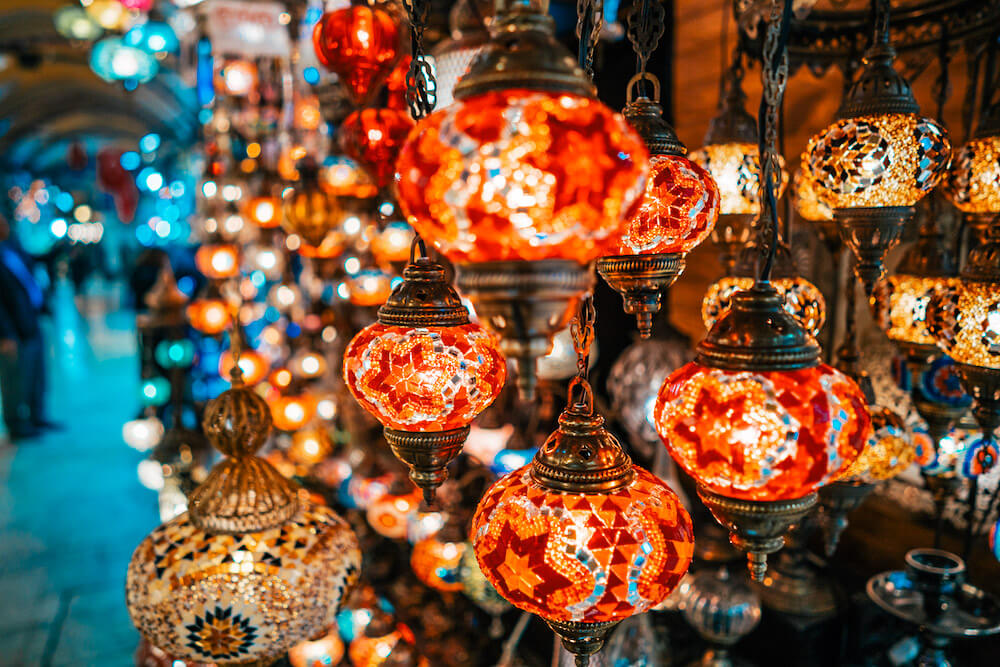
Beautiful mosaic lamps in the Grand Bazaar
Don’t forget to try some turkish delights
Visit a Turkish Bath (Hamam)
You can’t go to Istanbul and not visit a genuine Turkish bath. All modern and fancy spa centers have evolved from these old oriental baths. So, why not visit the original? Give your body a treat and indulge yourself in a soothing environment. It’s one of the most relaxing things to do in Istanbul.
I got such a good scrub from the staff that the sponge was totally destroyed after he was done with me. Say bye to all your dead skins in one of these bathes.
Hygiene was always a big part of old Orient culture, so there are centuries-old but functional baths everywhere. However, some are more popular than others.
Haseki Hürrem Sultan Hamamı, from the 6th century, Galatasaray Hamam from the 15th century, Süleymaniye Hamamı, Kılıç , Ali Paşa Hamamı, Ayasofya Hürrem Sultan Hamamı, all from the 16th century.
All these hamams have impressive architecture. There is no gender mixing, and you can choose between several levels of service. The prices start from $50 and can go up to several hundreds of dollars for the most luxurious service.
Basilica Cistern
The ancient cisterns underground just blows your mind
Basilica Cistern, or Cisterna Basilica, is the largest of hundreds of antique cisterns located beneath Istanbul. It was built during the reign of Byzantine Emperor Justinian in the 6th century. Besides its enormous size (almost 105,000 sq ft), the most distinctive feature is a forest of tall marble columns supporting the ceiling. There are 336 columns in total, each 30 ft high.
The impressive underground space is the filming location for many world-famous movies, and if you visit it, you will understand why. It is one of the eye-opening things to do in Istanbul.
Basilica Cistern is near the Blue Mosque, Hagia Sofia, and Hippodrome, so you won’t have to walk much. However, you can expect to wait in line because this is one of the biggest attractions in Istanbul. You can skip the line if you take a guided tour.
Hippodrome
While the Hippodrome was a center of life in old Constantinople, there isn’t much left of it now. Today it is a city park known as At Meydanı. It is a beautiful park, placed right in the middle of all Old Istanbul attractions. That makes it a great place to relax and catch your breath between all the sightseeing that Istanbul is constantly enticing you to do.
Underneath the Hippodrome park is the Basilica Cistern. You will find Hagia Sofia across the street, Topkapı Palace is just beyond it, and the Istanbul Archeological Museums are only a few meters away from Topkapı.
In the park, you can see a 3500-year-old Egyptian granite Obelisk, remains of the city’s aqueduct system, fascinating old fountains, and monuments.
The park also has a free WiFi network, compliments of the city of Istanbul.
Süleymaniye Mosque
Built during Suleiman the Magnificent reign, it was the largest mosque in Istanbul for almost 500 years – until the Çamlıca Mosque was completed in 2019. However, this is still a landmark of the old city and one of the must-sees in Istanbul.
The mosque complex is designed to let the air through and still protect from the elements, so you will never feel stuffy inside. You will also find mausoleums of Suleyman and his wife here.
The Süleymaniye Mosque is a functioning mosque, so the rules about dress code, shoes, and prayer times also apply here. The entrance to the mosque is free of charge. Süleymaniye Mosque is roughly 20 minutes by foot from Hagia Sofia, but just 5 minutes from Grand Bazaar; you might want to consider that when scheduling things to do in Istanbul.
Bosporus River
Taking a cruise along the Bosphorous River to check out Istanbul
Although it’s termed as a river, Bosphorous is actually a strait and a pretty significant one. It is a busy and lively sea route that connects the Black Sea to the Mediterranean. Cruises and tours make a big part of the traffic there. There is a large selection of companies that provide this service, and the prices start from $30 for short (2.5 hour long) cruises. Longer cruises with several stops, full course meals, and onboard entertainment (national music and dancers) can go up to $60 or $70. If you prefer a smaller crowd, another popular option are to tour the Bosporus on yachts.
Tip: Most of the cruises and tours start at Eminönü docks. Do not go there and try to choose the boat on the spot. There are some dishonest boat operators that will try to overcharge you, promise something, and won’t deliver, or take you on a shorter tour. Check the companies and buy a ticket online because there is a limited number of seats. Istanbul’s official ferry company is Şehir Hatları, it’s a good place to start the search or find options with reviews on tour sites.
Topkapi Palace
Located near Hagia Sofia, it was the court of the Ottoman Empire and home of every Sultan from the 15th to the 19th century. So much history makes it an almost mandatory entry on our things to do in Istanbul list.
There you can see the four Courts, the Harem that once housed over 300 concubines, the Sultan’s Treasury, and so much more. Unlike the European courts, which are mainly in one colossal building, Oriental Courts are a series of interconnected buildings. This enormous complex is simply captivating.
Ticket prices: Topkapi Palace Museum -about $15 Harem and Halberdiers with Tresses Dormitory – about $6.
Tip: This is another popular attraction where you can also get a guided tour to skip the line.
Take your time!
Istanbul is an incredibly exciting city, and it requires more than just a weekend trip to see all that it has to offer. If you are planning a visit, try to make it a longer one. You don’t want to just rush around from one tourist attraction to another without really soaking in the history and the atmosphere.
The Hop-on Hop-off bus is a convenient and comfortable way to travel between attractions and see the city. This can be an efficient option if you want to maximize your time.
You can make a list of things to do in Istanbul to plan your itinerary, but don’t forget to be a little bit adventurous. After all, The Orient was never about planning and precision, but magic and mystery.
Where to Stay in Istanbul
Istanbul is a touristic destination frequented by both backpackers and holiday makers. Similarly, there are a range of accommodations catering to different types of visitors. Here are some popular options to consider.
Hostels in Istanbul
Hostel Le Banc: Known for having an amazing atmosphere and it’s good location, the hostel has simple, modern interior with sturdy wooden beds in the dorms. Each bed is also fitted with curtains for extra privacy.
Archeo: The dorms in Archeo has stairs to access upper deck beds, eliminating the need for clumsy climbing. In addition, the beds are shaped like a capsule giving a really cozy feel. The hostel also has a cafe with character at the lobby. You can easily access the metro and some sites of interest.
Cheers Hostel: If you are looking to stay right in historic center of Istanbul, Cheers hostel is definitely an option to consider. Featuring a bar within the hostel and a cozy, colorful interior, this is a good place to meet other travelers.
Hotels in Istanbul
Glamour Hotel Istanbul Sirkeci: How about breakfast with a view, that is one of the main draws of the Glamour Hotel. Known for their sea view terrace and fulfiling breakfast, this hotel is also in a good location for exploring the Turkish capital.
Dream Bosphorus Hotel: Classic style, clean hotel that is centrally located in the tourist zone. It also has a rooftop terrace overlooking the Bosphorus river.
Catch Hotel Sultanahmet: If you are looking at a more differentiated and homely option, Catch Hotel Sultanahmet is essentially a series of houses from the Ottoman period. You get a cozy and quiet rest place after all a full day of exploration.
Not many cities in the world can compete with Athens when it comes to their history. It was looted, burnt down, and rebuilt many times. If you spend even a day there, you will understand why everyone wanted it. Thanks to that rich history, there are so many things to do in Athens and its wider area.
Times have changed, and visitors today bring much stronger weapons – money, and Athens opens its doors. All jokes aside, it doesn’t matter if you have money or not; Greeks are generally incredibly hospitable people and always ready to help or chat. They will gladly give you some insider tips about what to do in Athens.
And that is what’s impressive about this country. Despite being a hot tourist destination, visitors are not seen as walking dollar bills, but as guests in a country they love so much. And they will make you love it too.
How To Decide What To Do In Athens?
Every visit to cities and regions with this much history creates a big dilemma – what to see? So, the question arises – do we do the usual tourist stuff, or seek adventure and walk the roads less traveled?
Well, you shouldn’t underestimate the “cliched tourist attractions” They became cliched because they are popular. And they became popular because they are interesting and enjoyable.
The Greek capital is a modern city riddled with ancient architecture, so it will become a challenge of its own to choose historical sites in Athens to visit if you have limited time.
Overview of Athens
The Cheapest Way To Visit Historical Sites In Athens
There are many good deals for tourists, in the form of ticket bundles and free days to visit the historical attractions in Athens:
Attraction ticket bundles are cheaper. You can buy a combination ticket that allows you to visit Acropolis, Ancient Agora, Roman Agora, Temple of Olympian Zeus, Hadrian’s Library, Kerameikos, and Aristotle’s Lyceum. If you plan to visit 3 or more of these sites, this is a real money and time saver. The great thing is that you won’t have to wait in lines to buy tickets at every location. Combination tickets can be purchased online or at ticket booths on the sites. Kerameikos is generally the least crowded place, so it’s best to visit it first and buy tickets there if you want to get it on-site.
Also note that ticket prices change according to season so if you are going during the low season, double check prices. There are also reduced prices for certain groups like students which might not be available online, and you have to get it on-site to enjoy the discounted price.
Free admittance days. There are days when you can visit all of the archaeological sites in Athens for free – the first Sunday of each month from November 1 to March 31.
Tip: Since all the historical sites in Athens are open-air, the working hours depend on the sunlight, and they change accordingly. Keep that in mind when planning a visit. The timings are usually as follows but it is always good to double check on any changes.
April 1 until September 30 – 8:00am-8:00pm
October 1 until March 31 – 8:30am-4:00pm
Top Things To Do In Athens, Greece
The Famous Acropolis
Visiting the Acropolis is one of the first things to do in Athens. This iconic landmark is visible from every part of the city. The way it towers over the democracy’s birthplace shows you know why it was chosen for the temple of Greek Goddess Athens.
One of the most famous historical sites in Athens is the Parthenon. However, the other buildings on the Acropolis – the Propylea, the Erectheion, and the Temple of Athena Nike are just as impressive. On the way to the top, you will go by some interesting building. The most famous is the Roman Theater (Odeon of Herodes Atticus), which is still being used for concerts and theater plays.
This is the most popular attraction in Athens, so during peak seasons you might want to purchase the ticket online first for fast track access or get a combination ticketfor several historical sites in Athens.
Free entry days – the first Sunday of each month from November 1 to March 31.
Tips:
If you visit it during spring, summer, or early fall, bring some water, wear light clothes and a hat. The sun can be brutal there, and minimal shade is available.
Go there early in the day. The sun is much more pleasant, and there aren’t many visitors. The real crowds begin to gather around noon.
The walk to the Acropolis can be challenging because it is a large complex, and you are going up on a steep hill, so wear comfortable shoes. There is an elevator on the northwest side of the Acropolis, reserved only for people with walking difficulties.
The ancient theatre that still holds concerts in summers
Soak In Panoramic Views At Mount Lycabettus
One of the first things you will notice when you start admiring the Athens skyline from the Acropolis is Mount Lycabettus. Although it’s the highest point in Athens, it isn’t really comparable to Acropolis. However, the way it stands out from the surrounding buildings makes it an excellent viewpoint to see the city and catch the sunset.
You can get there on foot, but there is a funicular if you don’t want to walk. The price for a return trip is €7, and the starting point is at the junction of Plutarch Street and Aristippou Street. The funicular ticket also gets you a discount at the restaurant on the top of this hill.
The funicular travels through a tunnel to the top, so you won’t really be able to see the view while going up.
Relive History At The Ancient Agora And Temple of Hephaestus
This is one of the most important historical ruins in Athens. Agora translates as “Market,” but it has a much broader meaning. It was a place of commerce, meetings, political and philosophical discussions – it was the center of life in Athens.
Some may be disappointed because most of the complex is not as well preserved as with some of the other historical sites in Athens. However, there are a few buildings in the complex that are preserved or restored to their former glory. The Temple of Hephaestus, Stoa of Attalos, and the Byzantine Church of the Holy Apostles are just some of them.
This is a comparatively new addition to the list of things to do in Athens. Opened in 2009, this impressive museum was built to preserve the priceless historical objects from the Acropolis. It’s not just remarkable from the outside but also filled with exciting discoveries inside.
The fantastic architecture with large open spaces and the glass floor on the first level that reveals ancient ruins underneath will take you to a completely different world.
Tickets cost from €5 to €10, depending on the summer and winter season, but you can visit it for free on March 6, March 25, May 18, October 28, and the first Sunday of each month from November 1 to March 31.
Visit The National Archaeological Museum
This is the most significant archeological museum in Greece, and here you can find one of the finest Greece antiquity collections in the world. For museum nuts, this is one of the best places to visit in Athens.
Ticket prices:
6€ -from November 1 – March 31
12€ – April 1 – October 31
Tip: It is close to the city center -Syntagma Square. In the neighborhood, you can also find other museums: Benaki Museum, Museum of Cycladic Art, Byzantine Museum, War Museum, National Gallery.
Take A Stroll Through The Varvakios Agora
One of the most local things to do in Athens is visiting this market. The Varvakis Agora, AKA Dimotiki Agora, is like Oriental bazaars, with a lot of shops and stalls selling meat, fish, fruit, vegetables, spices… everything that you could ever imagine, and then some.
Greece is a significant food producer, so this is a great chance to buy olives, fruit, fish, and cheeses at the source, all fresh and yummy, and not in a tin can somewhere halfway around the world.
Tips: Avoid wearing expensive or slippery shoes. The floor, especially on the fish market, can be slippery and have puddles.
Also – do not be surprised when you see pieces of meat or even whole animals hanging in front of the stores. It’s just the tradition and adds to the “raw” charm of the market.
Get To Know The Charming Neighborhoods In Athens
Some of the most beautiful area that Athens is known for are the neighborhoods Monastiraki, Anafiotika, and Plaka. These are some of the oldest districts in the city. Best of all, they are conveniently located next to the Acropolis making them super easy to access.
Besides the picturesque architecture and delightful old houses, you will be able to enjoy great food and drinks in many tavernas and coffee shops.
If you are up for some shopping, Monastiraki is also one of the city’s best shopping places. One of the most fun things to do in Athens is a visit to the picturesque Monastiraki Flea Market. Here you can also find all sorts of weird and funky stuff as with many flea markets.
Tip: It’s okay to bargain with the sellers and trying to make them drop the price. In fact, it is kind of expected.
The bustling plaka district
Shopping In Athens
If trendy is more of your jam, then you should check out the Kolonaki district. This is the place to visit in Athens for upscale stuff. It extends from Syntagma Square to the foot of Lycabettus Hill and is famous for its fancy coffee shops, restaurant, and high-end boutiques.
Tip: Winter sales in Greece always start on the second week of January, and summer sales begin in the second week of July. The prices can go up to 80% lower than usual. The downside is that there are large crowds everywhere.
If you don’t want to walk, you can see Athens while comfortably riding in the back seat of a Hop-on Hop-off bus or an electric Tuk Tuk.
The prices are from €12 to €42, depending on the length of the tour.
Relax At Beaches In Athens
If you are visiting in the warmer months, one of the best things to do in Athens is definitely checking out the beaches. The closest beach to the city center of Athens is Edem. Other great beaches in Athens are Sounio, Kape Beach, Dikastika, Vouliagmeni Lake, and Yabanaki. The last one is an entire complex with fun activities, great for families with kids.
Try Greek Traditional food and drinks
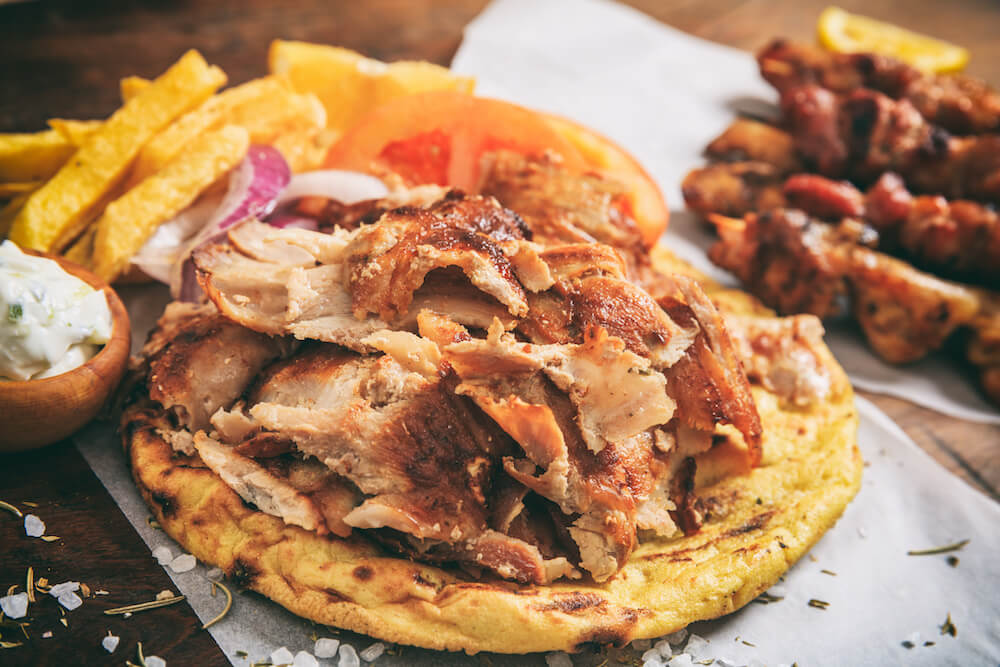
Gyros – Tasty, filling and can be a quick meal
Greek cuisine is internationally famous, so sampling as much Greek food as possible is one thing you must do in Athens! You shouldn’t miss these traditional Greek drinks: Cipro, Uzo, Metaxa, Retsina. Ellinikos (Greek Coffee)
They go great with traditional Greek food: Dolmadakia, Tiropita, Greek Salad (Choriatiki), Gyros, Souvlaki, Saganaki, and so much more.
There are so many tasty foods in Greece that trying to resist them all would be a Sisyphean task. For foodies who not just want to sample, but also learn more about traditional Greek delicacies, you can also consider taking afood tasting tour.
After a wild Athens night out, it is handy to know that Patsas is a great soup for hangovers.
Check out the Changing of the Guards in front of the Parliament
Undoubtedly one of the most popular things to see in Athens. The changing of the guards takes place on Syntagma Square. It is similar to the one in front of Buckingham Palace, London. The stars of the show are the Evzones, an elite military unit. They perform an intricate choreography before replacing their brothers in arms.
Tip: The ceremony is more impressive on Sundays at 11 am – it involves a larger group of soldiers.
Enjoy The Athens Nightlife
Some of you might be wondering what are some fun things to do in Athens at night. There are a few options. You can visit some of the fancy cafes, western-type nightclubs, and international restaurants, or you can go partying Greek style.
If you go to kafenio or taverna, you will be able to taste and feel Greece. Traditional meals and live music will make you want to sing along or even dance the Syrtaki or Zeibekiko with the locals. And they will gladly show you how to dance, so don’t be shy!
If you want something more, you can visit Kentro Diaskedasis, which translates as “Entertainment center,” and the name describes them perfectly – they are tavernas on steroids. They are also known as “bouzoukia.”
These establishments are like exceptionally large restaurants, but with a center stage. The most famous Greek singers perform on those stages, while you eat, drink, and have a “Louloudopolemo” – a flower war. Visitors buy plates with flower petals and throw them at each other or the performer. It’s a Greek tradition.
Some of the best nightlife spots in Athens are Estate Athens, Grammes Live, Iera Odos Club, Gazarte, Votanikos Club
Keep in mind that the biggest Greek stars, even Eurosong contestants, perform there, and the prices can be very high.
How To Get Around Athens?
You can get around Athens by Taxi, Uber, Subway, Buses, or Tram. The city is generally well connected with public transport. It has only three subway lines, but the stations are near bus or tram stops. Public transportation is sufficient for getting you to the main attractions in Athens.
The one-way ticket costs €1,2, and a 5-day ticket is much more worthwhile as it costs €8,2.
Where To Stay In Athens?
As a prominent tourist destination, Athens offers a wide range of accommodation options catering to different travelers and budgets. Here are some well-rated accommodations that are popular among travelers.
Hostels In Athens
Selina Athens Theatrou: Selina is a known brand with branches around the world. It is known usually as a more upscale hostel, often with a nice community team running it. The Athens branch offers a cinema room and a roof top bar with view of the Acropolis.
Bedbox Hostel: Conveniently located in the city center, Bedbox Hostel offers dorms with good level of privacy with curtains on each bed and a huge locker space. Some rooms also feature a private terrace which is great for summer.
Midrange Accommodations In Athens
Rastoni Athens Suites: Practical and well equipped apartments that serves your holiday needs. It is right in the popular Plaka district, placing in one of the best locations to explore the highlights of Athens.
BED in Athens: Despite the not so creative name, this is a popular hotel that have spacious looking rooms with clean and modern design. It also has a good location in the Prisri area, 300m from Monastiraki Square.
Apart from the nightlife venues, don’t forget to just enjoy the city view at night
Luxury Hotels In Athens
Electra Metropolis: The hotel is right in the heart of Athens, and features insane views of the city. Rooftop pool, sun terrace and retro style lounge are just some of the amazing amenities that guests can enjoy. If you are looking to pamper yourself, this is definitely an option to consider.
Acropolis View Deluxe Penthouse & Luxury Apartments: If you are looking for a place with your own amenities, the Acropolis View offers that with comfy, well equipped apartments. Some of them even feature enviable views of the city.
Athens Is Good For All Seasons
Museum tickets in Athens are much cheaper in the low season. Greek winters are also pretty mild and great for taking strolls and visiting attractions in Athens.
I would encourage visiting during the shoulder or less crowded season for a reasonably priced but full experience of Athens. Athens is also an excellent location for escaping winters.
Congratulations! Have you decided to visit the majestic Machu Picchu via the famous Inca Trail? This is definitely one of the most popular thing to do in South America. Sounds like a big adventure; where do you start? I had many questions when booking mine, so here is a guide to help you plan your Inca Trail Hike.
The Inca Trail or Camino Inca is the most popular hike to Machu Picchu.
The first thing to know is that Inca Trail is a protected zone, and you need a government permit to get in. Only 500 people are allowed on the trail each day, including porters and guides.
Since 2001, you are not allowed to hike the Inca Trail by yourself and will have to do this with a licensed tour operator. Here are the items you want to think about to sort out your Inca Trail trip.
When is the best time tohike the Inca Trail?
The Inca Trail is extremely popular, and permits are sold out almost every year. This is an activity that you want to plan early for.
April – September is the dry season, when rainfall is low. This is seen as a better time to visit as the weather is better. Therefore, you can expect a more massive crowd during this period.
November – February is the wet season. There is higher rainfall, so you want to be well prepared for wet weather during this time. Tickets for this period might be easier to get within a shorter time frame.
March and October are the bridging seasons, and the trail closes in February each year for maintenance.
If you want to go during the peak period, you have to book way in advance. I had to book five months in advance (in May) to get a slot at the end of Oct.
As such, it is essential to first decide when do you want to go. I usually try to avoid peak season whenever I travel. However, weather conditions can affect your whole experience when it comes to outdoor activities (as I found out when I did O’trek near the end season).
It is also important to note that permits are released by the government to licensed operators each year (usually in January but might vary). While you can prebook your slot with an operator before the permits are released, they cannot guarantee it until they actually get them. It will be wise to hold back on booking your flights, etc. until after the permit is secured.
Now, some of you late planners might realize that permits are all sold out for the period you are planning for. But hey, maybe now you can prepare early for next season and get better slots. Alternatively, the other popular trail that doesn’t require such advanced booking is the Salkantay trek.
Once you have decided on the period, here are some questions you want to think about.
This bridge marks the start of the Inca Trail
Donkeys carrying goods to vendors along the way
How many days do you intend to hike?
The classic Inca Trail hike is 4D3N, but there is also a 5D4N option. The 5D4N Inca Trail route is the same but done in shorter segments with an additional day to make it easier. There is also a 2-day version that starts further up the classic route and a 7-day option that combines the Salkantay trek.
How difficult is the Inca Trail?
This depends on your physical fitness and how your body adapts to the altitude. I did the classic 4D3N with a porter and personally did not find the hike too challenging. However, I was also the fastest hiker in my group of 8, and some did struggle with the altitude. Everyone from the group managed to complete it, but we did see people from other groups having to turn back during the hike.
Do you need a porter?
A porter is a local who will help you carry the bulk of your items from one campsite to another. These are super impressive humans that defy the law of physics. Ok I am exaggerating, but these porters trek at an incredible pace while having a huge load on their back. They also handle your meals and campsite preparations, you have got to take your hats off them. Most of them have plied their trade on the mountain paths since a young age.
If you engage a porter, you will only have to carry a day pack each day with whatever you need during the hike. The porter team will carry the rest of the items such as your tent, sleeping bag, etc. to the next campsite.
Porters will add on to the tour cost. Some agencies will offer the basic package with porter services as an option, while others only offer packages with porters included. This might affect your choice of an agency if you are looking to save on the porter cost.
Where do you want to get picked up from?
What are your plans before the trek? Do you need to get picked up from a specific town on the day of the trek? Most people start from Cusco and Ollantaytambo, and these common areas will not be a problem. You should check with the agency if you want to get picked up from some other towns.
Porters treking with load – These guys are impressive
The Green Machine – Porters from Alpaca Expeditions
Do you need to rent camping gear?
Will you bring your camping gear, or do you intend to rent some stuff. Some agencies will already include all the camping gear in the package while others don’t. If it’s not included, they usually offer the option of renting.
Typical extra gears that you will need to consider will be
– Sleeping Bag
– Sleeping Mat/Air foam
– Trekking Poles
If you plan on using your own sleeping bag, make sure it is sufficient to handle the temperature on the mountain.
I highly recommend trekking poles for the Inca Trail, because Day 2 and 3 involves a lot of steep stairs downwards. The trekking poles will help to lessen the impact on your knees. I never got around buying my own trekking poles despite using them quite extensively through Patagonia. Never thought I would hike as much I did, so I always rented or borrowed them. That said, I found these Black Diamond ones from my travel buddy to be strong and sturdy, particularly with the rubber grip.
Do you want to take the Vistadome train?
The PeruRail Vistadome train is a more luxurious way of getting back to Cusco from Machu Picchu. It is a comfortable train with large windows on the sides and ceiling, so you get a so-called “panoramic view” of surrounding nature.
To be fair, it is not exactly panoramic, it still feels like you are on a train. However, you get to enjoy the Andean nature from the large windows for a good few hours before it gets dark. It is also just an extremely comfortable way to get back after a multi-day hike, especially since the last day starts really early.
If you want to take the train, make sure to check if the agency offers it as part of the package or an added option. Some operators send the group back by bus.
Do you want to do Huayna Picchu or Machu Picchu Mountain after Inca Trail?
These are two mountains surrounding Machu Picchu, offering a great view of the ruins. Most Inca Trails operators will offer the permits to these treks as well.
Huayna Picchu is a shorter hike, thus it is more popular and sells out faster. The hike is usually done on the same day as the end of your Inca Trails hike. From the top of Huayna Picchu, you can get a top-down view of Manchu Picchu. Do note that hiking this mountain will eat into the time you can spend in the ruins of Manchu Picchu.
Manchu Picchu mountain is a longer hike. Some operators offer it on the same day, while others will only book it for the day after your Inca Trail hike. Depending on your plans, you want to find the one that is suitable for you if you plan to do this hike.
Beautiful Scenery Along the Inca Trail
Other things to consider
Different operators offer slightly different services. Some will set up private toilet tents while others will use shared toilets etc. I’m sure each one of us has different priorities on various items. You should read up some reviews on the agencies to find out what suits your preference.
Apart from safety and security, one of my biggest concerns in this area was the mistreatment of porters.
I wanted to make sure the agency I go with does their best to treat their porters well. There is one obvious difference you can notice on the Inca Trail between porters from different agencies. Some porters are hiking with proper trekking shoes, while others have to hike in worn-out slippers.
I ended up going with Alpaca Expeditions and had a really memorable experience. The founder started as a porter himself at the age of 18, and today, he has built a company with a strong porters team aptly called The Green Machine! The company runs a bunch of social initiatives not just on porters’ welfare but also empowering women and children.
One of the porters had a pain in one side of the knee halfway through the trek, and our guide immediately gave his trekking poles to him instead. The whole team felt like a family, and I had the chance to just hang around with them whenever I arrived at camp early. Our guide, Robinson, also provided a lot more interesting knowledge along the way whilst many groups focused solely on hiking.
A couple of other operators with good reviews are Llama Path and Peru Treks. For an international company, G Adventure is a popular choice.
Great views all round of mountains and lakes
Feel like you are above the clouds
Information about the Inca Trail
Here are questions you might have about the Trail, and this is my experience with Alpaca Expeditions. Things might vary a bit, depending on the operator you choose to go with.
How long is the Inca Trail Hike?
The total distance of the Classic Inca Trail hike to Machu Picchu will be around 26miles or 40km. This will span across 4 or 5 days, depending on which tour duration you pick.
For the 4D3N hike, here is a brief breakdown of the 4 days with Alpaca Expeditions:
DAY 1
Distance: 8.7 miles/14 km (6-7 hours) Campsite Altitude: 3300 meters (high) above sea level Difficulty: Moderate day Weather: Warm and windy
DAY 2
Walking distance: 9.94 miles/16 km (7-8 hours) Campsite altitude: 3600 meters (high) above sea level (chilly weather) Considered: Top day (Two highest passes) Area: Andes and Cloud Forest Weather: Cold and rainy
DAY 3
Walking distance: 6.2 miles/10km (5 hours) Campsite altitude: 2.600 meters (high) above sea level (chilly weather) Considered: Easy day – all downhill! Area: High Cloud Forest Weather: Warm and very humid
DAY 4
Considered: The most exciting and magical day (early wake up 3.30 AM) Area: High Cloud and Subtropical Forest Weather: Hot and very humid (bring lots of water)
Inca Trail path: Pushing through the Dead Women’s Pass
Many teasers along the way before getting to Manchu Picchu
Accommodation on Inca Trail
The multi-day hike to Machu Picchu will involve camping in 2-man tents. If you are alone, there is a good chance you will be paired with another traveler in the group. I got lucky due to some shuffles and had a tent to myself.
Are there toilets and showers on the Inca Trail?
We used portable toilets most of the time. It will either be shared by everyone or a private one just used within the group.
We had a private toilet tent, and it was always decently clean. There are some toilets set up by locals along the way, and they will likely be squad toilets.
On the last day, after all the camps are packed up, everyone will be using the toilets near the gate while waiting for the route to open. Those toilets will become very nasty; most people are not proficient with using squad toilets, so you might want to finish your bathroom business early.
There is the option of taking a cold shower at 1 or 2 of the campsites. None of us actually took a shower as the water is really cold. You can bring a quick dry towel and wipe yourself down, it should keep you refreshed and comfy.
Food and water on the Inca Trail
We had sumptuous meals along the way. The porter team prepares a great spread of 4-5 local dishes that keeps us ready to keep hiking! They even managed to bake a cake on the last day with the tools they brought along. Food is going to vary a bit depending on which operator you go with.
The porter team boil water early at every meal stop and cool them down so we can refill our bottles before we set off. Remember to bring a bottle to refill. I recommend carrying between 1-2 liters of water for each leg of the trek.
Sumptuous food on the Inca Trail
Camping gears packed up every morning
Inca Trail Packing List
For the Inca Trail, you want to pack for both warm and cold weather. If the weather is good, you will want to wear something cooling during the hike. However, it gets chilly at night, so you need something warm at camp.
I rented all the camping gear (sleeping bag, mat, and trekking poles); the tent comes included in the package. Here are some things I packed or would recommend packing after going for the hike.
I’m not big on brands for most things (unless specifically mentioned) as I get most items wherever on my travels whenever I need them.
Hiking Shoes (I used the Salomon X Ultra 3) You should consider using a pair with waterproofing treatment like Gore-tex if you are going during the wet season
4 t-shirts, ideally dri-fit and good for sports use
1 pair of hiking pants. I like convertibles are they are versatile for different kind of hikes and you can adjust easily based on the temperature.
4 sets of undergarments. The Uniqlo Airism ones are great, I am a big fan of quick dry stuff.
4 pairs of socks. Make sure you use at least sports quality socks, so they are thick enough. You might also want to bring extra pairs to cater for wet weather
I use my packing cubes to separate between items and clothes (clean/dry)
Plan for Acclimatization
If you have never hiked at high altitude, note that this will be an impacting factor. It is best to give yourself 1-2 days minimum to get used to the altitude before engaging in intense physical activities.
Altitude sickness affects people differently, and it is not related to just physical fitness. Even if you are physically fit, plan to factor in time for acclimatization. There are lots of stuff to do in Cusco to fill your time anyway!
If you are traveling down from the North like I did, Huaraz is an excellent spot to acclimatize and build up fitness. Here are some great trips and treks in Huaraz.
Fun fact: I always thought that altitude sickness only happens when going from a low altitude to a high altitude location. The guide told me that they also have problems when going to low-altitude places like Lima because they hang out so much at high altitude. Who would have thought!?
Mid way through the highest pass
Getting Cash in Cusco
Due to the poor payment infrastructure in Peru, there is likely to be an extra percentage fee when paying for the tour with credit cards or Paypal. Therefore, you probably want to use cash payment for your Inca Trail booking.
It’s all good if you are coming directly from home, just remember to bring enough cash for the payment.
However, if you are a long term traveler coming from somewhere else, you probably don’t have enough cash on hand and plan to withdraw the money in Peru. If so, note that there is a chance that your card might have a combination of these disadvantages:
Low cash withdrawal limit per single withdrawal enforced by Peruvian Bank
Withdrawal charge from your home bank
Withdrawal charge from Peruvian Bank
This means you will incur a lot of fees from having to withdraw a gazillion times through the ATM. In which case, you want to check out the BCP Bank next to Plaza de Armas (the main square). There is a service counter where you can withdraw a large amount of cash at one go, potentially saving on a portion of withdrawal fees.
Depending on your currency, home bank/card policy, withdrawal limit, etc, every person’s case is different. You will need to figure that part out to see if it is worth the savings.
Buenos Aires is one of the most populous cities in Latin America. As the largest city in Argentina, it comes as no surprise that there are many things to do in Buenos Aires, even within the main central area.
When planning for places to visit and things to do in Buenos Aires, you can divide the touristic areas into a few neighborhoods. Each district has something different to offer.
Here are some of the best things to do in Buenos Aires, Argentina.
Palermo
Palermo is one of the busiest areas visited by tourists as this is where all the action is. That is why you can find a selection of hostels in this area. From charming cafes and international food scene to a vibrant nightlife, this is where you get it all.
Apart from just walking around the district, there are a few places that you should visit in his area to get in touch with nature.
Jardín Botánico
The Botanic garden lies along the main street of Santa Fe. It is not particularly big, but it is an excellent place to relax under the shade. It is not only regularly visited by tourists but locals as well. The entry is free.
Ecoparque BA
Ecoparque BA is right next to the Botanic gardens. It used to be the zoo but is now more of an open park where you can see animals roaming around. Entry is also free here! You will find families bringing their kids around. The park makes for an enjoyable walk with interesting sights.
You can find animals roaming freely at Ecoparque
Beautiful roses at Jardin Rosadel
Bosques de Palermo y Jardin Rosedal
Bosques de Palermo is commonly known as the Palermo forest. It isn’t a “forest” but a huge park spanning across four big quadrants. With scenic lakes and lovely greenery, it is no wonder that many people come here to exercise or hang out on the greens.
Inside this park, you will find Paseo El Rosedal. This charming rose garden pecked with colorful roses is surrounded by Pergola Lake. If you go further in (away from Palermo), you will also find museums and the planetarium.
Right next to the area of Paseo El Rosedal is another famous nightlife zone. This stretch of clubs, bars, and restaurants is built under a train track, so it is a cool place to check out.
Bosques de Palermo is an open park, so there are no opening/closing hours, but the rose garden, museums, etc. have their operating hours.
Jardín Japonés
The Japanese Garden is where you can find a park imbued with the Japanese culture. Here you find floras from Japan, a nice collection of Bonsais and crafts from the Japanese culture. You need to purchase a ticket to enter the garden.
Visit the Hippodrome
Next to the Bosque de Palermo, you find the Palermo Hippodrome. The Hippodrome boasts quite an impressive architecture and is a great place to catch horse races. Grandstand tickets are not expensive, so check it out if you happen to around during a race day. The Argentine Polo Association is right opposite the Hippodrome, and you can catch polo matches here.
Puerto Madero
Puerto Madero is the “old-made-super-modern” area in Buenos Aires. What used to be an abandoned port area is now the grounds for skyscrapers and high-end clubs/restaurants. The waterfront is always a relaxing area for walks without having to worry about bumps on the pavement. The bridge and ship museums also set a lovely backdrop for a photo.
However, what’s best in this modern, revamped district is its nature! (So weird, from a port to a modern high rise district to nature? Yes, welcome to Argentina)
Reserva Ecológica Costanera Sur
Although Buenos Aires has many great parks and gardens, the Costanera Sur Ecological Reserve is a welcomed addition to the bustling city. Visiting this biodiverse paradise with different flora and fauna is one of the top things to do in Buenos Aires.
At the edge of the park, you can see a contrasting sight – the tall office buildings in Puerto Madero, peeking out through the greenery and croaks of toads. Despite being located next to the business district, going into the reserve teleports you into a different natural space.
The reserve is ideal for casual walks, exercising, or biking. Bring along some food and drinks for a picnic. At the coastal end of the reserve, you can relax on the grass and stare blankly into the vastness of the Rio de la Plata river. There are also toilets located there and at the reserve entrance.
Puerto Madero in the evening
Biodiverse green space – Reserva Ecológica Costanera Sur
La Boca
Catch a Boca Juniors Game
La Boca is home to the Bombonera stadium and the famous Boca Juniors Football Team. This is also the boyhood club of Diego Maradona, a football legend worshipped by Argentines. It comes as no surprise that Boca Juniors has some of the most passionate fans.
Rumor has it that you can feel the earth shake when the fans cheer. For football fans, catching a Boca Juniors game is one of the best things to do in Buenos Aires. However, it is not easy to get a game ticket on your own. The most straightforward way to do this through agencies like Landingpadba.
If you can’t or don’t want to catch a game, you can take a stadium tour or walk around the museum. That said, unless you want to soak in the atmosphere, you probably want to avoid the neighborhood during game days as the area can get crowded.
Usina del Arte
The cultural centers in Buenos Aires have always appealed to me. While this is not as big as the one in Recoleta, it comes with a super cool fact. The building of Usina del Arte used to be a power plant that was built in 1916. It was only repurposed into a cultural center in 2012. You can find some events and exhibitions here as well. If you are around the area, I encourage you to drop by.
Caminito
Caminito is the famed, colorful street in La Boca. It is, however, kind of made for tourists, like a street museum. Nonetheless, it is still worth a visit as you can see street musicians, shop in the artisanal markets, and see old buildings made of metal plating.
Look out for the colorful cobbled street by the river. In the area right in front of the colorful Teatro de la Ribera, you can often observe local artists deep in their painting works.
Artist painting a masterpiece by the river
Argentine legends and colorful facades
Centro and San Telmo
Obelisk
This iconic Obelisk sits in the middle of Av. 9 de Julio, one of the world’s widest avenues. If you have seen photos of Buenos Aires before, you probably have seen this Obelisk. There are many stories and debates regarding such a striking structure in the middle of the city. I will leave it to you to find out.
The Obelisk today also serves as a rallying point for protests and celebrations. Whenever there are national events, be it victories or country-wide demonstrations, you can be sure that there is a crowd at the Obelisk.
Catch a play in Teatro Colon
Located in front of Plaza Lavalle, the Colon Theatre is touted to be one of the world’s best opera houses. It is renowned for its exceptional acoustics as well as impressive architecture. The theatre is compared on the same level as La Scala of Milan, the Vienna State Opera, the Paris Opera, the Metropolitan of New York, and London’s Covent Garden.
It will be ideal to catch a show there to get the full experience. Alternatively, there is a guided tour to check out the place.
The theatre sometimes also open free events/plays for the public. You can collect the tickets in advance (usually limited to 2 per pax). Note that the circumstances may not always be at Teatro Colon. To stay updated on this, follow their Facebook page.
Visit Café Tortoni
Café Tortoni is the very first café in Buenos Aires, opened in 1858. It was a popular venue for politicians, writers, and musicians in the past. The classical interior is exquisite and worth visiting for a nice afternoon tea. You will usually see a line outside the café. Alternatively, the café also has evening tango shows where you can buy the ticket in advance.
Casa Rosada
Casa Rosada, located in Plaza de Mayo, is the presidential building. The pink building is strikingly prominent, even in the main square. Admission is free, but you need to make the reservation in advance here. There is also an English tour at specific times, so look out for that when booking.
There is a changing of the guards at Casa Rosada every 2 hours between 7am to 9pm.
Changing of Guards at Casa Rosada
Cafe Tortini, one of the first cafes in Buenos Aires
San Telmo Weekend Fair
Casa Rosada and Plaza de Mayo is the start/endpoint of the weekend street fair in San Telmo. As such, I would recommend visiting on the weekend if you want to lump these activities together.
The San Telmo street fair stretches down Defensa Street, all the way to the area around Plaza Dorrego. Here you can find lots of artisanal crafts, clothes, fancy dingy stuff, and food, etc., just like your typical street fair. There will also be talented street artists that adds on to the fun vibe. Tip: If you want to get a mate for a souvenir, there is a wide selection in the fair.
San Telmo Market
As you walk down the street fair, you will also pass by the San Telmo market. This market is operating every day, but the crowd really comes on during the weekends. You can find crafts, antiques, and lots of food here. Take your pick from street style snacks to satisfying meals. There are also options for international cuisine. I recommend trying out the empanada place, as you probably would, after seeing the crowd surrounding it.
Get a view of the city from Palace Barolo or Galeria Güemes
There are a couple of places within the city center area where you can get a good overview of the cityscape.
Palacio Barolo
Palacio Barolo is an office building famously designed by an Italian architect, Mario Palanti. The top of the building has a light that can be used to communicate with another similar looking twin building (Palacio Salvo) in Montevideo, Uruguay.
You can hear more stories about the architecture design and history of the place through the guided tour. The tour brings you to the top, where you can get a panoramic view of the city.
Galeria Güemes
Galeria Güemes is a shopping arcade that has preserves its European architecture from the 1900s. It is interesting to visit and look around the interior. There is a viewpoint on the 14th floor that also offers a view of the city. This viewpoint is smaller than the one at Palacio Barolo, but the entry ticket is much cheaper.
Access to the viewpoint only on Mondays-Fridays between 9 am -12 pm and 3 pm-5:30 pm.
Recoleta
Recoleta Cemetery
This is one of the most touristic Cemeteries in the sense that most of the visitors are tourists. If you are going in for a look around, this cemetery has many impressive graves and mausoleums decorated in different styles. More than 90 tombs in the Cemetery are listed as national historical monuments.
If you are keen to hear more stories about the cemetery and specific tombs, there are free guided tours in Spanish.
Tue-Fri: 11 am and 2 pm
Sat, Sun, Public Holiday: 11 am and 3 pm
(Timings might change, so always good to double-check)
If you don’t speak Spanish, there is the option of joining an English guided tour.
Recoleta Cemetery
Centro Cultural Recoleta
The Recoleta Cultural Center is right next to the Cemetery. The entrance façade is always painted with artistic murals. The cultural center is huge and a symbol of youth and vibrance. There are always exhibitions or activities going on and various interesting zones to check out. Locals go there to hang out, work, study, chill, all sorts of stuff.
During the weekends, this is a very lively place. There is a street fair, and groups of friends and families gather at the surrounding green spaces.
Floralis Genérica
Floralis Generica is an iconic metal sculpture located in the Plaza de las Naciones Unidas. Standing tall at 20m, the structure has six steel petals that open up every morning at 8 am to resemble a flower. The motion is all powered by hydraulics and photoelectric sensors.
The park itself is another beautiful space to hang out and usually crowded during the weekend.
El Ateneo Grand Splendid bookstore
Bookworms are in for a treat at the Grand Splendid bookstore. This has to be one of the top things to do in Buenos Aires. The Grand Splendid theatre first opened in 1919 and was the venue for many cultural events and plays. In 2000, the government repurposed this theatre into a majestic bookstore. Today, you can still see most of the preserved layout and decoration, so it looks impressive. The bookstore has nice seating and is great for relaxing and browsing through books.
Here is a video of the store interior, but nothing beats the real thing.
MALBA
The Museum of Latin American Art of Buenos Aires is a popular museum amongst visitors. The museum houses a collection of modern and contemporary artworks. There is a permanent exhibition featuring 400 art pieces from 160 artists and a temporary exhibition that rotates every few months.
Belgrano
Barrio Chino
Barrio Chino is the Chinatown in Buenos Aires. In this area, you can find Asian ingredients and spices that are not readily available elsewhere in the city. These commonly include products from China, Korea, and Japan. There are also a handful of restaurants here run by Chinese immigrants, where you can satisfy your Chinese food cravings.
Museo River Plate
If you are a fan of football, you probably know that Boca Junior’s bitter rival is River Plate. River Plate’s home ground, El Monumental de Nuñez is the largest stadium in Argentina. You can find the stadium in the Belgrano area. There is an option of visiting the stadium and museum.
If you are keen on visiting both La Bombonera and El Monumental de Nuñez, and really want to save all hassle; there is a tour that covers both stadiums and their surrounding area including transportation.
Find all sorts of Asian stuff at Barrio Chino
Home of River Plate Football Club
Do not miss these!
These are not just some of best traditional things to do in Buenos Aires, but in Argentina. I have included some recommended in Buenos Aires.
Learn/Watch Tango at a Milonga:
Argentina is the birthplace of Tango, so there is no better place to experience this elegant dance. Sometimes you can stumble upon a group dancing in open spaces or plazas, particularly on weekends.
In Buenos Aires, there is a milonga at Plaza Dorrego (San Telmo) on Sunday nights that is quite popular. Similarly, you can head to La Glorieta in Belgrano on weekends to see people dance as well.
There are also many indoor places where you can learn or watch people dance. La Virtua Tango in Palermo is quite welcoming for foreigners if you are looking to try it out. The instructors are mindful of non-Spanish speakers, and there are groups for different levels. You can buy a single entry ticket and experience it.
Try Asado/Parrilla:
Asado or Parrilla is essentially grilled meat. Asado is not just food but a culture in Argentina. In Buenos Aires, there are a few famous steakhouses that you can visit. These include La Cabrera (they have a happy hour timeslot with great discount) and Don Julio, both located in Palermo. You can learn more here, along with other local delicacies that you should try in Argentina.
A few of us also did an Asado workshop with a local chef. It is an interesting hands-on experience that brings you through the food preparation (meats and sauces), the grill setup and also the grilling. You get to eat the food that you cook and dry age beef as well. The chef will handle the dry age beef, since we don’t want to screw that precious gem up. Apart from tasting 3 different local wines, there is also a free flow of coffee and beer.
Buenos Aires is a modern city with more European influence than most South American cities. The capital city has much to offer to travelers in terms of sights, culture, and gastronomy. With the decreasing value of Argentine pesos, Buenos Aires has also grown to become an attractive digital nomad hub in recent years.
This vibrant city is hands down one of my favorite cities in South America. Here is a comprehensive nomad travel guide to plan your visit to Buenos Aires, Argentina. General travel information are all at the top and more digital nomad specified information are at the back of the article.
Cost
The cost of living in Argentina used to be on a comparable scale with the United States. It is still more expensive than other South American countries like Colombia and Bolivia. However, with the consistent fall of the pesos, the cost for visitors has dropped significantly.
Some imported items continue to be costly or hard to find, but most daily necessities are very affordable. If you follow the rule of buy and try local, you can travel and live comfortably here.
Travel budgets vary according to each individual’s travel style; an average monthly budget of $1000 – $2000 is sufficient. You can get a rough idea of cost of items here.
Things to Know About Money
Argentine Pesos
Blue Rate
There are two rates on the market: the official rate and the blue rate. The rates can have a big difference, and you want to try to get your money at the blue rate as much as possible. If your home currency is USD, you are definitely affected by this. For other currencies, check Google for the official rate and Western Union (for a rough gauge of the blue rate).
When using an international debit/credit card for payment, there is a high chance you will get the official rate. In my experience, even cards from new fintech companies like Revolut will give a rate that is closer to the official rate.
Furthermore, some merchants offer discounts for cash payments as they prefer cash since the peso fluctuates quickly. Some merchants don’t take card payments, so it is still best to have cash on hand.
So then comes the question…
How does one get cash?
For travelers, avoid ATMs as much as possible because there is usually a low withdrawal limit and a withdrawal fee charged by the local bank (+ any additional fee your home bank might charge you). And you are likely to get the official rate. Use this only in case of an emergency.
Common ways to get cash:
Azimo: Azimo is currently only available for users in certain European countries. Like other money transfer services, you can basically send money to yourself (pay in home currency, converted to Argentine pesos and sent) and pick it up from select merchants and retail stores. This is a common channel used by some expats and nomads.
Western Union: Western Union is an international money wiring service that most of us should be familiar with, or at least heard of. In general, Western Union provides a good exchange rate. You can check the rate on the website before you transfer. After you make the transfer, simply head to one of the branches or authorized agents to collect the cash.
Depending on your country and the method of funding the transfer, there may be a fee for the transfer.
Note that some branches can run out of cash. If you are withdrawing a large amount, you might want to break it down into multiple smaller withdrawals or go for bigger official branches (over small authorized agents).
Recoleta, Buenos Aires
Money Changers: You can check the rates at money changers. They are usually not superb, but this is better than ATMs.
You will sometimes also find some random dude on the street doing money exchange. The rates are usually slightly better than your licensed money changers. I am not going to advise for or against doing it. Exchanging money with a random dude on the street comes with its own risks of getting scammed and all. Some people have advised against it, some people have done it. It is up to your own discretion.
Most expats using money exchange as their method of acquiring cash will have their go-to person. Head to the BA expat group and see if you can get any recommendations.
Most Argentines are also looking to exchange their pesos for USD because the peso is too volatile to be kept as savings. However, there is a limit in Argentine for the amount of USD a typical local can buy per month (it’s $200 the last I checked). As such, your landlord might be interested in exchanging his/her pesos to USD as well.
That said, you want to avoid withdrawing too much money at once because the peso is devaluating rather quickly. Withdraw cash in shorter periods based on your expenses.
Is Buenos Aires safe?
Buenos Aires is one of the safest cities in South America. You still have to take common-sense precautions, but I feel safer here than in some other South American cities. There are definitely dodgy areas that you should avoid, but these are not in the usual touristic zones.
A few districts that travelers will likely visit and might hear people warning to take more caution at night will be San Telmo, La Boca, Retiro (where the main intercity bus terminal is). However, things can happen anywhere, even in the so-called “safer” districts. Just stay cautious and take the usual precautions.
Where to stay in Buenos Aires?
Popular neighborhoods for travelers are Palermo, Recoleta, El Centro, Villa Crespo, Las Canitas Belgrano, and San Telmo.
Palermo and San Telmo are common choices for travelers.
Palermo is the hip District where you find a bulk of the cafes, bars, restaurants, and clubs. Nightlife here is also bustling. This is the place to be if you want to be in the center of the action.
One of the biggest reasons for choosing San Telmo is the cost. Accommodation costs in this area are generally cheaper, and San Telmo itself has some must-visit attractions as well. People staying here also claim that you get a more local vibe compared to other touristic districts.
Recoleta is a more upscale neighborhood, where you find the stores of some luxury brands here. This area gives you easy access to some of the best parks and attractions in Buenos Aires.
El Centro is the city center of Buenos Aires that spans across several neighborhoods. It is busy during working hours as that is where the government buildings, offices, and shopping areas are. It gets quieter during the night and weekends. There are many attractions in this area as well.
Villa Crespo, Las Canitas are areas near Palermo and Belgrano, respectively. They are cheaper in accommodation costs compared to Palermo and still very well equipped with daily necessities. Belgrano is another family-oriented area. You get easy access to Barrio Chino where you find all your Asian ingredients, and the Belgrano C station is where you catch a train to Tigre. For nomads staying for an extended period, these neighborhoods are good options.
Friends and families relaxing at green spaces all around Buenos Aires
Finding Accommodation
Airbnb is a good option if you are looking for accommodation before you are in Buenos Aires. For tourists, this is one of the best platforms without dabbling in too much admin stuff.
For long-term stays, the price is likely not as good because Airbnb prices are targeted at “gringos” (tourists and foreigners). However, it is safer to book through Airbnb simply for the added protection in case things don’t turn out as expected. You can then negotiate an extended contract with the host directly after that if you wish to stay longer.
Alternatively, you can go on Facebook groups to find longer-term rentals once you are in the city. I do not recommend doing long term rentals without seeing the place beforehand.
Here are a few great Airbnb options I’ve stayed in:
Private Room in Alto Palermo:The apartment is in a great location near 2 main streets and metro line D. The room is not big but sufficient for one, and you can use the common area freely. Great price for a single traveler, since it is not easy to find rooms just for 1 anymore these days. Ana and Juan are really helpful and friendly.
Apartment in Palermo:The apartment is located next to Distrito Arcos – an open outlet shopping mall. This place is also at the edge of Palermo Soho and Hollywood, so you get easy access to both areas. Felipe stays nearby and is available to help with anything. The apartment faces the street and gets good sunlight, so it is fantastic for the morning person.
Apartment in Alto Palermo:The apartment is near the main street splitting Palermo Soho and Alto Palermo. The apartment faces the back of the building, so it is quiet. It is suited for relaxing at night. There is a comfy hammock chair in the patio. The host doesn’t stay nearby, but the building manager lives on the top floor and is very helpful.
Apartment in Villa Crespo:This is the most well-equipped apartment I’ve stayed in Buenos Aires. Located just behind the main street, you get easy access to basic necessities like supermarts, bakeries, groceries etc. It is also near metro line B and an outlet store shopping area. Palermo is a 10 minutes walk away.
Note that this apartment is on the ground floor so it can get noisy. The host, Cristian stays nearby and is very responsive to any questions. He also has other apartments in the same building and across the street from this one.
Hotels and hostels can be considered for short term visits and budget travelers. You can also use them as a temporary base as you scout for a long term accommodation. Here are some nice options.
Selina Palermo: Selina has expanded quickly across Latin America, and they are like a more luxurious form of a hostel. Selina is a popular choice among nomads for staying or hanging out. The one in Buenos Aires is located in a great location in Palermo. It has a comfy ground floor café and rooftop bar.
Infinito Eco Hotel: Infinito is a minimalistic design hotel in Palermo. The best thing about this place is that it has a jacuzzi and sauna, as well as a terrace to chill.
Art Factory Soho: Classy looking black exterior with clean design interior. Great for fans of minimalist design. Located in a convenient location in Palermo.
Viajero Buenos Aires Hostel: If you have traveled around South America, you might have heard of Viajero. They have hostels in various cities in Colombia, Argentina and Uruguay. Viajero Buenos Aires is a great budget option that comes with not 1 but 2 pools in the hostel. They are in the San Telmo neighbourhood.
America del Sur Hostel: Another nice budget option with social vibes in San Telmo. America del Sur also has another popular branch in El Calafate.
Lively weekend crowd at the Recoleta Cultural Center
Casa Rosada at Plaza de Mayo
Leisure and Culture
There are no short of places to visit in Buenos Aires when it comes to leisure and cultural activities. Buenos Aires has a few prominent districts worth visiting, each with their own unique neighborhood vibes.
The city is filled with parks where you can hang out or exercise. It is a very vibrant city with energetic vibes. It is not surprising to see multiple exercise boot camps /groups in the parks in the evenings and weekends. You can also easily find gyms and classes such as Crossfit or Yoga around the city.
For great nightlife, you can get easy access to some great nightlife in Palermo or around the Bosque de Palermo.
For cultural events, check out theatre colon and the cultural centers’ websites. Theatre Colon also sometimes give out free tickets for weekend shows (usually limited to 2/pax). You can collect the ticket beforehand at the booth.
There is a tremendous amount of things to do in Buenos Aires that it warrants a separate article. Here you can find some of the best things to do in Buenos Aires.
Food in Buenos Aires
Buenos Aires has a very international food scene. Apart from cuisines from around Latin America, you can also get international cuisines worldwide. Asian, European, and Middle Eastern food are easy to find.
Local Argentina cuisine has a mix of European and Latin American flavors. Argentina has some really awesome local stuff, and here are 10 must-try local food and drinks to try when you are in Argentina. If you are a big fan of ice cream, you are in luck! Buenos Aires has many ice cream parlors, and here are some heladerías to try.
Metro in Buenos Aires
Mate – The national drink of Argentina
Transportation
I generally like cities with a metro/subway system because they are much easier to figure out than buses. Buenos Aires has an excellent metro system that is also very affordable. The metro will already be able to take you to most of the attractions, either directly or within reasonable walking distance.
The transportation card in Buenos Aires is called SUBE. It is convenient to get a SUBE card for transport. You can recharge at any metro station or street kiosks.
There is also a bus system that is more comprehensive in coverage, but I have never gotten around using it. This is because Uber and other taxi apps, like Cabify are also available in the city. The cost is cheap enough to make it worthwhile for the time savings. So anywhere that I can’t reach by metro, I usually just go by Uber.
Uber is still not fully legal, so you might find that the driver asks you to sit in the front if you are alone. This is so you appear more like a friend than a passenger.
Getting to town from Airport
International arrivals usually come through the main Ezeiza Airport (EZE). The Airport is located 32km from the city. There are a few options to get from the airport to the city.
Taxi and Uber
The most comfortable way is to order a car/taxi from the Airport. You can make the order at the booths in the Airport. Taxiezeiza have been known to provide reliable services.
Uber is another option, and I have found it cheaper than the airport taxi. However, since they are still a controversial service, the pickup is not right in front of the airport building. There are a few pickup areas located a short walk away. Sometimes it will involve having to converse with the driver on the specific pick up point. If you don’t speak/understand Spanish, then this might not be the best choice.
Public Bus
If you like to save on the transport and catch the bus, Bus Line 8 takes you to Plaza de Mayo (City Center area) in around 1.5-2 hours. You can then find your way to your accommodation in other ways.
Shuttle Services
These are shuttle buses or vans that bring you from the Airport to a specified location in Buenos Aires. You will need to find one that suits where you need to get to. Tienda Leon, which takes you to Puerto Madero, near the city center, is a popular option here.
Cafes and co-working spaces
Argentina has pretty decent internet speed. It is possible to find accommodations or working areas with high speed. The only thing to note is that upload speed in Argentina is not very fast. Even connections with 100mbps of download speed can just be providing 10mbps of upload speed. This might or might not be sufficient, depending on how you work.
Great Cafes to Work From in Buenos Aires Argentina
Digital Nomads and Expat Communities in Buenos Aires
As the capital city of Argentina, Buenos Aires already has an active expats community. Furthermore, it has grown into a digital nomad hub in recent years. If you are looking to information for foreigners or a community to hang out with, there are certainly options in Buenos Aires.
A common place to start is on facebook groups. Here are a few that will be of interest to digital nomads in Buenos Aires.
One of the things you might think about is doing day or weekend trips around Buenos Aires.
Tigre, touted as the Venice of South America, is a great option. Take a boat trip or canoe down the Tigre Delta.
For a beach getaway, Mar de Plata can offer a relaxing vacation by the coast.
Lujan is another beautiful city northwest of Buenos Aires. The main highlight here would be the exquisite Basilica of Our Lady Lujan.
Buenos Aires also offers a convenient channel to get to Montevideo or Colonia in Uruguay via the ferry in Puerto Madero.
Visa Run for Digital Nomads
Visa requirement depends on your passport. A good number of countries get 90 days for Argentina, with a possibility of another 90 days extension at a fee.
For digital nomads, there are many options for doing a visa run that fits nicely with visiting amazing places both in and around Argentina.
The fast option is to take the ferry to visit Montevideo or Colonia in Uruguay from Puerto Madero. There is also an option to head to Uruguay from the port in Tigre.
Other popular options include visiting Iguazu fallsup north and crossing into Brazil (to see Iguazu Falls on Brazil’s side). To the west, you can visit Mendoza and head to Santiago, Chile. Alternatively, take a trip to visit Patagonia on both the Argentina and Chile side. Or fly to Sao Paulo or Rio for a quick Brazilian holiday.
Iguazu Falls Argentina
Nature around Argentina
That said, Buenos Aires can be a great base to explore Argentina and surrounding regions. You have many options of diverse yet incredible landscapes, all accessible at a short flight away.
While the International Ezeiza Airport is far from the city, Jorge Newberry Airport is located only about 15 mins drive from Palermo. This is where most domestic flights will depart. There are also plans to move some international flights to Jorge Newberry airport as well.
Here are some popular options:
Looking to get into nature? Patagonia is almost right at your doorstep. Most people fly into the city of Bariloche. Here you can do the scenic Refugio Frey hike or catch some lovely greenery at Llao Llao.
If you have more time, head into the small town of El Chalten. Breathtaking views await you at the heart of Patagonia. This is often combined with a visit to the famous Perito Moreno Glacier near El Calafate.
Have you been to Ushuaia? Widely known as the Southernmost point of the world, this small, quaint town is a total contrast to the bustling city. Don’t forget that it is also the gateway to Antarctica if you are up for the adventure. This is definitely one for the books.
Is Patagonia too cold for winter? Head up to see the tumbling Iguazu Falls. This is the most incredible falls I have seen since Niagara falls. The Argentina Iguazu Falls is worth a full day visit; some even come back for a second day. Don’t miss it!You can find a complete guide to the Argentina Iguazu Falls here.
Fly over to Brazil for some crazy New Year’s Eve celebration or the famous Brazilian Carnival. Not at the right time of the year? Brazil still offers some of the most amazing beaches in South America.
Nothing beats a great cup of coffee to kick start your workday. That is why cafes are the work location of choice for many digital nomads. One of the main reasons that Buenos Aires is attractive for nomads is the range of cafes available for selection. Many of these cafes in Buenos Aires are great spots for working and hanging out.
Most of the cafes I frequent are around Palermo, mainly because they are within proximity of each other. That said, it is easy to switch from one to another if one is too crowded or when I simply want a change of environment.
Here are some cafes in Buenos Aires that have good internet speed. Upload speed is generally not that fast (below 10mbps) in the city, even for places with excellent internet download speed.
Some places have regular and high speed internet (2.4 and 5.8GHz). Speed test listed is of the higher speed connection where applicable.Cafe names link to their instagram,this is probably the best way to find out their latest operating status due to Covid
Surry Hills is one of those cafes in Buenos Aires that you will likely find people busy with their laptops. I have only had coffee there but their breakfast options look fantastic.
I did not really enjoy their hard sofa style chairs. However, they also have regular tables, chairs that are more suitable for working. In addition, there is a bar-style sitting area looking out at the street if you enjoy watching the outside life go by.
Internet Speed (Download/Upload): 50/7 mbps
Google maps: Jorge Luis Borges 1842, C1414 DGF, Buenos Aires
A spacious looking café next to plaza Armenia. Hacienda has a bright and spacious feel, with great coffee and juices for selection. There are many power points across the different tables, and I have never encountered problems with finding a place here.
Nice French themed cafe and restaurant right next to the popular Plaza Armenia. They have both indoor, outdoor and rooftop seating. There’s also a small art gallery between the first and second storey. Power sockets are only at the first level seatings as far as I know. Pastries here are awesome.
Located at the corner of Soler and Jorge Luis Borges, Padre Roasters is comparatively big for a café because it is more of a café bar. Consequently, you get more food and drink options here compared to your usual café. In addition they also open until much later than your typical cafés. If you are looking to go somewhere later in the night, this is a good option.
Internet Speed (Download/Upload): 89/10 mbps
Google Maps: Jorge Luis Borges 2008, C1425 FFB, Buenos Aires
For all you bookworms that like to be around books, this is the perfect spot. Libros del Pasaje is a large bookstore with a nice café right inside the store. There is an indoor area and an outdoor shelter area. If book vibes get you more in the zone, this is a great place to hang for a bit. The cafe also has a lunch set and other filling food options so you can be here the whole day.
If you enjoy Libros del Pasaje, Dain Usain will be another great option with a different vibe. Compared to the classic, warm tone at Libros de Pasaje, Dain Usain is a bookstore/event place with a modern, bright tone.
The Internet here is not the fastest internet but there are 3 stories, including a lovely rooftop patio. Sometimes, there are talks held in the café area. Otherwise, it is a relatively quiet space compared to other cafes. The bench in the middle of the room with the sunlight shining through the roof is my favorite spot.
Another french inspired bakery cafe with nice ambience. The pastries and coffee here are great There are some seats with power sockets. One problem to note is that ordering is always self service. There’s only 1 counter and usually with queue because takeaways are the same line. So if you are going alone at a busy time, then you might not get a seat. Avoid weekends if you are going alone and there to work, it is too crowded. Internet speed is not very fast but plus points for the food and drinks basically.
A small café between the famous Don Julio Parrilla place and a huge gym. This is a great place to go if you want to get to know the staff. That said, the staff here are a friendly bunch. Since the cafe is small, you are sure to know them if you visit regularly.
Mulata café is located almost right opposite the street of Kajue Café. You can get very coffee here, and the place can get crowded on weekends. It is not very big. As such, it is best to visit at non-peak hours if you plan to sit down and work.
The seating in Dorina Café is pretty standard and suitable for working. However, it is not too common to see people working here with their laptops. The cafe has these thick, fat toasts that are a feast for the eye, and a nice selection of cakes.
Café Flor actually functions more like a coworking space. The cafe charges by time and comes with a free flow of coffee and snacks. Don’t let that fool you though, the coffee here is actually decent. There is also a good variety of seating options for your selection with a meeting table in the basement level.
Usina Cafetera has now opened a branch in Palermo Hollywood and easily ranks in my favorites list. It has a spacious interior with pleasing decor and an outdoor patio as well. The menu is huge, from the regular cafe options to food selections for lunch. There is not a whole lot of power points considering the large space but look out for them along the walls. The internet speed is insanely fast for Argentina standard. I have not found upload speed above 10mbps, and you get 30mbps here.
Situated in Palermo Hollywood, Von Berry House is one of my favorite cafes in Buenos Aires for working. It has nice ambiance, seating, and great coffee. I always go for the almond latte. Von Berry is sort of a combination of a lifestyle store and café. Although the seating area is not big, it has a great setup for working. Moreover, you will often find people with laptops there, so it is quite motivating for hustling. As a bonus, there is a free flow of drinking water.
Spacious cafe in Palermo Hollywood and nearby great restaurants. Good place for coffee and work after lunch. Menu prices here are slightly higher but popular place with good crowd. There are plugs at the booth seating, which might take some effort to plug in due to the table design, but there are also a couple of other seats with power sockets.
Internet Speed (Download/Upload): 84/8mbps
Google Maps: Costa Rica 5901, C1414 BTK, Buenos Aires
There are 2 Café Cuervos in Palermo, one in Soho and the other in Hollywood. The branch in Soho is very small, so go to the one in Hollywood if you want to sit and work. In all honesty, the one in Hollywood isn’t extremely big either. Nonetheless, you will always find people working there, and it is not uncommon to find all the seats taken up.
It can be a good option if you are alone. Apart from the long table by the window, their tables are small for 2 or more laptops. I’m not a big fan of the seating options available. However, their cheese croissant is to die for. And when it comes to coffee, many have claimed that this is one of best cafes in Buenos Aires.
If being around action figurines makes you more productive, then Knowhere Cafe is where you want to go. This is a collectables store with all sorts of collectable figurines from Marvel Superheroes to Japanese Anime, and a cafe. The cafe area on the ground floor is not huge but most of the seats by the wall has power points. There is also an open terrace with more seats (but no power sockets here) on the second floor, watched over by a huge raptor.
If Cuervo is out of seats, Vive Café nearby is a good option as well. Vive café is a small rustic cafe with a cozy vibe. If you like a more local and homely décor, this might be your kind of place.
The cafe is located on a relatively quiet street in Palermo Hollywood. It is both a café and a training school, so you can get good coffee here. It is not a huge space. The second level has a large table, great for working with power sockets hanging from the top. You will know what I mean when you check it out.
Internet Speed (Download/Upload): 39/5 mbps
Google Maps: Humboldt 1542, C1414 CTN, Buenos Aires
If you are looking to get out of Palermo, Santal café is a good option with excellent brunch options. The cafe is located near Belgrano. The layout is interesting, with a variety of seating options. Not all are suitable for working, but there are some good ones. It is relatively big and also has an outdoor area.
The Cafe is situated in Belgrano, opposite the spacious public park – Barrancas de Belgrano and Belgrano C station. There are not many power points in the cafe, but they have a good selection of pastries and drinks. Big Rabbit gets very crowded on weekends, so avoid working there on weekends.
All Saints Cafe has a few branches. I have visited the ones in Juramento and Alto Palermo mall. Both locations have a good supply of power sockets. The one in Alto Palermo has standard seating in a bright modern setup, while the Juramento outlet has more seat varieties and a charming ambience. For the Alto Palermo one, you should use the wifi from the Williamsburg Burger Place sharing the same space.
Juramento Internet Speed (Download/Upload): 35.5/7.5 mbps
Google Maps: Cdad. de La Paz 2300, C1428 CABA
Google Maps: Alto Palermo, Av. Santa Fe 3253, C1425 CABA
Located in Belgrano, Meli Melo has both great food and drinks. It is usually crowded around lunch time. There are two levels and almost all the seats have an access to a power plug. The seat variety is also great ranging from sofa seating, tall tables and a nice long desk up on the second floor.
Located in Villa Crespo, Malvon is a restaurant café worth checking out. Food here is great, there are healthy option and they have fantastic coffee and big cakes. The place has a very charming old school interior, and a great outdoor space. Some of the seatings are not ideal for sitting for too long but there are a variety of options.
Internet Speed (Download/Upload): 54/6 mbps
Google Maps: Alto Palermo, Av. Santa Fe 3253, C1425 CABA
Another good working spot in Villa Crespo is Mazzo Cafe. The food is decent and their daily lunch set is quite a bang for buck. You get an appetizer, main course, dessert and drink for an affordable price. The restaurant cafe is not big but there is a sheltered outdoor patio, an interior space and a small 2nd level platform for selection. The staff here is young and very friendly. There are power points along the wall so look out for them if you need to charge your machine.
Located at the famous train arch, right next to the Bosque de Palermo, you will find Pltz (prononced Platz). They have both indoor and outdoor seatings. The good thing about this place is that their outdoor seatings have power sockets, and internet speed is very fast.
Internet Speed (Download/Upload): 141/12.68 mbps
Ocio SnackBar
Old school cafe place at a corner in Las Canitas. This is the typical place where locals come get their breakfast and merienda. Couldn’t even find their instagram (if they have one). Crazy fast internet for Argentina and the seating is good. There are also power sockets are some tables.
If you prefer a more modern cafe, not far from Ocio is Tiempo de Cafe. Spacious, clean design with lots of natural light. Good amount of power plugs around the place. Staff is great and they have a big menu, so there are lots of options.
Internet Speed (Download/Upload): 84.5/5.19 mbps
Google Maps: Soldado de la Independencia 503, C1426 CABA
Finding yourself all the way in Villa Uruquiza? There are some nice cafes around the area. Urbano is popular among locals as I always see people here. Lots of seats and great natural light. There are a good amount of power plugs, the sockets are on the floor for the seats next to the window.
Relatively new cafe in the Recoleta area. The interior design is modern and spacious, one that I am a sucker of. There’s not a lot of seating though but you can still find a few seats with power points. The menu is not big but the food and drinks are good.
Iguaza Falls, one of the most impressive waterfalls in South America and the world. With 275 waterfalls in a sub-tropical rain forest, it is definitely worth the visit if you are in South America. At Iguazu Falls Argentina, you can get right above the Garganta del Diablo (devil’s throat) which crashes down at 262 feet.
Similar to the Niagara Falls, you can see the impressive falls from two countries. It can be visited from both Argentina and Brazil. Both places give you a different perspective and experience of the Iguazu Falls.
Having been to the Niagara Falls, I was really looking forward to a visit to Iguazu. Not many waterfalls have come to impress me after having been to Niagara Falls. And Iguazu Falls certainly did not disappoint.
Iguazu Falls Argentina or Brazil?
One common question is whether it is better to visit the Iguazu falls from Argentina or Brazil. OR if it makes sense to see both?
From the Brazilian side, you can get a fantastic, panoramic view of the falls. A trip to the falls in Brazil is typically shorter. On the Argentina side, you can get closer to the falls, and it is a full day trip since there are a few routes to explore.
I recommend checking out both if you have the time and budget; it is great to see these impressive falls from different perspectives.
I will let you make your own decision on which is better after visiting both! But if you really only have time for one, the Argentina side has more bang for the buck, since there is more to do.
Here is what you need to know to plan your trip to the Iguazu falls on the Argentina side.
Get close to one of the raging waterfalls at Iguazu Falls Argentina
When is the best to visit the Iguazu Falls?
Good news! Iguazu Falls is a year-round destination, so you can visit any time of the year. Iguazu Falls has a hot and humid tropical climate.
The mid-seasons months of April to May and Sept to Oct have a lesser crowd and a more pleasant temperature.
In Autumn (Mar-May), it is the dry season, so don’t expect as much rain. However, the falls might also not be as strong in that case.
On the other, you get more rainfall in Spring (Sep-Nov), so stronger falls but a higher chance of rain, so it is really a balance.
The summer months (Dec – Feb) are the peak travel season, and the weather will be warmer. Accommodation prices also tend to be higher then.
I would also recommend that you watch out for the weather forecast since the falls definitely look more impressive on a good weather day with the sun.
Special ”Walks in the moonlight tour”
There is a special guided night tour in the Iguazu Falls that is held only 5 times every month on specific days. The tour lasts 2.5 hours and takes you to the Devil Throats. You will get to enjoy the Iguazu falls under the moonlight and experience the park at night.
The schedule is dependent on the lunar calendar since the moon plays an important role. If you plan to do it, check out their tour calendar beforehand and plan around it. You will need to make reservations in advance.
How do I get to Iguazu Falls?
The nearest town to Iguazu Falls is Puerto Iguazu. This is where travelers will arrive at and stay while they explore this impressive nature wonder.
The bus to Iguazu Falls depart at the main bus station. You can buy both the departure and return tickets. Buses are available in approximately 20 minutes intervals, usually starting from 7am. You can double check the schedule at the bus company booth.
The bus ride takes around 30 mins and drops your right at the entrance. The return bus will be at the same area where you are dropped off. You need the return ticket to get back, so make sure you keep it safely amidst your Iguazu Falls adventure.
The park opens from 8am – 6pm daily.
See the majestic falls sparkle under the sun
How many days to visit Iguazu Falls Argentina?
Plan to spend 1 or 2 days at the Argentina Iguazu Falls. You need at least one full day if you want to see most of the park, and you want to start early. 2 days will allow you to see all of the park at a more leisure pace.
There is a 50% discount off the entry fee on a 2nd day visit. If you plan to go back on the second day, remember to keep your ticket stub and get it validated when you leave on the first day. This is how they track and determine if you qualify for the discount when you return.
Note: For the “lack of time” travelers, you cannot and should not try to do both the Argentina and Brazil side in 1 day.
What to bring
Here are some items that you should bring:
Passport or some form of ID for purchasing entrance tickets. There are different ticket prices for certain nationalities, and this is used to determine what ticket applies to you.
Mosquito repellent
Sunblock lotion
Changes of clothes. This is highly recommended if you plan to do the boat tour that brings you right under the falls.
Waterproof bag/casing. If you want to take videos or photos with your phone on the boat tour, make sure you have a waterproof bag to keep your phone in or a casing for your GoPro.
Rain Jacket or Poncho. Make sure you are prepared for wet weather. Even if you are not going on the boat tour, you will still get wet at the devil’s throat due to the falls’ impact. It won’t be soaking wet, but you should prepare something to protect anything expensive (camera) or important.
Food and water. As you can expect from any popular attractions, prices of food and drinks sold at the park are higher, so you might want to pack your own lunch.
Good walking shoes. There will be quite a bit of walking involved, so make sure you go with a pair of comfortable walking shoes.
Rainbow at Iguazu Falls
The Devil’s Throat
What is the Gran Aventura Boat Tour?
The Gran Aventura Boat Tour is an additional activity, not included in the entry ticket. I would highly recommend this if you are up for the adventure. This boat tour takes you right under the falls, so you can get soaking wet be blessed by the holy water of the Iguazu falls.
The tour starts with a ride on a 4×4. This takes you through the jungle to the boat starting point with a guide. You get to see and learn more about the waterfalls and flora and fauna of the park during the ride.
Before you board the boat, you will get a life jacket and green waterproof bag to keep your stuff. The waterproof bag provided will not fit big backpacks. The boat will then navigate through the river before reaching the falls.
If you want to hold your phone or GoPro for pictures/videos when going under the falls, make sure you use a waterproof casing or bag. The souvenir stores in the park do sell small waterproof bags.
Remember to factor in time for this activity if you are going to do it.
How do I get around the park?
When you get into the park, visit the visitor center, and grab a map. The map is very useful in telling you all the possible routes and the estimated time needed for each.
You can get around the park easily by walking and with the ecological jungle train.
The main viewpoints and attractions are basically on the Upper walk, lower walk, and devil’s throat. However, the whole park provides an amazing experience. I would encourage you to check out all the routes, if possible.
Can I do it myself or go with a tour?
For a typical visit to Iguazu Falls in the day time, this can be done by yourself. If you like to go with a tour, here are some options available for a hassle free trip as well as additional activities to consider.
What else is there to do in Puerto Iguazu?
Another point of interest in Puerto Iguazu is the Hito Tres Fronteras. This is a small park where you can see the intersection point of Argentina, Brazil, and Paraguay.
Country flags at the frontier viewpoint
You can see both Brazil and Argentina from the viewpoint.
There is also an animal shelter, GüiráOga that is just right out of town. This shelter houses and nurses animals that are not able to survive in the wild due to injuries etc. Some of the animals will go back into their natural habitat after they recover. Visit is via a 1.5 hour guided tour, you should contact them in advance to find out the timing for English tours.
Where to stay in Puerto Iguazu?
It will be convenient to stay near bus station since you will be taking most of your transports there. There are also hostels with swimming pools and these are great options for the tropical climate.
Iguazu Falls Hostel has a great location because it is right next to the bus terminal. The hostel also has a large garden with swimming pool. There are hammocks to relax as well.
Tucan Hostel is around 1.5 blocks away from the bus terminal. It is a family run hostel so you can expect local Argentine hospitality. There is also a small pool in the garden.
From Cataratas Airport to Puerto Iguazu
A convenient and cheap way to get from the airport to Puerto Iguazu is via minibuses. They start from the airport and drop you right at your hostel if it is in the city center. You will need to buy the ticket from the counters in the airport. They typically leave every 25 mins.
Another more direct way is by taxi. There is a desk in the airport where you can book one.
From Puerto Iguazu Argentina to Iguazu Falls Brazil
If you are looking to take a day trip to the Iguazu Falls on the Brazilian side, there are direct buses from Cruzero del Norte and Rio Uruguay that brings you to the Brazilian Iguazu falls directly. There is usually a bus starting every hour, and the journey is around 45 minutes. You will need to bring your passport along as you will be crossing over the border.
From the bus terminal, you can also get buses to Foz do Iguaçu, if you are traveling to or going to stay over in Brazil. Foz do Iguaçu is the nearest city to the Iguazu Falls on Brazil side. You can get catch 120 from the city to the Iguazu Falls.
The digital nomad lifestyle is not all glamour as sometimes portrayed. Yet, the idea of traveling around the world remains an attractive appeal to many. Backed by remote jobs or careers, digital nomads enjoy greater geographical flexibility which allows them to travel more freely.
This lifestyle has piqued the interest of many travel enthusiasts as they seek a way to extend their adventure indefinitely.
The common yet generic question of “How do I become a Digital Nomad?”, often stems deeper down to financial considerations, such as “How do I sustain my adventures financially?”, “What skills can I learn to make it work?”.
Digital Nomadism itself is not an occupation. It is simply a lifestyle made possible by some level of geographical or temporal flexibility at work. This level of flexibility can vary from nomad to nomad, depending on what they do.
Some can have total autonomy, while others might have to follow certain working hours. There are nomads who limit themselves to specific locations to fulfill time zone or job requirements. There are also others who are moving regularly as part of their business/career.
Since it is a lifestyle, there is no one size that fits all. Only what suits you best, depending on your living needs, life goals, traveling preferences, career goals, etc.
Captivating images working by the beach or pool paint an idealistic image of the lifestyle. But, make no mistake! A sustainable nomad lifestyle is built upon practical business/career decisions and constant hustle.
Remote work can generally be achieved through three options:
Get employed by a company that allows employees to work remotely
Become a freelancer in a service that is possible to deliver remotely
Run your own business that operates online
Having met a fair share of digital nomads, these are some of the common businesses or remote jobs that I’ve seen digital nomads engage in. These allow them to support themselves while also having a good level of flexibility.
The good news is that most of the skills needed to take up these popular jobs for digital nomads can be learnt through online materials.
The IT industry is one of the areas that are most receptive to remote working culture. Companies see the cost savings in not having to run large physical spaces while also opening them up to a greater pool of talents worldwide. Technology is also a core enabler in making remote work possible and easier in today’s world. It is not surprising that a good bunch of digital nomads are developers.
I know many programmers are also used to working weird hours, coding late into the night when they get “into the zone”. They can be freelancing or working for a company that allows them to work from anywhere or anytime. There is also a high market demand for many IT skills, such as cloud computing, blockchain, and Artificial Intelligence in recent years.
By planning ahead, nomadic coders can code locally without having to have internet connectivity all the time. It creates more flexibility in location selection.
You can also use travel VPN to hook up to necessary resources while on the road.
Some key digital marketing areas will include Social Media Management, Search Engine Optimization, and Search Engine Marketing.
Management tools such as Hootsuite, Sprout, etc are often used to set up automated execution of planned strategies, which means more time flexibility. If you can generate Return on Investment with marketing spendings, you can be sure clients will come your way.
Some excellent and free resources to get started on learning digital marketing includes:
The world is a visual place; aesthetically attractive design is always appreciated in print and digital space. Graphic Design spans a broad scope, and there will always be demand for it.
A good place to start will be to get familiar with the Adobe Creative Suite. Adobe is the most dominant player in the graphics creation tool space. There are also many new tools in the industry, such as Sketch, Affinity, Invision, Figma.
One of the downsides is the regular need for fast internet bandwidth when working with large graphic files. Plan ahead to avoid working with slow internet connectivity. This can be a limiting factor in your selection of travel locations or activities.
For just learning the knicks and knacks of these design tools, Udemy is a good and cheap way to start digging into it. Skillshare is another affordable platform with a bunch of courses. Adobe also has their own tutorial series.
Language Teachers
Online language learning has grown in popularity in recent years, especially since COVID-19 started. With so many languages is the world, this is one of the most popular jobs for digital nomads.
The improvement of video conferencing technology and internet infrastructure has paved the way for online learning.
For students preferring teachers from native speaking countries, online learning also provides a channel to bridge that geographical distance.
You can market your services individually. Alternatively, a good place to start will be platforms that match students and teachers. These include Preply, Teachaway, Cambly, and a whole bunch more.
English is evidently in demand, but the platforms require certain certifications like the CELTA or TEFL most of the time. Some platforms also have nationality requirements, preferring teachers from native speaking countries.
English is not the only choice! If you happen to have the advantage of knowing other languages, you might also do well in that space. You need a stable internet connection with high uptime, that is also fast enough for streaming.
Virtual Assistant
The straightforward title says it all. Virtual assistants are remote workers that help with a range of administrative and data organizational work. The idea is that clients already expect a Virtual Assistant to be working remotely, so you have flexibility in choosing your place of work.
The job scope of virtual assistants today has spread wide and far; some even touch the realm of social media management or writing at times, depending on their clients’ needs.
Market demands are diverse and varying, but if you have a knack at organizing information and doing various administrative tasks, this can be a comfortable area to start. It is one of the jobs for digital nomads that is easy to start.
Writers
If you are good with the pen (or keyboard in this digital world), then writing might be where you can start! I find that seeing the world increases your perspective, and can trigger thought-provoking ideas.
Content writing is applicable almost everywhere, and not only in mainstream publishing mediums where content takes the central role.
There is also a lucrative careers in writing for businesses. These include copywriting of sales and marketing materials and writing SEO-friendly articles.
An advantage of writing is that you don’t always need very fast internet speed. You can plan and structure the story even in more remote parts of the world. It does, however, demand much greater focus and an uninterrupted me-time to collate the thoughts.
Here is a paid resource from successful freelance writer Alexandra Fasulo, who started on Fiverr and has made over a million dollars. Hear more on our podcast interview here. It involves tons of hard work but definitely shows freelancing is a viable remote career path.
Freelancing and Job Seeking Platforms
So, where can you start finding projects, clients, or employers? Here are some job seeking and freelancing platforms that can get you started. You can also build up your network of contacts and start spreading by word of mouth.
I am collating an extended list of websites that is too long to list here. If you like to get access, just drop your email below.
Get List of 70+ Freelancing/Remote Job Boards and Nomad Tips!
Businesses
Online Trading
Online trading is another popular option for those who have the appetite to tide the market’s highs and lows. In contrast to mid-long term investments, day traders look to get in and out of the market within the day or in a much shorter term.
Trading gives you a lot of freedom because you don’t have a client to satisfy. If you want to take the day off, it is totally up to you. However, when you do work, you might need to match your schedule with the opening hours of the markets you choose to dabble in.
It is crucial to acquire the necessary knowledge and temperament in doing online trading, such as pattern and data analysis. These skills do take practice and time to hone. While it is increasingly easy to open a brokerage account, it is essential not to go into it with a gambling mindset.
Dropshipping
Dropshipping has grown in popularity with its low startup cost model. However, it has also garnered some negative reputation, partly due to self-proclaimed gurus selling dreams of overnight successes.
Without going into that deep hole, the dropshipping model is indeed logical and suitable for digital nomads.
A simple way to see this is like a typical reseller e-commerce business, but with the product manufacturers handling the logistics of product fulfillment direct to end consumers.
Without handling the shipping or storage of goods, this gives you geographical freedom to run the business from anywhere. However, not having control over the supply chain comes with its fair share of challenges.
A practical tip is to avoid getting sucked in by claims of easy or overnight successes. Treat it with the same commitment and difficulty of building an e-commerce business or brand, and you will at least be starting with the right mindset for success.
Bloggers
Blogging in itself is a huge industry where there are multiple ways to generate revenue. These include ad placements, affiliate marketing, brand partnerships, sponsored reviews, etc.
Simply put, if you can build a blog with a significant readership, you can monetize it through various creative means.
Travel blogging is one of the most popular themes in the digital nomad space because it ties in with the whole nature of a nomad. It also portrays the more glamorous side of the lifestyle as everyone usually sees the fun but not the hustle.
This is also a very competitive space since barriers to entry are low. While there are many travel blogs, there are very few successful ones. Building a successful blog business today is more business than simply passion, demanding a combination of skills mentioned above.
Sell your own Digital Products
Online courses and ebooks are popular choices in this area.
Technologies and platforms these days have made it easy for one to publish their content.
One massive advantage of these products is their potential to become a passive income stream; a financial goal for most digital nomads, if not everyone.
Digital products just need to be created once; and when paired with the right marketing/sales funnel, they can generate revenue continuously without much further intervention.
As with many other options, you can start selling from your website, or it can be through other platforms that generally works on a revenue-sharing model. For courses, this can be Udemy, teachable, while for ebooks, there is Amazon, Lulu, Payhip, blurb, etc.
Remember that digital products don’t just mean courses and ebooks, there are also…
Photographers licensing photos and selling presets,
Graphic designers selling design templates,
Videographers selling stock videos…,
so anything is possible as long as it is digital and has a demand! Get creative!
Get Thinking And Get Moving
While these are common businesses/jobs for digital nomads, they serve more as a starting point for exploration rather than a strict guide.
The list is non-exhaustive; The goal is to have a sustainable income source without being permanently grounded to a specific location.
You will find that even among nomads in similar industries, the method of operations and goals can differ, depending on the lifestyle each individual pursues.
Start looking into what you are interested in and see how you can make it location independent! The world is huge, and opportunities are aplenty; you just need to find what suits you.
It is important to remember that a sustainable income is not the only thing to consider when transiting to a remote lifestyle. Here are other tips to becoming a digital nomad.
Serbia has a central position in the Balkan peninsula, it is a sort of a crossroad. Over time many people settled here, bringing their own culture, customs, and food. That’s why food in Serbia is a great mix of Balkan food flavors. This country is also one of the most ethnically diverse states in the region, with over 25% of the population belonging to ethnic minorities.
Serbians view three things in high status: Novak Djokovic, Food, and Drinks.
Since Djokovic wasn’t available for an interview, and the chances of you running into him in Serbia are pretty slim (he lives in Monaco); we are going to talk about something you will definitely get to experience: The best food in Serbia.
What Is Special About Serbian Food?
Serbian Food is all about slow cooking and slow eating
And both processes take hours.
Despite having fast food stalls on every corner, Serbian food culture involves a lot of slow cooking. Most of the best Serbian dishes are cooked for hours in terracotta pots. Chefs start preparing them early in the morning so they would be ready for lunch.
Minced meat for the street food barbeque dishes takes even longer to prepare. The preparations start two days before the actual cooking, so even fast food in Serbia is not fast.
Serbians also values slow eating
Eating is more of a social experience rather than just filling the stomach.
This is also where “Meze” comes in. Meze is a common ritual in all the Balkan countries and has the same name. It’s a form of appetizer or hors d’oeuvre, usually served on a big platter. The platter consists of many different kinds of Serbian food – white and yellow cheeses, various smoked and air-dried meats, spreads, even salads. It’s served both in homes and restaurants.
At home, people eat it before lunch while drinking traditional rakija. This ritual takes up to one hour. Sometimes, it is served for the guests that just pop by in the evening. When served at home, it symbolizes respect, closeness, and the desire to make your guest feel welcome and spend more time with you.
It’s not important what goes into meze – It’s usually things that the host has in his fridge. What is important is the sentiment and spending time in good company.
What Are The Best Food In Serbia?
There are so many tasty food in Serbia, here are some of the signature dishes that you should definitely not miss on your trip to Serbia:
Burek
Burek fresh from Oven
As a pastry lover, this is not just a personal favorite but, by far, the most popular breakfast food in Serbia.
Thin dough sheets stuffed with cheese, minced meat, or spinach, forms a perfect burek. The most popular is the burek with cheese, and it is also lightest on the stomach. Beware of overeating as I sometimes end up stuffing myself with too much of it after wanting to try all the flavors available.
The burek is all about the thin dough sheets. It takes years to master the art of making them as thin as possible, and the process involves using a lot of fat. That’s why burek goes extremely well with Serbian yogurt to reduce the feeling of fattiness when eating it. The dough makes a big part of a good burek.
Tip: If you don’t eat pork products, you should go for a Sarajevski Burek; it is usually made with oil or beef lard.
Cevapi And Pljeskavica
Cevapi and pljeskavica in a tavern
These are the most popular street food in Serbia. Cevapi is essentially stick-shaped minced meat grilled on charcoal barbeque. Pljeskavica uses the same meat, but comes in the form like a burger patty. Every region in Serbia and Balkans has its version and, of course, each country claims theirs is the best one. The ingredients vary depending on the region.
Leskovacki cevap. This is the most common type in Serbia. The original recipe involves only veal and beef meat, but sometimes the producers also use some percentage of pork meat.
Sarajevski and Pazarski cevap. If you don’t eat pork, this is the safest version of cevap. They consist of veal and lamb meat.
You can easily get them in restaurants, but the ones in corner street shops usually taste just as great and cost much less. These stores are also where most locals get their meal fixes, so mingle in!
Komplet lepinja
It translates as “the complete bun,” and it’s one of the best dishes in the Universe. Komplet Lepinja is a common breakfast option, but can certainly also be a good lunch. It is very filling and packed with calories.
The complete bun is a thin round bread, cut in the middle, then filled with kajmak and raw eggs. It’s all nicely mixed up inside the bread and then spiked with mocha (fat and juices left behind after pork and lamb roasting). It is all placed in the oven again, and after 10 minutes, you get one step closer to nirvana. Or a heart attack. But it’s worth it…
Sach Roasted Meat
Sach is a way of roasting food in Serbia. It’s the name of a big clay or cast iron roasting plate. The meat is placed in this dish, positioned near an open fire, and covered with burning charcoal. It’s cooked for hours, and the product is incredibly moist and soft meat. This cooking process can be used for any meat, but the most popular are lamb and veal in Serbia.
Gibanica
Gibanica
This is a Serbian cheese pie, and uses thin pre-baked dough sheets. The filling includes cheese, eggs, and milk cream mix. It goes great with Serbian yogurt, and this is a typical breakfast or dinner food in Serbia.
Gibanica can also come with meat, spinach, or pickled cabbage fillings. There’s even a vegetarian version with leek.
Svadbarski Kupus
Cabbage is all present in Serbian food culture – raw or pickled. This dish is made from raw cabbage, veal, lamb, and pork meat. They are then nicely layered into tall (2-3 ft) terracotta pots and slowly cooked on an open fire. It’s a traditional food in Serbia that is usually for wedding celebrations. However, it became so popular due to its taste, and you can now find it in many traditional restaurants.
Podvarak
Podvarak is another great meal with pickled cabbage. Sliced cabbage is cooked with smoked fatty pieces of pork meat, most commonly ribs, bacon, or shoulder. Serbian pickled cabbage differs a lot from the German Sauerkraut. It has fewer spices and many visitors who tried both prefer the Serbian version.
Sarma
Sarma
This is one of the most popular Serbian lunch dishes. A mix of rice, minced veal and pork meat are rolled into pickled cabbage leaves. They are then slowly cooked in a clay pot for several hours. It’s a great mix of tastes. Sometimes the chef adds smoked meat for extra flavor, and it creates an excellent mix of tastes.
You can also find vegetarian Sarma in some restaurants. They usually have the “Posno” makreting, and have a vegetables and rice filling mix.
Jagnjeca Sarma
It is a dish made from lamb liver, lungs, and heart, all nicely cut down to small pieces, fried and wrapped with caul fat (lace fat). It is slowly baked in a clay pot. Since it is quite a fatty dish, it goes very well with yogurt.
Kajmak
This is a type of salty milk cream and traditional Balkan food. Freshly boiled milk is skimmed, salted, layered up, and fermented. The process of making it is long, but the result is very impressive. Locals use it as a spread that goes great with fresh warm bread. It contains mainly milk fat, and thus a high calories count. Be careful not to succumb to the delicious goodness and overdo it.
Ajvar
Ajvar
This is a Serbian homemade spread, but not really a dish on its own. The best way to eat it is with bread and white cheese. This special red peppers spread takes an enormous amount of time and effort to prepare. Every family is incredibly proud of their Ajvar. Do not miss out on a chance to try it when you visit a local’s place. You can also find Ajvar in supermarkets, and the more expensive ones taste like the homemade stuff.
Slatko
For something sweet, Slatko, which translates directly as “sweet,” is a good option to satisfy your dessert cravings. Slatko is a traditional food in Serbia and a way of preserving fruits for the winter by cooking them in sugar syrup.
Various kinds of fruits can be used for this dessert; berries, plums, and cherries are common. The ones available in supermarkets can be as good as the homemade ones.
Traditional Serbian Drinks
It’s impossible to talk about food in Serbia, and not mention traditional Serbian drinks:
Rakija
Plum Rakija
This alcohol drink is made by distilling different fruits. The plum rakija is the most common and easiest to find; but the most valued is rakija from quince. Many Serbians make this drink, it’s like a badge of honor to be able to make the best one.
If you visit a Serbian home, it’s one of the first things that’s offered to you. Your host will say it with a sense of pride and a smile in the corner of his lips, saying its homemade, from his friends, father, grandfather… and so on.
The origin of the rakija is very important – the closer the relationship with the producer is, the better.
Tip:Many foreigners want to buy rakija to take home with them. You can get high quality, traditionally made rakija in supermarkets as well, but they are expensive – in line with the finest cognacs and whiskeys.
Most Serbians who don’t produce rakija, buy it from trusted friends or relatives, and the prices are much lower. If you want to buy, you can ask your hosts or Serbian friends if they have a good producer in mind.
Serbian Wines
Serbia is not particularly well known for wine production. However, for wine lovers, there are some wines made from domestic grape types that will be hard to find anywhere else:
Red wines:
Prokupac
Vranac
They are dry and go very well with red, strong meats.
White wines:
Tamjanika
Grasevina.
These are autochthonous wines with a strong aroma.
It depends if whether you want a quick but hearty bite or a full course meal. In Serbia, you can get food in three types of establishments:
Fast Food Shops And Bakeries
You can find them in every corner. They offer a wide variety of foods, barbeque, crepes, pastry…. Traditional bakeries in Serbia offer a limited number of products, mostly burek. More modern ones have a large variety of pastries, even cakes. An important thing to note is that you can usually find the best burek in the old, small specialized bakeries.
Kafana
Kafanas are traditional Serbian restaurants. Apart from a charming, old-school atmosphere, they also offer rakija, smoked meats, and other different products they produce independently. Every kafana has its specialty and is famous for it. It is not uncommon to see 90% of the guests eating the same dish.
Kafana has a special place in Serbian food culture. They are not only a place to eat, but also to spend time with your friends, conduct business talks, and enjoy traditional music.
Restaurants
Mix grill at a Belgrade Restaurant
Serbian restaurants are not that different from their foreign counterparts. They offer international cuisine, often combined with traditional Serbian food. If a restaurant looks expensive, it usually is.
Where Can A Vegetarian Eat In Serbia?
Although Serbian cuisine is mainly meat-based, vegetarians and vegans do have some options here.
In bakeries, shops, and restaurants, just look for the “Posno” sign or international Vegetarian and Vegan signs. While most international restaurants have vegetarian dishes on their menu, it is harder to find them in fast food stores.
Luckily, fast food in Serbia always comes with a variety of salads and spreads. You can ask for a burger bun with all kinds of vegetables, spreads, and salads, but without the meat patty.
What Are The Prices Of Food In Serbia?
Street food in Serbia is, like almost anywhere in the world, the cheapest way to go.
It is not surprising that some of them serve better tasting food than those you find in restaurants and kafana. The prices of food in Serbia vary, depending on the region. Belgrade is the capital, and prices are higher than the rest of Serbia.
The cheapest food is in South Serbia, where the street food sandwich or burek will cost you from $1 to $2, a meal in kafana with a salad and a drink will cost around $10, and a restaurant will be slightly more expensive.
The prices of food in Serbian supermarkets are comparable to the ones in the European Union.
Dolina Gladi (aka the Valley of Hunger)
If you do visit Belgrade, you may hear of this street. It’s an interesting name for one of the Belgrade’s best food spots. The entire street is packed with fast food stores, and this is the place to stop for a quick bite after a night out. The food selection is enormous with many international dishes there.
No matter what dish you choose, you are in for a treat with food in Serbia. To burn off your calories, here are some of the best things to do in Belgrade!